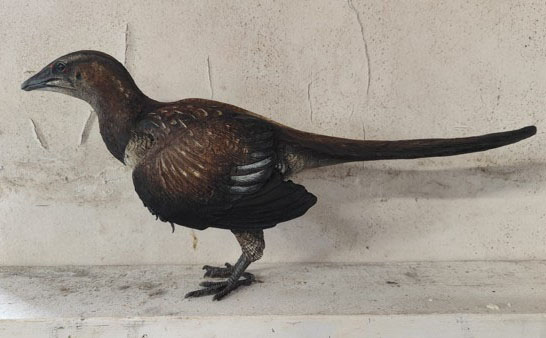
The first ever bird to inhabit the Earth used its robust hind legs to make two or three powerful leaps while flapping its way to flight, according to a study by the University of Southampton.
Scientists have debated for over a century how Archaeopteryx - a 150 million year old reptile-like bird - was able to take-off into the air.
The creature, which represents an important evolutionary step between non-avian dinosaurs and birds, was incapable of achieving flight with just a single jump as modern birds do.
Archaeopteryx had limited shoulder mobility and no breastbone, which hampered its ability to quickly reach flight speed. Exactly how it left the ground has, until now, remained a puzzle.
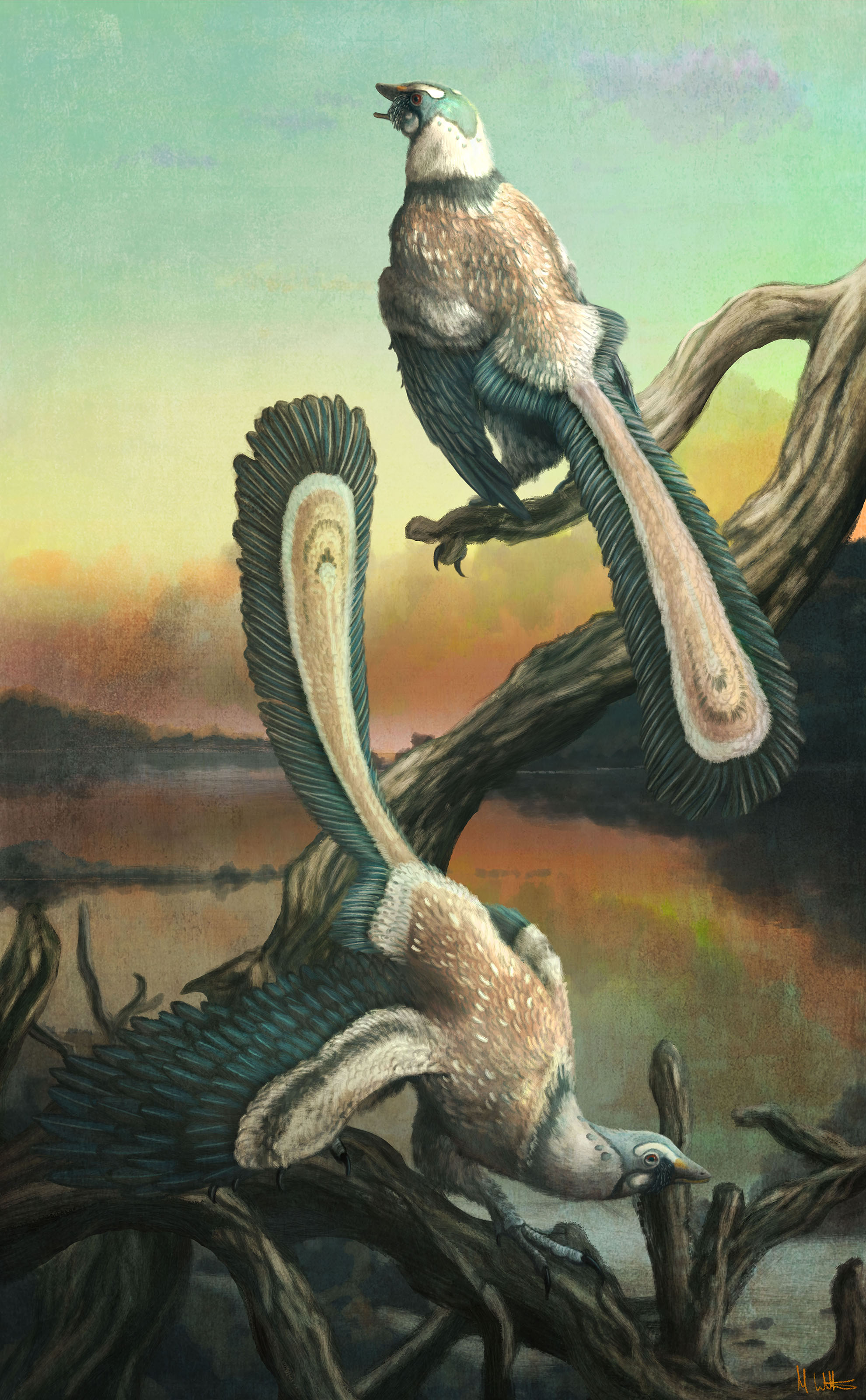
"Archaeopteryx is the first real bird," explains palaeobiologist at the University of Southampton, Dr Neil Gostling . "It was covered in feathers and possessed wings, but also retained a number of distinctly dinosaur features, such as a long bony tail, claws on separate fingers, and teeth in a beakless jaw. It wasn't a particularly well developed 'bird' compared to those we know today."
Professor of Biomechanics at Southampton, Markus Heller , adds: "We know Archaeopteryx couldn't rely on its wings to take off - with no keeled sternum, and a shoulder that couldn't lift the wing above the back - so we asked what its legs could contribute. It turns out that is where take-off is won: the legs generate the force, and the wings take over afterwards."
Several mechanisms for how early birds first left the ground have been suggested over the years, including flapping while running up an incline, and gliding from a height - for example from a tree, or a cliff.
These methods are difficult to test experimentally, but following observations made by the late Dr Colin Palmer, the team combined sophisticated computer modelling with these observations from living birds, such as gulls, magpies, crows and finches, and fitted this to Archaeopteryx's anatomy. By analysing joint moments at the hip, knee, and ankle, alongside muscle capacity, they estimated the ancient bird's take-off velocity.
The scientists, including Dr Pauline Provini from the Muséum National d'Histoire Naturelle in Paris, concluded that Archaeopteryx could have achieved its minimum sustainable flight speed in as few as two or three leaps, without requiring the energetically demanding single leap used by modern birds.
"Our findings show that a mid-sized, 400g Archaeopteryx could have achieved a sustainable flight speed of seven metres per second with three bipedal leaps, or with two bipedal leaps with a downward flap between jumps." said Dr Erik Meilak, a former PhD researcher at the University of Southampton who carried out the study.
"All birds push with their legs when they take-off," explains Dr Gostling. "In fact up to 90 percent of the force required to get off the ground comes from the legs and then the wings take over.
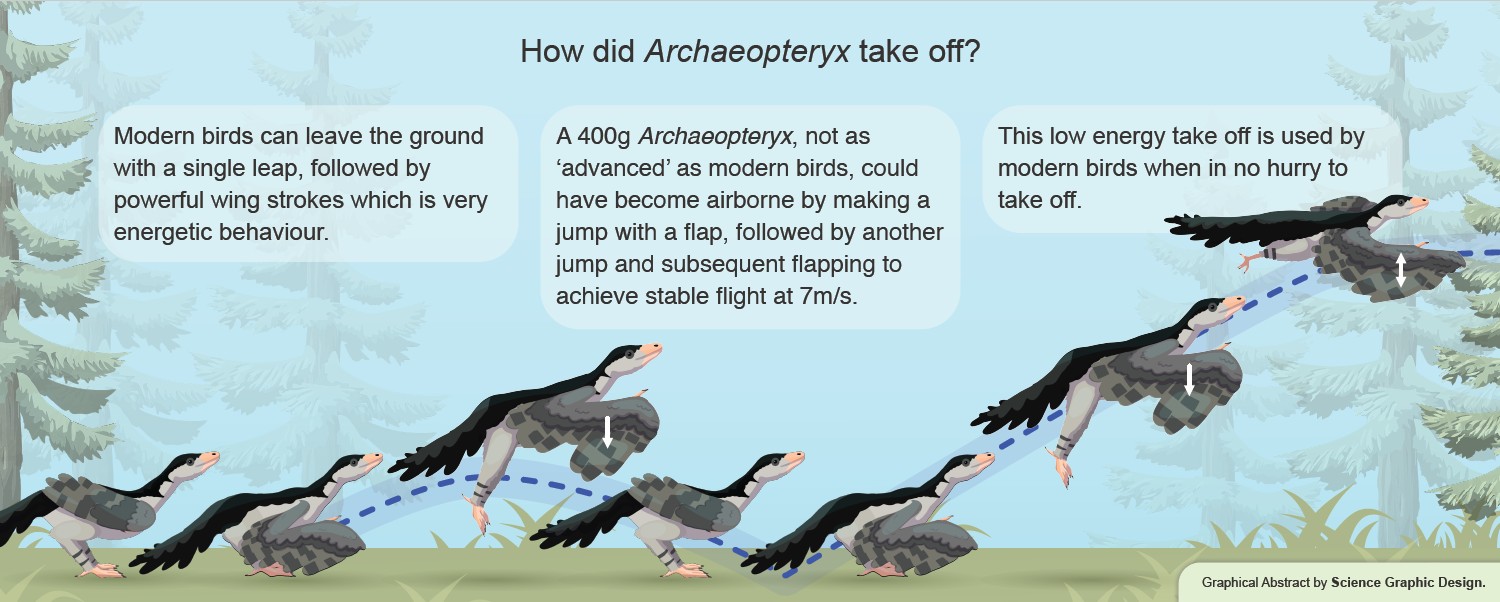
"Archaeopteryx would have either taken off with a leap, leap, leap and then lots of flapping, or a leap, a flap, another leap and more flapping.
"Although today's birds can take-off with just one leap, we still see many, such as crows, magpies and seagulls, also using the multiple hop technique. They use one leap if startled, stressed or threatened, or - like their ancestors - two or three or more if they are saving energy."
The researchers findings are published in the journal Developmental Biology .