
Participants in UConn Health clinical trial leave with personalized therapy
 A working professional who describes herself as "a tired mom of two" believes she's gaining the upper hand on a condition that's made her struggle with fatigue, weight gain, lethargy, and hair loss.
Jenna, 38, has been dealing with hypothyroidism her entire life, diagnosed in her 20s with Hashimoto's hypothyroidism, an autoimmune disorder resulting in fluctuating - most often, on the low side - production of thyroid hormones.
Thyroid hormones help the body regulate metabolism and influence how our organs work. Symptoms associated with inadequate thyroid hormone levels include elevated cholesterol, increased cardiovascular risk, brain fog, difficulty with weight loss, depression, and cold intolerance. Hypothyroidism is believed to affect about 10% of the adult population and is more common in females.
Jenna was using the generally accepted standard of care for managing her hypothyroidism: a daily dose of levothyroxine, a synthetic version of the thyroid hormone known as thyroxine, or T4.
I'm so happy I did this trial. I didn't even realize there were other treatment options.
— Jenna, study participant
Levothyroxine, also known as LT4, has proven to be very effective in managing hypothyroidism - as long as the dosage and frequency can consistently match the hormone imbalance. But the frequently changing hormone levels cause a constantly moving target, so the same dose that's effective Monday may not be enough by Wednesday, and by the weekend could be too much.
"It's trial and error until you find a sweet spot, and then it will fluctuate again, and you trial and error again, so it's this constant fluctuation," Jenna says. "For me, while levothyroxine kept me relatively maintained, if there's a way that I could feel better, of course I'd rather do that. Plus, it's just better monitoring during the trial. I wasn't concerned about levels because they're checking me every six weeks, where before I was getting checked every year. And they're monitoring for any potential adverse events. It's incredibly safe and convenient."
Blood tests can measure thyroid stimulating hormone, or TSH, and T4 levels and dosage can be adjusted accordingly, or, the body can give cues, particularly for those whose conversation with their doctor about their dose is limited to their annual physical, which was often the case with Jenna.
"Normally what happens when I notice is fatigue, I start losing my hair, and overall I'm just lethargic, just sort of exhausted," she says. "And normally, in most of my cases, it's because it's been too long since I had my blood drawn and TSH levels checked."
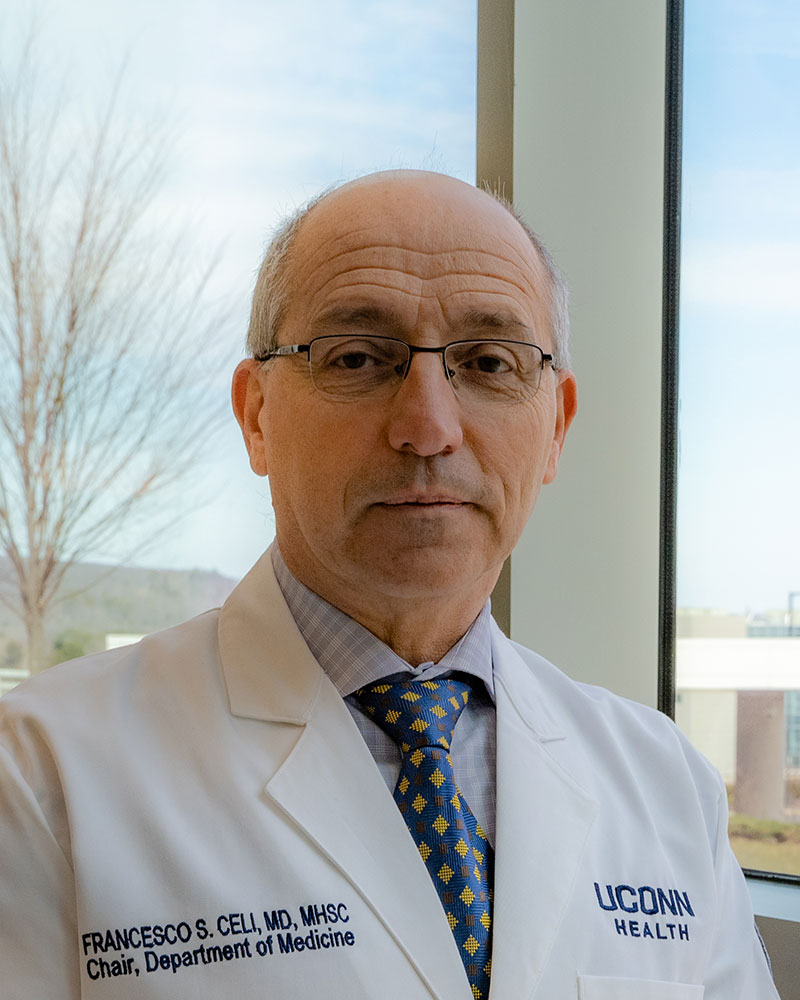
That was until she enrolled in a clinical trial studying alternate approaches to treating hypothyroidism, led by Dr. Francesco Celi, endocrinologist and chair of UConn Health's Department of Medicine.
Funded by the National Institute of Diabetes and Digestive and Kidney Diseases, the trial studies the impact of adding an additional synthetic hormone, liothyronine, or LT3, which replaces triiodothyronine, or T3.
"What we are challenged with in clinic is that, we are very good at bringing TSH within normal range, but patients quite often complain of symptoms which are related to hypothyroidism, so they're not completely back to normal," Celi says. "And some evidence indicates that the lack of production of T3 plays a role in that. So we have been doing a series of studies, for the last 20 years, looking at the metabolic effects of thyroid hormone in humans and the different types of combination therapy, meaning adding T3 to the treatment, to see whether patients have improvement in their well-being."
Study participants are assigned randomly to one of three blinded groups. One gets LT4 and a placebo, the second gets LT4 plus a daily dose of LT3, and the third gets LT4 plus a twice-daily dose of LT3. Each participant is followed for a six-month period that includes regular bloodwork and a study visit every six weeks. The medication dosage is adjusted at each study visit based on bloodwork. Participants also self-report their overall quality of life by way of periodic questionnaires.
"This is the only center in the United States that runs this study," Celi says. "It is my hope that physicians in the community become aware of this, especially endocrinologists, primary care physicians, geriatricians, and GYNs, who are likely to have patients who could benefit from our trial."
All outpatient visits, lab work, thyroid hormone and lipid panel analyses, and medication are provided at no cost to the participants. And while there's no monetary compensation, after their six months, participants get something that perhaps is of greater value.
"At the completion of the study, when the participants are discharged to the care of their physicians, they are informed of what would be the LT4 and LT3 combination therapy dose they would have received," Celi says. "Of course neither the participants nor the study personnel know what treatment they were assigned."
This is the only center in the United States that runs this study
— Dr. Francesco Celi
In Jenna's case, she decided with her endocrinologist to changing the treatment from LT4 only to LT4 and LT3 combination therapy. That meant changing from the daily LT4 does of 150 micrograms before the study to 88 micrograms of LT4 and 10 micrograms of LT3.
Today, six months removed from her completion of the trial, Jenna is still on the same LT4 and LT3 regimen and her bloodwork has been in range. She reports feeling great with much less fatigue and has even lost more than 10 pounds since the new year.
"I've always struggled with feeling exhausted and never had an easy time trying to lose weight, but over the last six months, I've felt really good," she says. "I've had more energy in the morning and have actually been able to lose some weight. I'm so happy I did this trial. I didn't even realize there were other treatment options. I'm so happy I can now better optimize my thyroid treatment! And to anyone in similar situations of ongoing hypothyroidism, I recommend trying this study."
Study participants must be at least 18, already taking LT4, and able to travel to UConn Health for their outpatient and lab visits. They will be able to find out which of the random study groups they were assigned to, but not until the entire study is completed.


