
University of South Florida engineers have developed an innovative laser-based technology that is helping nuclear power plants solve a complex maintenance challenge affecting a critical reactor safety system. After four years of research, design, and testing, the custom system has been successfully tested at two Tennessee Valley Authority nuclear plants.
The technology, created by Ahmad Vaselbehagh, professor of mechanical and aerospace engineering, and postdoctoral research associate Ty Hagan, addresses a longstanding maintenance issue involving specialized ice condensers used in certain nuclear power plants in the United States, Japan, and Finland. During routine inspections, plant operators must individually lift and weigh thousands of baskets filled with borated ice that help cool and depressurize the containment building in the unlikely event of severe accidents.
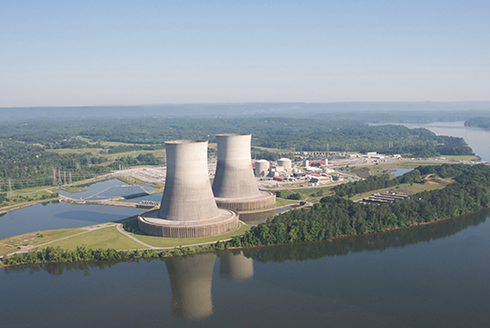
Over time, the process used to replenish the ice can cause neighboring baskets to freeze together, preventing workers from lifting and inspecting them individually. TVA challenged researchers to develop a safer, more efficient way to separate the baskets without damaging equipment or requiring labor-intensive manual work.
Vaselbehagh and Hagan designed a custom laser de-icing system capable of operating more than 40 feet below the surface in narrow spaces between the ice baskets. Using a precision laser, the device cuts through the sheets of ice connecting adjacent baskets, allowing plant workers to safely separate and inspect them without fully melting the ice, thereby avoiding the generation of larger volumes of meltwater, which would introduce additional challenges, including refreezing in other regions and the need to manage excess water at lower elevations.
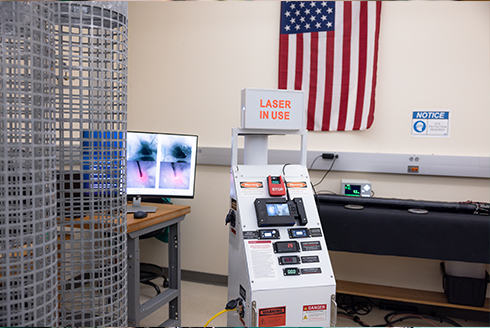
Developing the solution required expertise across mechanical engineering, electrical engineering, optics, controls, manufacturing, and safety compliance. The team engineered a system that could withstand freezing temperatures, fit through extremely tight openings, and be operated safely by plant personnel in a highly regulated nuclear environment.
"This was one of the most challenging projects I've ever led because it included conceptualization, design, engineering, fabrication, testing, and production of something that had to work flawlessly in the hands of the plant's personnel without our presence to guide or support them," Vaselbehagh said. "There is a huge difference between theoretical work and developing a system that can perform reliably in a real industrial environment."
The researchers also completed specialized radiation worker and laser safety certifications and conducted extensive testing in freezing environments and contamination-controlled areas to ensure the system met the rigorous standards required for use inside active nuclear facilities.
The final device contains hundreds of components and was engineered to reliably perform in one of the industry's most demanding operating environments. To support deployment, the team also developed operating procedures, documentation, and training materials so plant personnel can use and maintain the technology independently.
"When you're building a system that has to work in the real world, it's never just one discipline," Hagan said. "You have to understand mechanical systems, electrical systems, controls, safety requirements, and how everything works together."
The technology can clear several feet of ice buildup in minutes, significantly reducing maintenance time and enabling nuclear facilities to complete critical safety inspections more efficiently.
For Vaselbehagh and Hagan, the project demonstrates how university research can move beyond the laboratory to solve complex challenges facing critical infrastructure and the nation's energy industry.


