
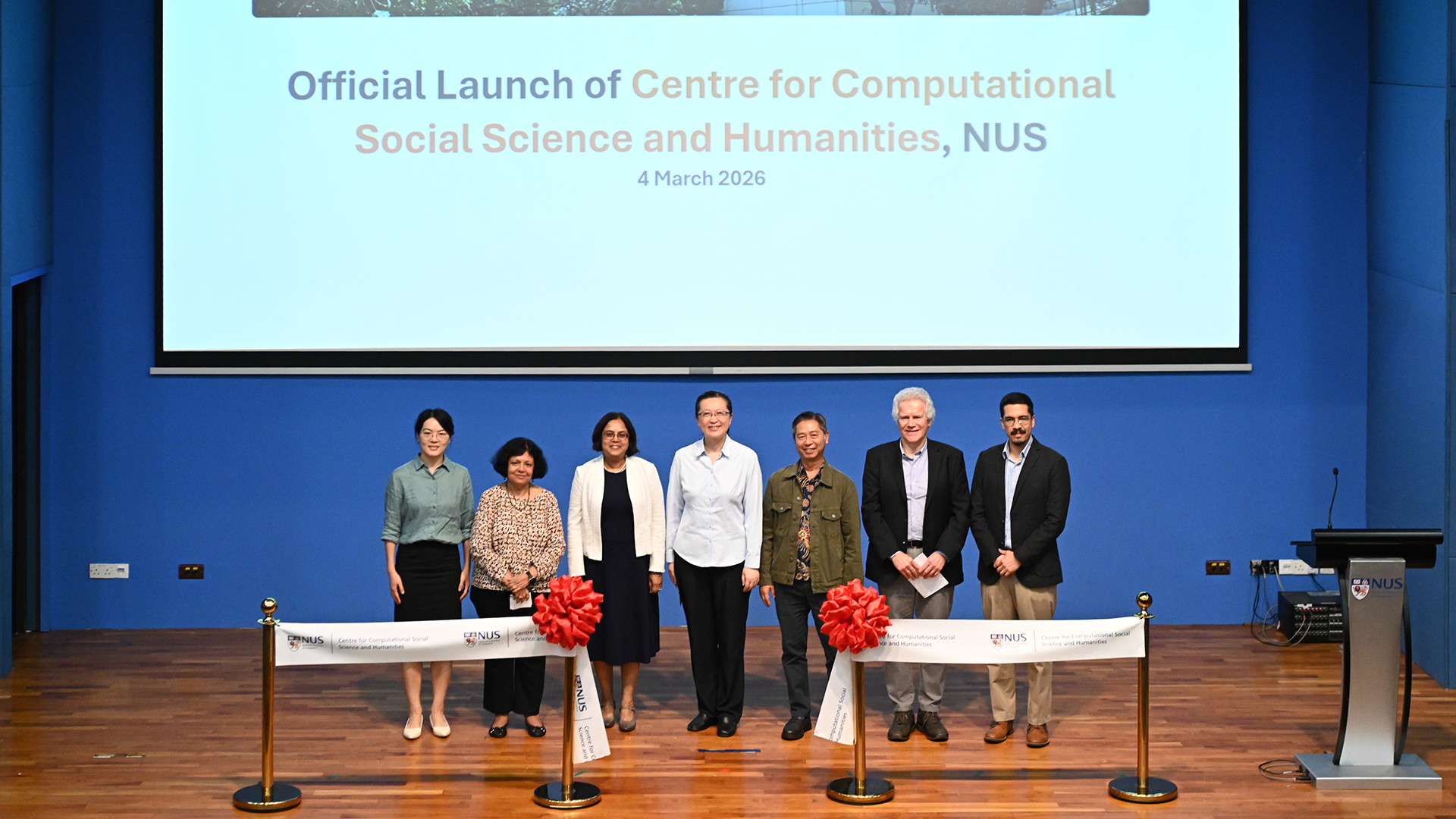
A new research centre at the National University of Singapore (NUS) is bringing together data science, AI and computational methods with deep insights from social sciences and humanities to better understand complex social phenomena and develop solutions to pressing societal challenges. By combining technological innovation with human insight, the Centre for Computational Social Science and Humanities (CSSH) aims to generate research that improves lives, strengthens institutions, preserves cultural knowledge, and shapes more inclusive and resilient societies in Singapore and beyond.
Officially launched today, CSSH is the first in Singapore to systematically bring together computational social science and the humanities within a single centre to bridge research, policy and real-world applications.
The Centre draws on expertise across disciplines including computing, new media, linguistics, geography, public policy and healthcare, amongst others. This interdisciplinary foundation enables CSSH to examine how digital technologies intersect with social systems, such as assessing the societal implications of AI-enabled platforms, using digital tools to help preserve Singapore's cultural heritage, and strengthening digital literacy in vulnerable communities.
NUS Deputy President (Research and Technology) Professor Liu Bin said, "Rapid advances in digital technologies and AI are transforming our world. But technological breakthroughs are only as valuable as the difference they make to peoples' lives. CSSH reflects NUS' commitment to ensuring that innovation translates to tangible improvements in how we live, work and build stronger communities. By integrating computational methods with social science and humanities, the Centre will help translate research insights into policies and practices that deliver real-world impact."
She added that the Centre complements Singapore's broader push for innovative, responsible harnessing of technology and AI which emphasises that progress should be not only technically advanced, but trusted, inclusive and grounded in real social needs.
Driving real-world impact through interdisciplinary innovation
CSSH is led by Co-Directors Professor Atreyi Kankanhalli from the NUS School of Computing and Professor Peter Millican from the NUS Faculty of Arts and Social Sciences. The Centre supports both seed funding for emerging ideas and larger projects, all designed to generate real-world impact.
Prof Kankanhalli said, "What distinguishes CSSH is our ability to study human behaviour, institutions and societies at a scale and depth that was not previously possible. By combining computational methods with rich domain expertise in the social sciences and humanities, we can uncover patterns, test ideas, and generate evidence that directly informs policy and practice. Our goal is not just to analyse social problems, but to help shape systems that work better for people."
Since beginning operations in the second half of 2024, CSSH has embarked on more than 50 interdisciplinary projects involving 105 researchers from across NUS and their external collaborators. The projects demonstrate the breadth of its work - from AI-enabled analysis of social media impacts to digital preservation of historical archives.
Amongst the major research projects currently being undertaken by CSSH is one titled "Computational Social Simulations for Aiding Policy Design", led by Prof Kankanhalli. In this five-year project, researchers from NUS and three other local universities are collaborating to develop an AI-driven social simulation platform for policymakers to help test and refine policy interventions before they are rolled out.
Using large language models (LLMs), the platform will model diverse public personas to enable policymakers to conduct swift preliminary testing of policy ideas. The simulations will complement traditional research methods by reducing the frequency of costly, time-consuming large-scale surveys and field studies during early policy development, while retaining real-world validation and community engagement at critical decision points. CSSH Deputy Director Associate Professor Dandan Qiao from the NUS School of Computing is also contributing her expertise to the project.
Another project titled "The Jawi AI Project", led by NUS Faculty of Arts and Social Sciences Associate Professor Miguel Escobar Varela, harnesses AI to enable large-scale transliteration and analysis of Jawi texts. Early Malay-language newspapers in Singapore, published between 1870 and 1970 were written in Jawi, a script few can read today.
In collaboration with the National Library Board (NLB), the team comprising local and foreign experts is transforming thousands of archived pages into searchable Malay text, significantly expanding the range of materials available at NLB's digitised archives. Assoc Prof Escobar Varela, who is also Deputy Director at CSSH, noted that the project could significantly expand research into Malay-language journalism and public debate in the region, broadening how Singapore's history is understood and taught.
Prof Millican highlighted that a core mission of CSSH is to break down the walls between disciplines. By connecting humanities and social science researchers with computing and data science experts, the Centre fosters collaborations that neither field could achieve alone. "Many of today's biggest challenges demand both deep specialist insight and serious technical firepower", he explained, "whether they involve untangling complex social issues, tackling health crises, anticipating future problems, or building the tools to address these. CSSH provides a natural home for such interdisciplinary conversations."
He added that the Centre looks forward to developing more projects addressing societal challenges to which computational insights can make the greatest difference. Focus areas include AI and emerging technologies, sustainability and environmental policy, population trends and demographic change, public health and social care, and the preservation and understanding of history and cultural heritage.


