
UConn Health pilot program established in two areas and expanding
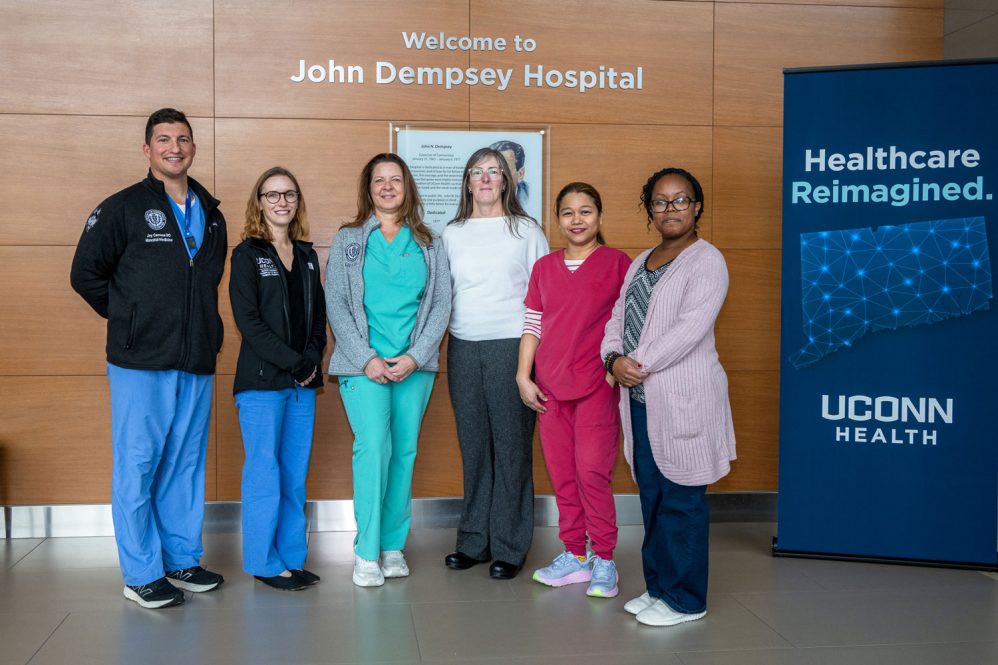
From left: Dr. Jason Carrese, Elizabeth Higgins, Kelly Ann Kucia, Christine Campbell, Candice Antonio, and Dr. Dyanne Tappin are among those involved in UConn Health's Peer Support Program. (Tina Encarnacion/UConn Health photo)
UConn Health introduces peer support services that are available to all providers and staff in OB/GYN and inpatient Internal Medicine.
These services offer a dedicated space where trained colleagues, familiar with the challenges of health care, help staff process difficulties, gain new perspectives, and build resilience.
The peer support pilot program was established after a year-and-a-half effort by staff who saw a need for such a program at UConn Health. The co-leaders, Dr. Dyanne Tappin and Dr. Jason Carrese, developed a proposal, secured funding, dedicated staff time, and gained hospital leadership approval. They officially launched a pilot program in September and recently expanded to the Department of Emergency Medicine with plans to establish an effective system for more providers and staff by expanding to other areas throughout the institution.
"In today's demanding health care environment, unanticipated events can test even the most experienced among us," says Carrese, a UConn John Dempsey Hospital hospitalist and assistant professor of medicine in the UConn School of Medicine. "Peer support reminds us that we're not alone; it's a genuine way to reach out to one another, offer support when it's needed, and share resources that can make a real difference."
A nomination process across both departments results in over 40 people being nominated for participation earlier this year. Throughout the summer, a series of training sessions, called "Lunch and Learns," were held monthly, with a more in-depth two-hour "Dinner and Learn" session. Caresse and Tappin - with the help of the Connecticut Hospital Association and Dr. Gerry Lewis, an international expert in peer support in different industries including health care, police, and fire departments - guided the training of the first cohort of peer supporters.
"It started as a grassroots effort - just colleagues, like us, who cared deeply about supporting one another." says Tappin, an assistant professor of OB/GYN in the UConn School of Medicine. "We are beginning within our own departments, and it is naturally going to grow from there."
The team launched a peer support intranet page that offers a range of resources and a process for individuals to request peer support. Through a new workflow, requests submitted through the site are reviewed within 72 hours by Carrese and Tappin. Once reviewed, the individual is matched with a peer supporter, who follows up by providing emotional and relevant resources tailored to the person's needs.
"Peer support conversations are not meant to be reviewed or evaluated," Tappin says. "They take place in safe, private spaces and are designed to offer emotional first aid - not therapy, and not to discuss or analyze a clinical case. These conversations focus on active listening, providing individuals with tools to cope, and helping them feel supported in the moment. When needed, peer supporters can also help connect individuals with expedited referrals for therapy, counseling, or other resources. Ultimately, this is the first level of support in the continuum of care - sometimes it starts simply with asking, 'Hey, how are you doing? How are you coping with this difficult situation?'"
Of the 40 trained peer supporters, the majority are nurses, with additional representation from physicians to nurse practitioners to other staff members within the institution. The program emphasizes choice and personalization. Within the system, individuals can indicate whether they prefer to speak with someone in a similar or a different role and/or specialty. Some might request support from their own departments, while others may feel more comfortable speaking to someone outside their fieldwork. This allows all to feel supported in a way that best suits their needs.
Flyers with QR codes have been shared across units and by email, but staff can access the program through the UConn Health's Intranet, The Hub. By navigating from Human Resources to the well-being section, then to the peer support tab, they can find the links and QR codes to a Qualtrics form. Once submitted, the support process begins.
"Peer support is a vital component of care for those who dedicate their lives to caring for others. Health care providers often work under tremendous stress and rarely can process difficult experiences in a understanding environment among colleagues who share similar journeys or can truly relate," says Dr. Lenora Williams, UConn Health OB/GYN and one of the peer supporters in the first cohort. "Establishing dedicated spaces for this kind of support and healing is essential to sustaining the well-being of our providers, and in turn, maintaining the exemplary standard of care that defines the UConn Health system."
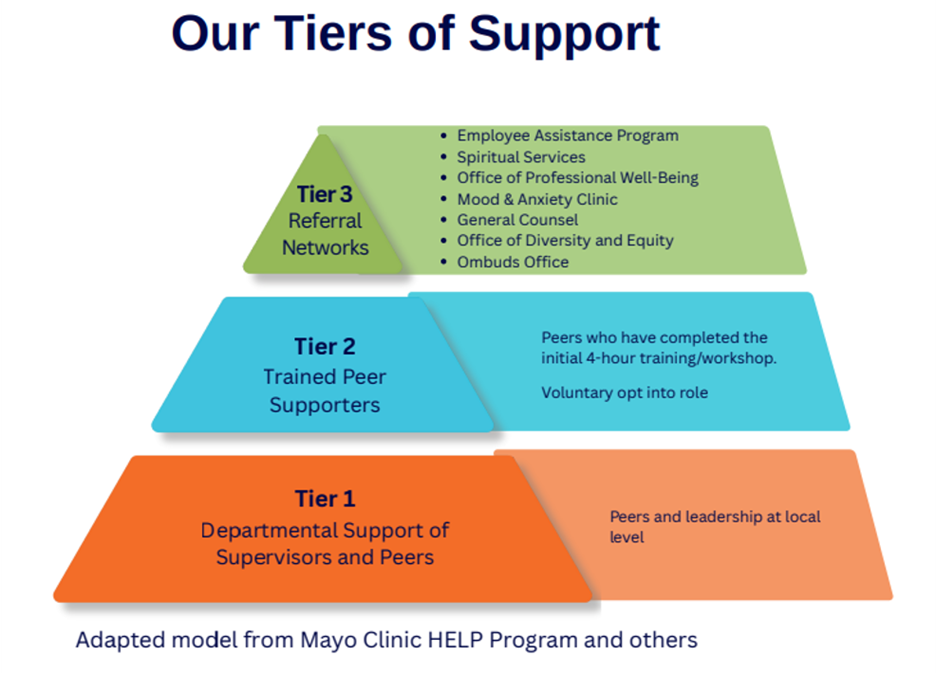
Additionally, Tappin and Caresse have worked to build bridges and enhance the services provided by the "Tier 3" Support Referral Network, which includes Employee Assistance Program, Office of Inclusion and Civil Rights, the ombudsman, chaplain, Mood and Anxiety Clinic, Office of Professional Well-Being, and many others. Furthermore, they have worked closely within their departments to encourage a "change in culture" within the "Tier 1" - which Tappin describes as the informal, "down-on-the-ground" conversations among colleagues and leaders within departments to check-in with one another.
UConn Health's Peer Support program is designed to support both providers and staff. The program offers a trusted and growing resource to help individuals navigate the professional challenges that arise throughout their health care journey. By fostering connection, empathy, and understanding among colleagues, the Peer Support Program aims to strengthen well-being and resilience across UConn Health's clinical community.


