
Scientists from the University of Portsmouth are helping UK-based charity Keep Me Breathing with an ambitious challenge, to put a new respiratory monitoring device to the test on a 1,000-mile cycle ride from Arundel to Austria.
Keep Me Breathing duo James Howell and Max Edginton will take on a gruelling 21.2 km climb in July as part of Ride for Rare - a fundraising challenge supporting this high-impact medical technology charity developing life-saving respiratory monitoring devices for people living with rare and chronic conditions.
The University's Extreme Environments Laboratories (EEL) - a globally recognised centre for research into human performance in extreme environments - will gather real-time physiological data before the ride to support validation of the medical device.
The charity was set up by James Oakley, after his son Casper was diagnosed with Congenital Central Hypoventilation Syndrome (CCHS) - a rare condition that affects the autonomic nervous system's control of breathing, the same system responsible for regulating heart rate, blood pressure, digestion and body temperature.
Every single night, Casper must wear an airtight ventilator mask - without it, he could stop breathing, turn blue, suffer brain damage and die.
Having already raised over £500,000, the charity is pushing towards a £1 million target to fund a potentially life-saving device that alerts patients when they need to breathe or require urgent medical assistance.
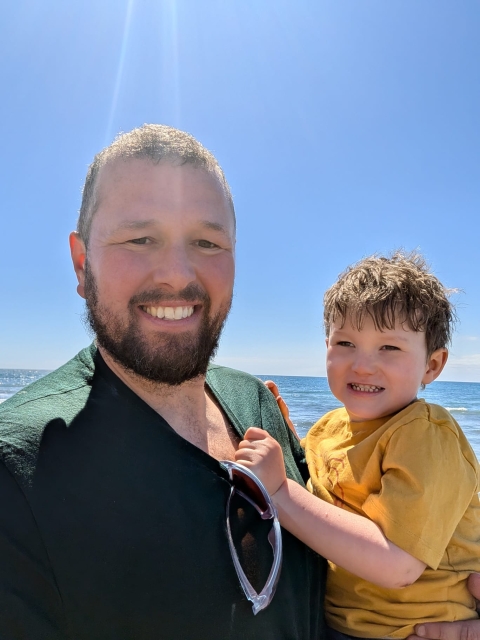
James Oakley and his son Casper. Image credit: James Oakley.
Recreations of some of the high-altitude climbs the team will experience during their fundraiser have taken place in the labs. This included a controlled lab simulation of the Grossglockner Pass, Austria's highest paved mountain pass, a climb of 21.2 km with a 1754m vertical ascent, topping out at 2,504m.
Dr Joe Costello , from the Extreme Environments and Occupational Performance Research Group at the University of Portsmouth, said: "We are proud to support this highly important research and charity fundraiser, contributing to a cause with the potential to change lives by providing our facilities to simulate the challenging conditions the team will face on their cycle.
"The University has been working closely with the charity over the last year to develop and test their non-invasive carbon dioxide monitor. Within our specialised extreme environment laboratories, we are assessing the accuracy of the device when people are exercising and exposed to extreme environments such as hypoxia, heat, and cold. It is always exciting to be working collaboratively with partners on exciting new technology which can be developed and tested within our unique facilities."
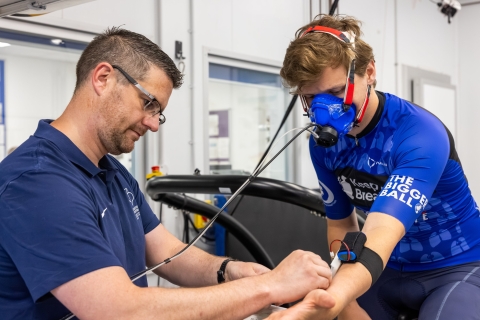
Dr Joe Costello and James Howell in the University of Portsmouth's Extreme Environment Laboratory.
KMB founder James Oakley, said: "This ride is not just a challenge. It is a way of pushing the technology as hard as possible, learning from the data, and making sure these devices can cope when babies and children need them most.
"Every donation, every introduction, every bit of practical support helps bring this closer to the children and adults whose lives could be changed by it. For families like ours, that means everything."
Dr Alexander T Deng, Chief Medical Officer (CMO) for Keep Me Breathing, added: "Our work with the University of Portsmouth is helping us, for the first time, to give patients and clinicians continuous CO₂ trend data across real daily activities - not just a few hours on the ward. For the tens of thousands on home ventilation in the UK, this could transform how we treat patients, detect deterioration early, and keep people safer at home."
About the Extreme Environments Laboratories
The University of Portsmouth is recognised for its Extreme Environments Laboratories , which enhance understanding of human comfort, performance, and survival in challenging conditions such as high altitudes, humid jungles, and rough seas.
Insights gained from these labs are applied across diverse fields including sport, product development, emergency rescue, military training, polar exploration, and film production.
The University regularly collaborates with esteemed partners such as the Ministry of Defence, the Royal Society for the Prevention of Accidents, the RNLI, and Olympic and Paralympic athletes.
More recently, the University provided scientific support to the Turner Twins as they tested George Mallory and Andrew Irvine's 1924 Everest expedition kit ahead of a pioneering Himalayan expedition. Notably, in 2013, actors Jake Gyllenhaal and Josh Brolin used the University's temperature and altitude facilities to prepare for their roles in the film Everest.


