
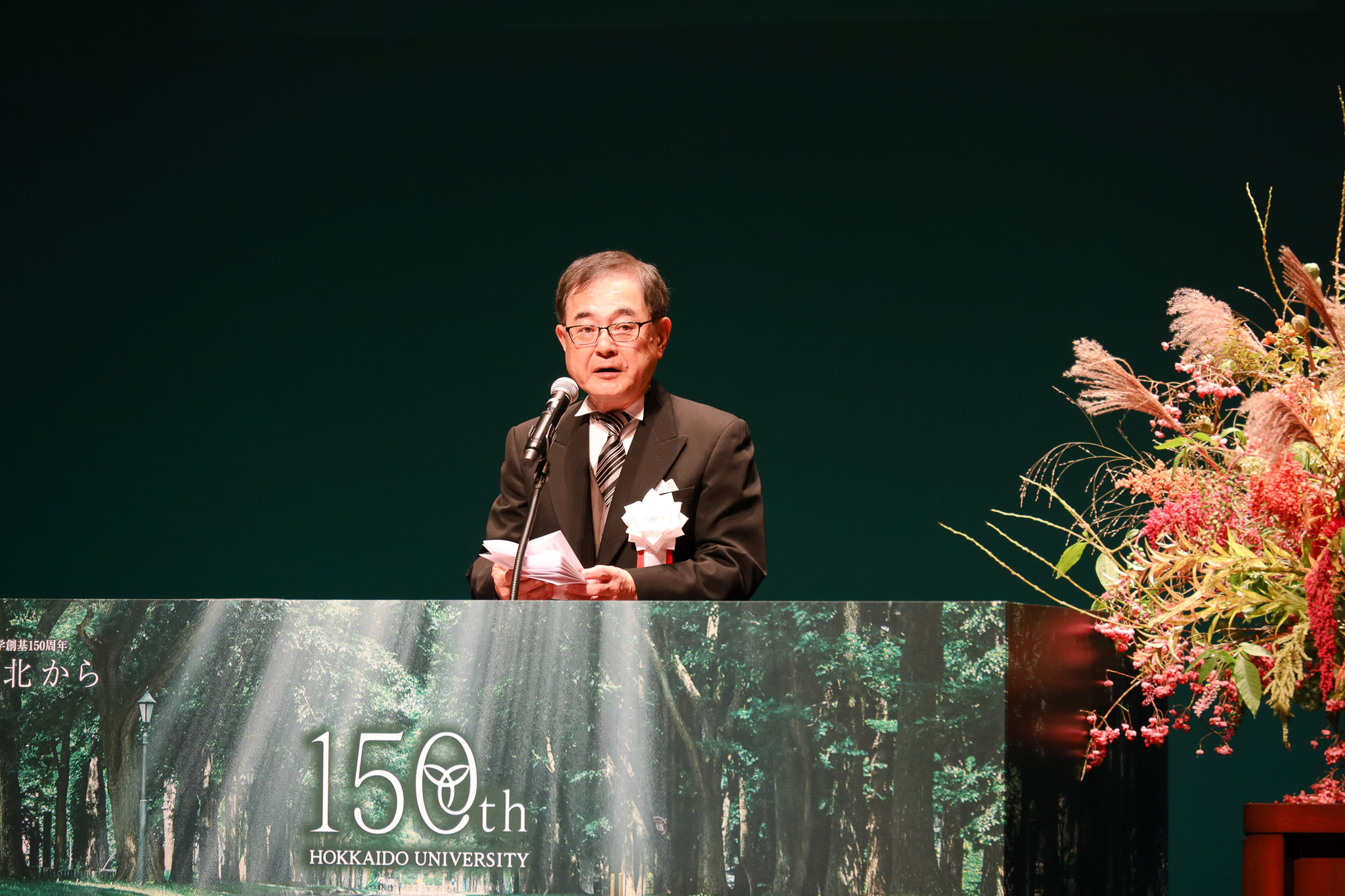
Since its founding as Sapporo Agricultural College in the 9th year of the Meiji Era (1876), Hokkaido University has undergone numerous transitions and changes and has now reached its 150th Anniversary Celebration. Joining us to celebrate this momentous occasion are many esteemed guests and friends of the University, including Deputy Minister of Education, Culture, Sports, Science and Technology Yasuyoshi Kakita on behalf of Minister Yoshihiro Seki; Governor of Hokkaido Naomichi Suzuki, Mayor of Sapporo Katsuhiro Akimoto, and President of the Ainu Association of Hokkaido Tetsuya Ogawa. Please accept my heartfelt thanks for your presence here today. In addition to these esteemed members of our community, we are also honored to welcome our valued friends from abroad who have traveled great distances to be here with us today. I also extend my sincere gratitude to the many government agencies, members of parliament, partner organizations and companies that have supported us, and distinguished members of the university community, including representatives of National University Corporations. I would also like to thank the local communities and people of Hokkaido who have supported the development of our University across these last 150 years.
Sapporo Agricultural College first opened its doors in 1876 when Sapporo was a town with a population of less than 2,000. When measured against the long histories and large populations of major cities of the day-such as Osaka, Kyoto, Nagoya, Kanazawa, and most notably Edo (modern-day Tokyo), whose population exceeded 500,000-the comparison seems almost absurd.
Yet there can be little doubt that Hokkaido, with its vast lands and abundant natural resources, was the ideal place to realize Japan's food production ambitions. Today, we would describe that mission in terms of food security, but over the past 150 years and continuing into 2026, it has remained one of Hokkaido's most enduring and important contributions to the country. It was for this reason that a higher education institution was established in Sapporo, backed by the Meiji government with an unprecedented allocation of funds, to cultivate the human resources needed to support the agriculture-centered industries upon which Hokkaido was built.
From the early Meiji Era to the present day, Hokkaido has been the engine driving Japan's growth, and this has profoundly shaped the identity and mission of Hokkaido University. The DNA of Sapporo Agricultural College lives on in Hokkaido University's emphasis on practical learning, one of its four guiding principles. Even 150 years later, putting academic knowledge into practice for the benefit of society remains one of the University's central ambitions.
Now, universities face two seemingly opposite challenges: we are confronting a severe crisis while also being expected to serve as powerful engines of innovation for both the world and local communities.
The first and most pressing crisis is that Japan's population decline and the rise of generative AI are fundamentally challenging the very meaning and relevance of universities in society. The decline in the population of university-age students poses a serious threat to the continued existence of universities. At the same time, our traditional role as centers of knowledge is increasingly being challenged by AI.
In response, Hokkaido University will boldly transform the way we educate students and develop human resources, as well as the way research is conducted in our graduate schools and research institutes. To guide this transformation, Hokkaido University has set forth a vision for a new model of higher education in Japan: the "Novel Japan University Model."
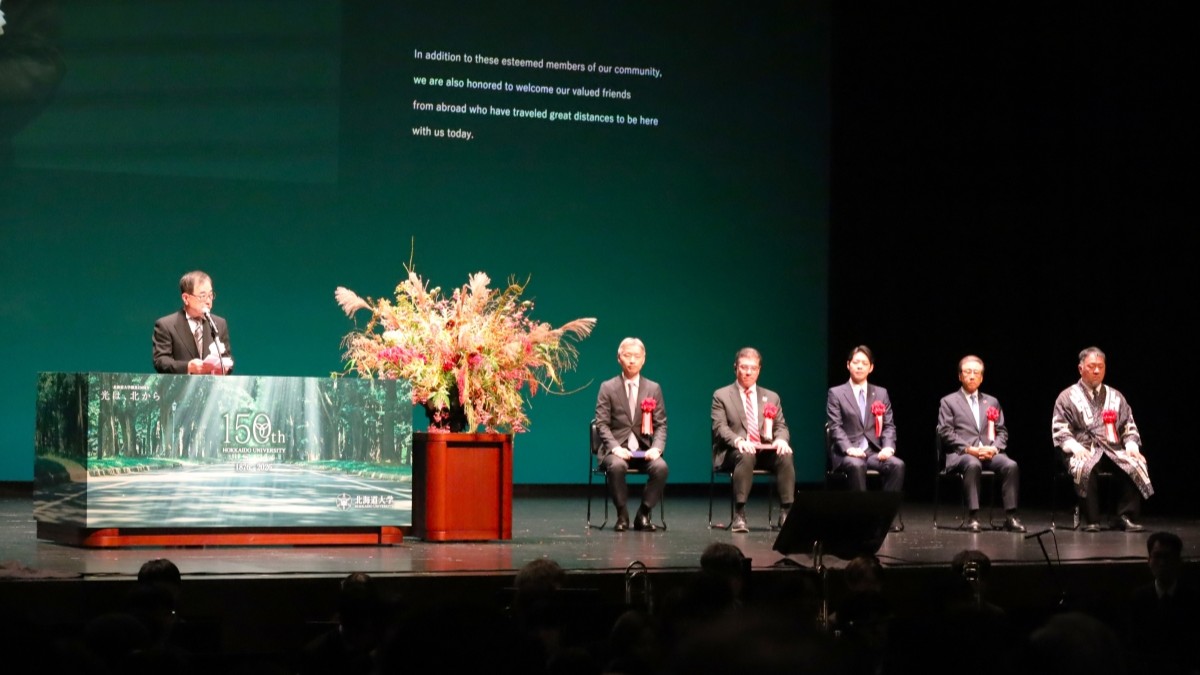
Regarding the second challenge, universities are attracting growing attention as engines of innovation capable of transforming society and industrial structures. From the latter half of the 20th century until now, cutting-edge research at universities in America, Great Britain, and, in more recent years, China and Taiwan has fundamentally transformed both society and industry. The potential Hokkaido holds today is similar to the potential envisioned during the early Meiji period. However, in terms of scale, significance, feasibility, and pace, it is on an entirely different level. If you allow me to be a touch arrogant to say this, I believe Hokkaido could be the determining factor over the next decade in the fate of Japan's revival. The role Hokkaido University plays today, with its influence in fields such as semiconductors, AI, renewable energy, and sustainable food production, will be vastly more significant than its role during the Meiji Era. Hokkaido University intends to continue responding head-on to the societal expectations of our day.
Just as establishing agricultural practices in a cold climate was the "first ambitious challenge" of our predecessors at Sapporo Agricultural School, I believe that the creation of new industries and the societal implementation of renewable energy is the "second ambitious challenge" that marks this 150th anniversary.
However, this is not the only challenge we will be facing in the years to come. Cutting-edge technologies that change the world are often the fruits of young researchers who seem to sprout up from the humblest of places, and history has shown that shifts in ethics and philosophy, as well as historical research, stemming from the humanities and social sciences, can have a significant impact on society. I believe that Hokkaido University will continue to serve as a cradle for innovative research, and we will soon see even more shining stars coming from the north, like our very own Nobel laureates, Professor Suzuki and Professor List.
We must also respect the perspectives of researchers who devote themselves to issues that often go unnoticed by society, whether that be discrimination, poverty, or other overlooked challenges. Likewise, I believe it is the responsibility of the University to confront the challenges facing our world today, including climate change and the growing threats to democracy and peace.
On July 27, Hokkaido University expressed remorse and apologized for how its research concerning the Ainu people was carried out during the early Showa Era, as well as for its collection and storage of Ainu ancestral remains and burial items.
Reflecting on this, I believe it is necessary for us to remember that even today we are still susceptible to the ideology of its time and our own unconscious biases, and those can in turn affect how we view and report our research findings, without us even realizing it. And this is even more important in an age when AI is transforming the way we currently do research.
There are many lessons we should learn from this reflection on past research practices. I believe it is our responsibility not to treat them purely as a negative legacy, but to ensure that the problems brought to light are passed on as lessons for the future.
Hokkaido University has always held firmly to Dr. William S. Clark's parting words, "Be Ambitious," and to the spirit they embody, making it a truly unique institution among Japan's national universities.
Oftentimes, a spirit of ambition is thought to be like that expressed in Ryotaro Shiba's work "Clouds above the Hill: A Historical Novel of the Russo-Japanese War." This work, embodying the shining self-esteem of a young man in the Meiji Era aspiring to carry the country into the future, is certainly one interpretation of how to "be ambitious." However, I believe there was another meaning behind Dr. Clark's parting words. I do not believe that he expected the students he left behind on this spot of land on the northern frontier of a country in the far east, surrounded by nature and the harsh conditions of a northern climate, to live lives without hardship or struggle. Rather, I believe he anticipated that they would face troubles, but in the face of those troubles, he was spurring them on to be shining examples of human perseverance with words of encouragement.
In the past 150 years, Japan has remained a small country in the far east in terms of both resources and energy, and Hokkaido is still known as "the land of the north." I believe that the "be ambitious" spirit lies in a resilient way of life, remaining steadfast through adversity with fortitude and tenacity. Without our "be ambitious" spirit, there would be no Hokkaido University, and if we do not carry our "be ambitious" spirit into the future, there will be no next 150 years for Hokkaido University.
May Hokkaido University always remain an institution known, through the next 150 years and even the next 200 years and beyond, for its "eternal ambition." I hope that you will continue to support our efforts as we carry that spirit forward into an even brighter future.

HOUKIN Kiyohiro
20th President of Hokkaido University
September 26, 2026


