
InFocus: Queer and Disabled Story by PWDA member Shannon
InFocus: Queer & Disabled is a digital storytelling campaign led by PWDA, centring the voices and lived experiences of LGBTQIA+ people with disability.
We live in a world vastly shaped by religious ideology. Whilst I acknowledge the harm experienced by many in our community at the hands of these institutions, the focus of this piece will instead be on how these beliefs have fundamentally shaped our understanding of sex and relationships, and how that is impacting our disabled and LGBTQIA+ communities.
Many may identify that purity culture overlooks the queer experience, but it also continues to deny sexual pleasure to many disabled people. Despite some progress, virginity is a word still frequently used to describe someone's level of sexual experience. The concept is considerably outdated, particularly for vulva owners. Our sexual experience is not only attributed to whether or not we have had penis-in-vagina sex, but also to whether our hymens remain intact. The problem with the latter is that a hymen can remain intact even after penis-in-vagina sex. It can also break from many other activities such as vigorous sport or using tampons, to name a few. For vulva owners, it can often lead to shame as they are seen as promiscuous or easy. Penis owners on the other hand, face adverse views with virginity seen as something to be rid of, and experiencing shame from not having experienced penis-in-vagina sex.
If we insist on maintaining concepts such as virginity, we need to broaden our understanding of what sex is. This means we can no longer cling to the traditional definition of penis-in-vagina sex. This singular act does not and should not indicate someone's sexual experience. To treat it as such discredits queer experience and sexual expression, and assumes acts such as oral sex, alternative penetration, and physical intimacy are not sex.
Sex is a deeply personal expression and how it's defined should be an individual choice. For me, sex is the moment where arousal and physical touch from another combine with the intent of achieving orgasm. However, this is my personal definition and shouldn't be held as a broad definition for everyone. Not all people experience orgasm, but that does not mean they lack sexual experience. Others may experience orgasm without physical touch or the sensation of touch; that does not mean they have not had a sexual experience.
In holding onto outdated concepts such as virginity, we perpetuate purity culture and infantilise people with disability and their sexual needs. Not because we lack capacity for sex, but because non-disabled people are uncomfortable with the idea that we have sex or sexual desires. The decision to cease funding sex services on the NDIS exemplifies this. Disabled people are held to a false standard of purity we never asked for, leading to denial of access to sex and sexual pleasure. But this extends beyond the NDIS. Many sex-on-premises establishments remain inaccessible to people in wheelchairs, with business owners citing costs as a barrier. Grants and funding opportunities are often denied to these businesses, making access for disabled people less a choice and more a consequence of bureaucracy and inequitable funding.
Beyond sex and physical intimacy, our religious institutions have shaped how we define relationships and what love looks like. Open relating and alternative relationship structures are rarely brought into focus-including in disability spaces. Workshops for people with disability often cover coercion, dating tips, and occasionally sexual pleasure, but seldom include conversations on polyamory and ethical non-monogamy (ENM).
ENM, occasionally referred to as Consensual Non-Monogamy or simply non-monogamy, is a romantic or sexual relationship involving multiple partners. In the case of polyamory-a branch of ENM-it's about loving multiple people in a community that sees love from an abundance mindset rather than scarcity.
Given these communities are among the few spaces where disabled, neurodivergent, and queer people are broadly represented, why aren't alternative relationship structures discussed by disability organisations? By maintaining a monocentric understanding of relationships, we perpetuate stigmatisation of these dynamics and deny those who may be more comfortable in them, the opportunity to explore them.
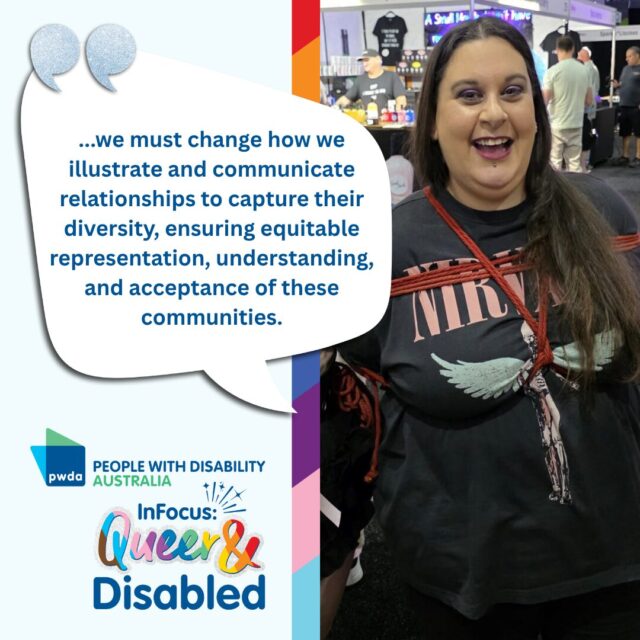
Similarly to the LGBTQIA+ history of hiding identity, many in ENM and polyamorous communities cannot be open about their relationships, fearing loss of jobs, housing, or even access to their children. This creates a culture of shame and forces yet another marginalised community-already composed of various other marginalised people-into the shadows. Instead, we must change how we illustrate and communicate relationships to capture their diversity, ensuring equitable representation, understanding, and acceptance of these communities.
Find more InFocus: Queer and Disabled stories:


