
A nationwide survey shows that Americans are fiercely divided over immigration-until the issue turns personal.
Americans are sharply divided over immigration policy, particularly enforcement measures, but share common ground on some fundamental issues, including broad support for birthright citizenship.
Those are the takeaways from a new nationwide survey of more than 30,000 adults across all 50 states conducted by the Civic Health and Institutions Project (CHIP50), a nonprofit joint initiative of the University of Rochester, Harvard University, Northeastern University, and Rutgers University.
While the findings highlight deep partisan divisions, they suggest Americans also leave room for nuance when policy matters become personal.
"Immigration is one of the most polarizing issues in American politics," says University of Rochester political scientist James Druckman, a coauthor of the study and a nationally recognized expert on political polarization. "But when you look closely at the data, you see that Americans will distinguish between different policies and principles."
Deep partisan divides
The survey found that roughly two-thirds of Americans say immigration is important to them personally, but revealed stark differences along party lines in how they view policy and enforcement.
For instance, 37 percent of respondents approve of President Donald Trump's handling of immigration, while 49 percent disapprove. Among Republicans, however, approval reaches 78 percent, compared with just 11 percent for Democrats.
Similar divisions appear in attitudes toward federal immigration enforcement efforts. Nationwide, a third of respondents approve of the tactics used by Immigration and Customs Enforcement (ICE) agents, while nearly half of them disapprove. Yet Republicans are far more supportive of them than Democrats, with the gap reaching almost 60 points.
"These differences are among the largest partisan divides we see on any policy issue," Druckman says.
Broad support for birthright citizenship
Even as Americans disagree sharply about enforcement, the survey finds majority support for maintaining birthright citizenship, the constitutional principle of the Fourteenth Amendment that grants citizenship to anyone born in the United States, regardless of their parents' immigration status.
Nearly 59 percent of Americans support birthright citizenship, whereas 24 percent oppose it. Support crosses party lines, although at different levels. The survey found 79 percent of Democrats, 59 percent of independents, and 39 percent of Republicans favor the policy.
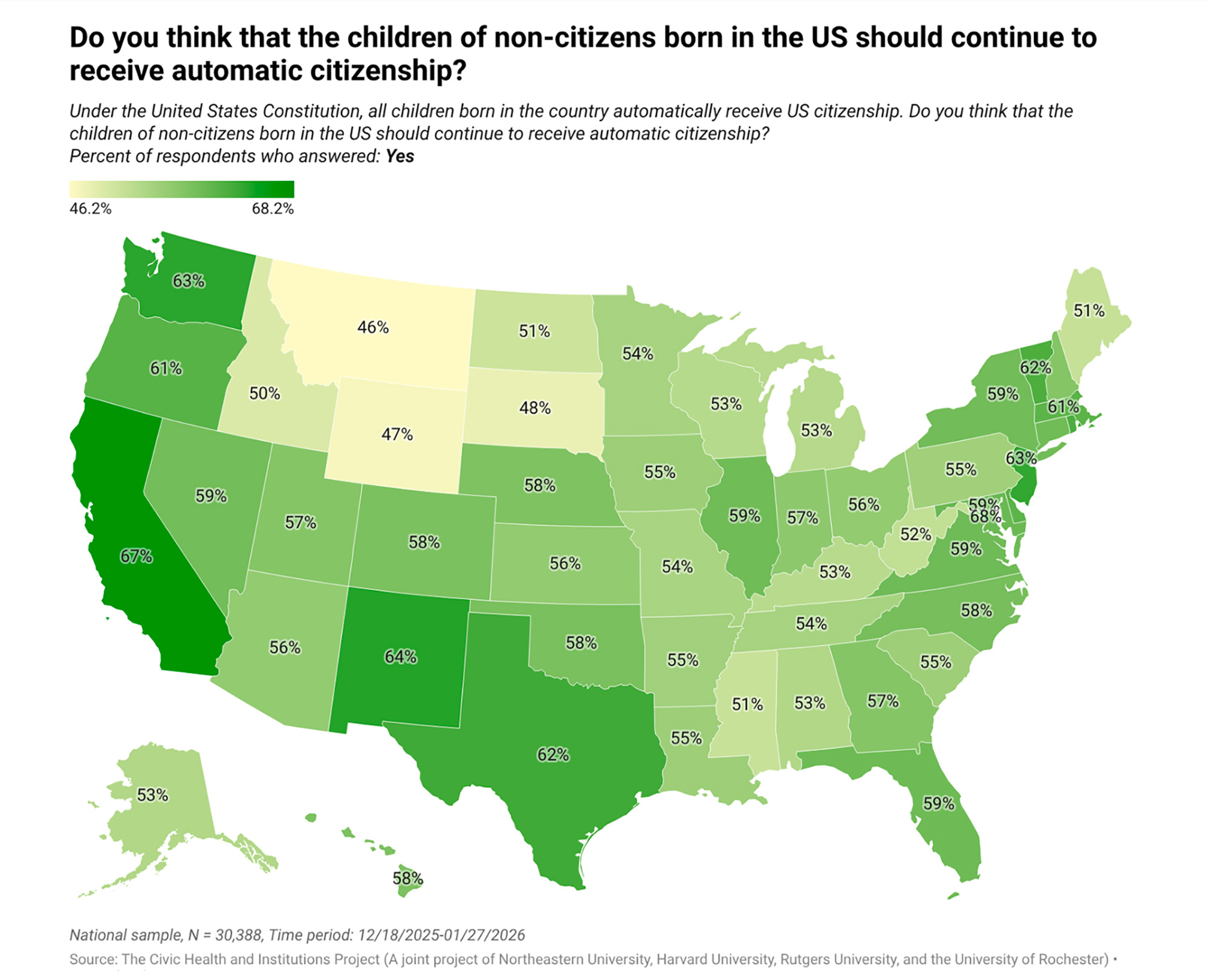
Support also extends across the country geographically. Support for birthright citizenship fell below 50 percent in just three states-Montana (46 percent), Wyoming (47 percent), and South Dakota (48 percent).
"The relative consistency of support-at least compared to enforcement attitudes-suggests that Americans distinguish between debates over immigration enforcement and long-standing constitutional norms," Druckman says.
A shift when policy gets personal
Although Americans often express strong views about immigration broadly, the survey shows that opinions shift when policy gets personal.
About one in four respondents say they worry that a family member or close friend could be deported, while about one in five say they personally know someone who is undocumented. Those concerns nearly double among Hispanic Americans.
The nuance plays out when Americans are asked their thoughts on deporting undocumented immigrants who have lived in the United States for more than 10 years.
"Americans may support enforcement in principle but become more hesitant when policies affect people who have built lives in the United States."
Just 31 percent favor the idea of deporting longtime undocumented residents, including only half of Republicans, who widely favor stricter enforcement.
"That suggests Americans may support enforcement in principle but become more hesitant when policies affect people who have built lives in the United States," Druckman says.
More aggressive enforcement proposals also face limited national support. Only about a third of Americans support using the military to assist with mass deportations.
Taken together, the findings suggest immigration remains a complex issue for American voters-one marked by sharp partisan divides but also pockets of potential agreement.
"People may have very different ideas about how immigration should be handled," Druckman says. "But the data show that their views are often more nuanced than the political conversation might suggest."


