
Research and development (R&D) statistics report on research and development activity, including expenditure and related employment across the business, government, and higher education sectors in New Zealand.
In 2025, the survey was conducted for the business sector only. In every second (even) year, all three sectors are surveyed.
R&D expenditure figures are in nominal terms and are not adjusted for inflation.
This release focuses on data from 2025, with comparisons back to 2018. The survey design has remained comparable over this period.
Key facts
In 2025, business R&D expenditure was $4.1 billion (up 0.4 percent compared with 2024).
Between 2024 and 2025, for the business sector:
- the number of businesses that reported R&D activity fell to 2,265 (down 0.8 percent)
- average R&D expenditure per business that performed R&D activity increased by $22,000 (1.2 percent) to $1.8 million
- R&D expenditure as a proportion of gross domestic product (GDP expenditure measure) fell from 0.98 percent to 0.95 percent
- the number of full-time equivalent (FTE) staff who worked on R&D decreased to 19,000 (down 5.1 percent)
- the most common reasons for carrying out R&D remained 'to maintain position in the market' (31 percent) and 'to gain entry into new markets' (31 percent).
Overall business R&D expenditure increases to $4.1 billion
The business sector spent $4.1 billion on internal R&D expenditure in 2025. This was up $15 million (0.4 percent) from 2024.
| Year | Business sector R&D expenditure |
| 2018 | 2134000000 |
| 2019 | 2427000000 |
| 2020 | 2731000000 |
| 2021 | 2867000000 |
| 2022 | 3182000000 |
| 2023 | 3690000000 |
| 2024 | 4073000000 |
| 2025 | 4088000000 |
| 1878000000 | 2390000000 |
|---|---|
| 2277000000 | 2578000000 |
| 2567000000 | 2895000000 |
| 2721000000 | 3014000000 |
| 3004000000 | 3360000000 |
| 3450000000 | 3930000000 |
| 3764000000 | 4383000000 |
| 3864000000 | 4313000000 |
Wages and salaries made up 58 percent of business R&D expenditure, while other current expenditure contributed 34 percent, and capital expenditure contributed 8.0 percent. Other current expenditure includes items like rent and fixed overhead costs, while capital expenditure includes purchase of land, machinery, and equipment. These proportions have remained relatively consistent since 2018.
While R&D expenditure is not adjusted for inflation, movements in relevant price indexes suggest that the volume of R&D activity has decreased slightly between the March 2024 and March 2025 quarters. Compared with the 0.4 percent change in business R&D expenditure, relevant inflation measures over the same period were:
- labour cost index (all salary and wage rates for all private sector industries) - 2.5 percent
- producers price index (inputs) - 5.3 percent
- capital goods price index - 1.6 percent.
Price indexes has more information on inflation.
Large businesses (businesses with 100 or more employees) contributed 56 percent of total business R&D expenditure but only accounted for 14 percent of all businesses carrying out R&D.
Businesses in the services industry group contributed 67 percent of total business R&D expenditure in 2025, or $2.7 billion. Services make up a large proportion of the total New Zealand economy and account for a wide range of industries, including construction, wholesale trade, health care, and information and communications technology (ICT).
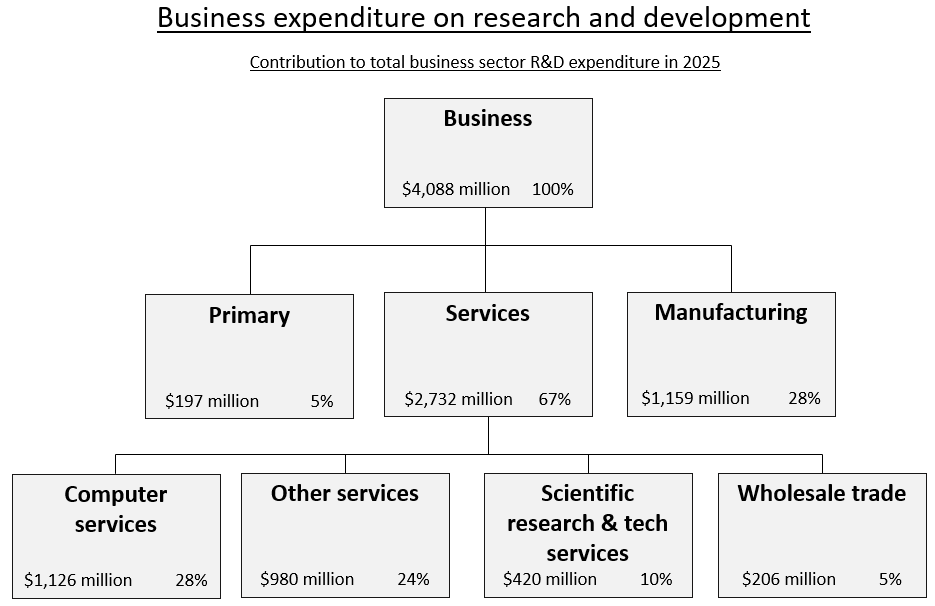
The 'other services' industry saw the biggest increase in R&D expenditure from 2024, up $129 million (15 percent) to $980 million. This represented 24 percent of total business R&D expenditure in 2025. This industry includes electricity, gas, water, and waste services; financial and insurance services; and telecommunications services.
R&D for the purpose of ICT grows significantly
Businesses may carry out R&D for their own benefit, or for that of other businesses, industries, or sectors. This is also known as the purpose of research.
For example, the manufacturing industry spent a total of $1.2 billion on R&D in 2025. Of this expenditure, respondents reported that 66 percent was intended to benefit industries other than manufacturing, such as primary industries (16 percent).
In recent years, the largest proportion of total R&D expenditure has been for the purpose of the manufacturing industry. Business R&D expenditure for the purpose of ICT has more than doubled since 2018, to $858 million, making it the highest-spending purpose in 2025. Manufacturing was the second highest ($582 million).
| Purpose of research | 2018 | 2025 |
| Information and communication services | 352000000 | 858000000 |
| Manufacturing | 499000000 | 582000000 |
| Health | 249000000 | 570000000 |
| Commercial services and tourism | 216000000 | 364000000 |
| Animal production and animal primary products | 193000000 | 328000000 |
| Other | 137000000 | 299000000 |
| Plant production and plant primary products | 117000000 | 235000000 |
| Construction | 68000000 | 205000000 |
| Energy | 50000000 | 193000000 |
| Transport | 127000000 | 191000000 |
| Environment | 31000000 | 81000000 |
| "Law | 6000000 | 74000000 |
| politics | 22000000 | 39000000 |
| and community services" | 35000000 | 36000000 |
| Education and training | 14000000 | 17000000 |
| Cultural understanding | 18000000 | 14000000 |
| Economic framework | ||
| Mineral resources |
Over 40 percent of businesses expect their R&D expenditure to remain the same
Businesses were asked about what they expected to happen to the amount of R&D they would carry out or fund in their next financial year.
When asked about future R&D expenditure:
- 41 percent of businesses expected it to stay the same
- 37 percent expected an increase
- 13 percent expected a decrease.
These proportions have remained largely unchanged since 2018.
Data updates
We made updates and corrections to 2023 and 2024 results as part of the publication of the 2025 release. These were due to updated respondent data across most of the business sector figures.
All updates and corrections are noted with a revision flag on the affected series in the published tables, CSV files, and relevant Infoshare series.
Information about the survey
The Stats NZ Research and Development Survey runs annually, with the business sector being surveyed every year. Every two years, the government and higher education sectors are also surveyed.
The 2025 survey was conducted from August to December 2025, and entities were asked to report on the last financial year for which information was available, as at August 2025. Most respondents reported for the period 1 April 2024 to 31 March 2025.
A sample of 4,998 businesses was selected from known R&D performers.
The R&D expenditure and personnel figures stated in this release refer only to internal R&D carried out within the organisation or business. External R&D expenditure is collected in the survey and is available in the downloadable CSV.
The Research and Development Survey has been conducted by Stats NZ since 2006, and additional data is available in Infoshare.
Relative sampling errors
Relative sampling errors (RSEs) are published for not just headline figures, but for all the figures collected in the survey. They are available in the RSEs Excel file or the downloadable CSV under Download data.
Research and Development Survey - Survey series - DataInfo+ has more information on relative sampling errors.
Text alternative for Business expenditure on research and development, contribution to total business sector R&D expenditure in 2025
Diagram shows sector contribution to total expenditure on research and development in 2025. Total business sector R&D expenditure, $4,088 million, 100 percent. Primary industry group, $197 million, 5 percent. Services industry group, $2,732 million, 67 percent. Manufacturing industry group, $1,159 million, 28 percent. Computer services, $1,126 million, 28 percent. Other services, $980 million, 24 percent. Scientific research and technical services, $420 million, 10 percent. Wholesale trade, $206 million, 5 percent.
More data
Use Infoshare to access the research and development survey time series.
Subject category: Industry sectors
Group: Research and Development Survey - RAD
Definitions and metadata
Research and Development Survey - Survey series - DataInfo+ details the general methodology used to produce research and development statistics.
Research and Development Survey - Concepts - DataInfo+ details the definitions used to produce research and development statistics.
Research and Development Survey - 2025 data collection - DataInfo+ details period-specific information for this release.
Technical enquiries
Kathy Jackson
[email protected]
04 931 4600
ISSN 1178-0657
Next release
Research and development survey: 2026 (all three sectors collection) will be released in 2027.


