
The U.S. has built "deliberate" and "systematic" new procedures for deporting immigrants to 35 foreign nations, often putting the immigrants in danger while sidestepping U.S. law, according to a report published today (Monday, Oct. 5) by the UC Berkeley Human Rights Center Investigations Lab.
The system has evolved rapidly since the start of 2025, the report says, with the Trump administration striking previously unknown agreements to pay countries tens of millions of dollars to accept refugees and migrants who have been living in the U.S. Other countries have been threatened with the loss of aid if they refuse.

The result: More than 21,000 immigrants and refugees - many of them in the U.S. legally, with no criminal record - have been removed from the country and sent to third countries where they have no previous connection. Some have been falsely labelled as gang members or criminals and then imprisoned. Others, the investigators found, have been returned from the third country back to their home countries despite the risk of persecution, torture and death.
"We are witnessing one of the most horrendous attacks on immigrant communities in U.S. history," the report says. "The Trump administration's mass removal policies are systematic, pervasive and coordinated with maximum intent to terrorize immigrants. … This research outlines an architecture of cruelty, a scaffolding that is being used to construct a new regime in which refugees and migrants are treated as if they exist outside the rule of law."
Veteran U.S. immigration Judge Jeremiah Johnson was among more than 130 judges who were fired as the Trump administration's third-country deportations accelerated. In a foreword to the 80-page report, Johnson offered a blunt assessment: "One thing is clear - Trump's mass deportation campaign is unlawfully removing people from the United States."
The report - "Architecture of Cruelty: Third Country Removal Agreements and the Second Trump Administration" - is the first major analysis of an immigrant-removal system put in place by the Trump administration. The study was directed by Linda Gordon, supervising attorney of UC Berkeley's Human Rights Center Investigations Lab.
While news publications and human rights groups have reported on the deportations and related abuses, Gordon said the Investigations Lab was able to apply its expertise on a first-of-its-kind study, tracking down dozens of agreements between the U.S. and destination countries that had been largely unknown.
One thing is clear - Trump's mass deportation campaign is unlawfully removing people from the United States.
former U.S. immigration Judge Jeremiah Johnson
"Once we had those documents, we could take a step back and see the patterns that amounted to significant violations - human rights violations, legal violations," she said. The evidence drawn from foreign news reports, social media posts and obscure government records "does document those violations very clearly."
By paying millions of dollars to countries to accept the deported people, she said, the U.S. is creating a global network of nations that are undermining long-established national and international laws on the humane treatment of migrants and refugees.
In addition to the report, the center has produced a Third Country Removals Dashboard, an interactive Third Country Removal Timeline, and a Third Country Agreements Reading Room, where the pacts struck between the U.S. and foreign nations are available for review and study.
Using Amazon as a deportation model
The Center's investigation was launched in July 2025, part of a broad project involving other human rights and legal groups, along with 72 journalists at 25 media organizations worldwide who joined in the Forbidden Stories consortium.
Under law in the U.S. and many other countries, and under international law, refugees and migrants are entitled to a thorough legal review before they can be deported. It is illegal to deport them to their home countries or to third countries where they may have a justified fear of persecution, torture or death.
The new report details how the Trump administration sought to change that system from the time it took office on Jan. 20, 2025.
On Inauguration Day, the White House ordered the departments of State, Justice and Homeland Security to pursue new international cooperation agreements on border enforcement. In effect, the report says, the legal system that was designed to protect the rights of immigrants and refugees was recalibrated to make deportations faster and easier - and to minimize U.S. exposure to legal challenge.
In March 2025, it says, then-Homeland Security Secretary Kristi Noem issued a guidance that immigration officers should "not affirmatively ask whether the alien is afraid of being removed" to a third country.
The next month, at the Border Security Expo in Phoenix, acting ICE Director Todd Lyons in a keynote address said the new system should be like a high-efficiency delivery operation. "We need to get better at treating this like a business," Lyons said. The deportation process should look "like (Amazon) Prime, but with human beings."
The worst of the worst?
By August 31 this year, agreements had been struck with 35 countries. In all, the Berkeley investigators found, 21,644 people had been deported to 28 countries as of that date, sometimes half a world away from where they were born. Without advance notice, they were often transported in chains and straitjackets to a place where the language and customs were unfamiliar, and where they knew no one.
According to the report, the majority of people removed from the U.S. have been refugees without criminal records who have lived in the country for years with legal protection.
"We know that most arrive in a foreign country with little to no prior notice of where they have been sent," the authors write. "We know that many have endured horrendous conditions in these countries without receiving any information about what will happen to them. We know that many have been pressured or forcibly sent to the home countries from which they previously fled and from which they gained protective status in the United States."

U.S Department of Homeland Security / Tia Dufour
The report cited a number of dramatic examples:
The administration sent 252 Venezuelan men to the notorious CECOT prison in El Salvador, falsely accusing them of membership in the Tren de Aragua criminal gang. Some were reportedly tortured, and many remain imprisoned.
Other immigrants, described by U.S. officials as the "worst of the worst," were sent to the small African nation of Eswatini. Though they had a history of criminal activity, the men had long ago completed their sentences and had lived peacefully in the U.S. for years. "Once in Eswatini," the report said, "they were improperly redetained and remain imprisoned there, despite having committed no new crime."
Iranian nationals were sent to Qatar and Kuwait, then returned to Iran and the risk of persecution - in apparent violation of U.S. law. Russian nationals were deported to Egypt, which returned them to Russia and its repressive government.
A "disproportionate" number of LGBTQ+ immigrants have been removed from the U.S., the report says, and 13 of the destination countries criminalize LGBTQ+ identities. Other countries have recently decriminalized same-sex sexual activity, but still have weak legal safeguards.
These actions, the authors said, "have created dread, fear and terror in immigrant communities in the United States, including the more than 65,000 people incarcerated in detention centers, who likely wonder if they are next."
Eroding protections, evading accountability
The U.S. has long used agreements with other countries to govern deportation relationships. But, the report says, the pattern of possibly illegal deportations is made possible by two crucial factors: the payment of millions of dollars to nations which agree to accept the U.S. migrants and refugees, or threats that aid will be withheld; and loosely worded agreements that seem to allow little protection for the deportees - and little legal accountability for the U.S.
We are witnessing one of the most horrendous attacks on immigrant communities in U.S. history.
"Architecture of Cruelty"
In some cases identified by the Berkeley human rights investigators, countries are paid based explicitly on the number of people they accept: Rwanda received $7.5 million for taking up to 250 people, and Eswatini $5.1 million for up to 160 people.
In other cases, agreements are silent with regards to how much funding has been negotiated by the governments. Instead, the report traces payments by the U.S. to international organizations working inside the countries. Organizations in three impoverished African nations - the Central African Republic, the Democratic Republic of the Congo and Cameroon - were paid a total of more than $100 million after the countries agreed to accept deportees who had been implicated in crime or terrorism.
Agreements made by past presidents included specific, strict guidelines for protecting those deported from the U.S., Gordon said. But in the new agreements, the language is often much more vague. Such agreements do little to prevent deportees from being mistreated in the new country, or from being returned to their home countries to face risk of persecution and death.
"They're quite hollow commitments - or seemingly no commitments," Gordon explained. "Even when there are vague, broad references to international law, there's no explicit commitment to how the United States and the third country are going to protect the people who are being removed. That is extremely concerning."
Some countries might promise to process asylum claims, the report found, but they "are clearly unequipped" to do so.
The authors cite the example of Equatorial Guinea. In its agreement with the U.S., the country agreed to protect the rights of people it received. But the investigators found that the country has "no operative protection law, no institution to receive claims, no consistent international presence to fill that gap, and extensive documented human rights abuses against immigrants."
Last year, the U.S. agreed to pay Equatorial Guinea $7.5 million to accept third country nationals from the U.S.
"With these removal agreements," the report concludes, "State Department officials are effectively creating new international norms and implementing foreign policy without effective guardrails or oversight."
An uncertain legal landscape
According to the authors at the Investigations Lab, a central drive in Trump's strategy has been to gut the U.S. Immigration courts. Johnson, the former immigration judge, wrote that 21 judges were assigned to the federal immigration court in San Francisco in January 2025.
"Now there are only two judges left," he wrote, "and the courthouse is shuttered. No hearings for noncitizens, no hearings to preside over for judges like me …. Today, full and fair hearings are an endangered species."
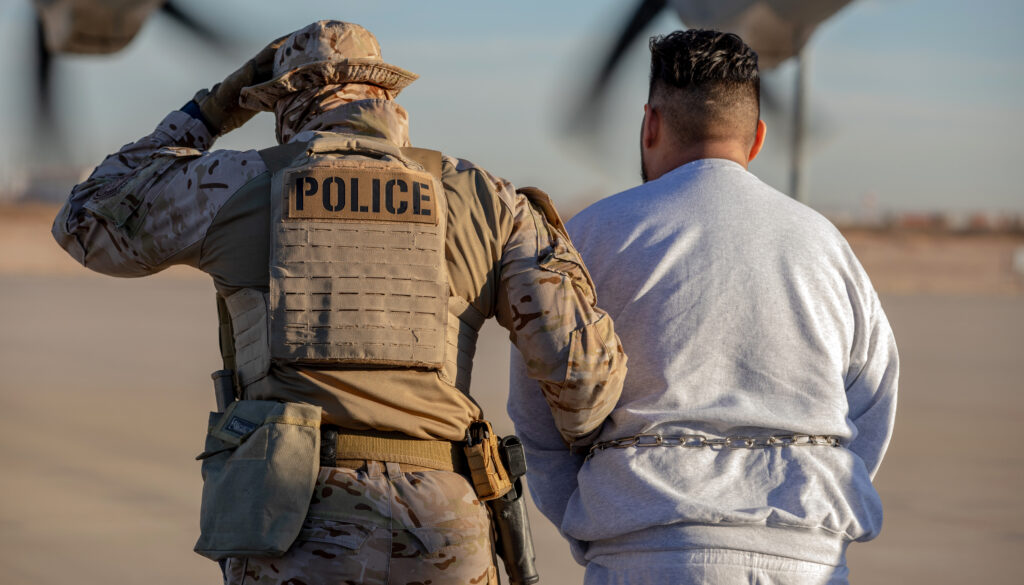
Photo by Cpl. Adaris Cole, U.S. Army
In response to a nationwide class-action suit, D.V.D. v. Department of Homeland Security, a federal district court in Massachusetts in February blocked further third-country removals, finding them unlawful. A federal appeals court last month largely upheld that ruling.
Just last week, however, a divided U.S. Supreme Court ruled that the third-country deportations could resume, pending the high court's own review. Oral arguments are slated for December, and a final decision could be months away.
News media partners in the Forbidden Stories project have already begun publishing stories from their investigations, supported by information from the Investigations Lab.
Gordon said the Lab will continue to press a multi-pronged effort to study the deportation agreements and to protect people who have been removed from the U.S. without proper legal processes and safeguards.
'Safeguarding the rule of law'
It expects to provide support in litigation on behalf of some people who have been removed, Gordon said. Working with journalists, lawyers and human rights groups, the Lab plans to use existing disclosure laws to force the release of apparently missing agreements and implementation plans with foreign nations.
A new study will put significant focus on the financial side of the deportation policy. A key question: How does the Trump administration use other foreign security agreements and trade agreements to pressure other countries to accept people removed from the U.S.?
Further, the Human Rights Center will probe "who is profiting from these transcontinental deportations," the report concludes. "This next step will advance our larger effort to uphold the human rights of those who are being most impacted, while safeguarding democratic principles and the rule of law."


