
Senior reserve leaders from across the NATO alliance gathered to discuss the growing importance of reserve forces in addressing global security challenges during the NATO Air Reserve Symposium. The event focused on how Allied Reserve Organizations and the NATO Committee on the Reserves can support NATO's future transformation efforts.
Chief of the Air Force Reserve and Commander of Air Force Reserve Command Lt. Gen. John P. Healy and AFRC Senior Enlisted Advisor Chief Master Sgt. Israel Nuñez delivered remarks and participated in panel discussions alongside representatives from across the alliance.
Healy underscored the rising strategic value of reserve components as global threats evolve.
"Our security environment demands a ready, interoperable and, when necessary, lethal force," Healy said. "Air Reserve forces provide a decisive edge - what we call the 'Reserve Advantage'."
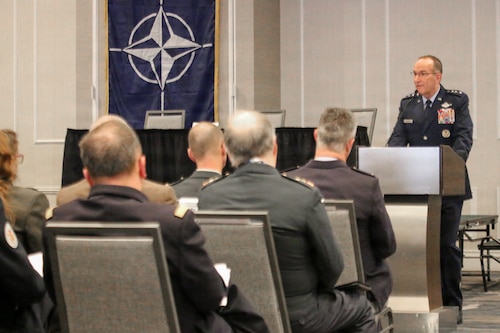
He identified three pillars of that advantage: civilian-sector expertise, strategic depth and surge capacity, and a strong connection to the communities' reservists serve. He highlighted the dual‑role versatility of Citizen Airmen, describing a security forces noncommissioned officers who shifted from leading tactical training to serving as a corporate chief financial officer within 48 hours.
"That is twice the citizen," Healy said.
Healy outlined expanding Air Force Reserve engagement in the Indo‑Pacific, including subject matter exchanges with the Philippines, on-going civil engineering support in Palau and integrated training during exercise Ulchi Freedom Shield in South Korea. He also cited increased cooperation with Australia on Agile Combat Support.
In Europe, Healy pointed to new agreements with France and the United Kingdom aimed at strengthening reserve professional development exchanges, C‑130J operations, base defense and intelligence, surveillance and reconnaissance capabilities. He also referenced developing partnerships with Estonia, Lithuania, Canada and Finland under the Reserve Allies and Partners Program, launched in 2024 to deepen reserve cooperation with allied and partner nations outside the National Guard's State Partnership Program.
Healy emphasized that modern military power relies on interoperability as much as advanced platforms. He highlighted the Base Defense Leadership Course at Youngstown Air Reserve Station, Ohio, as an example of strengthening coalition readiness through training with the Netherlands and Denmark.
"The next fight will be a coalition fight," Healy said. "We will not have the luxury of time to figure out how to work together."
He concluded by inviting partner nations to the 30th International Air Reserve Symposium, set for Sept. 21-24, at Dobbins Air Reserve Base, Georgia, which will include hands‑on demonstrations by U.S. Reserve units.
"Let's move beyond sharing ideas and start solving shared problems," Healy said. "Our most lethal weapon system is our people. Together as allies and partners, we provide a decisive edge. We are stronger together."
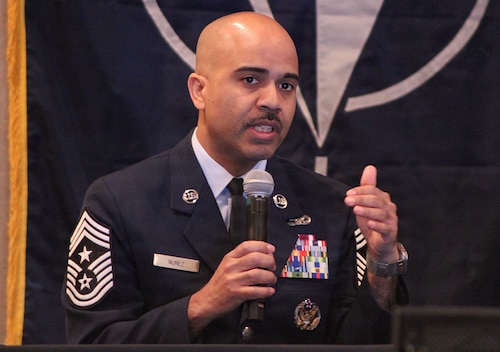
Nuñez reinforced the essential connection between disciplined Airmen, high standards and mission-ready noncommissioned officers. He said today's security environment requires an enlisted force that is both highly trained and uncompromising in its professionalism.
"Lethality and readiness are not buzzwords," Nuñez said. "They are the cornerstones of our ability to deter aggression and, if necessary, fly, fight and win."
Nuñez stressed that discipline - down to dress and appearance - remains fundamental to maintaining the nation's airpower advantage. He cited preventable incidents, including fatal ones, as proof that eroding standards carry real operational consequences.
"When the nation needed decisive airpower," he said, referencing precision strikes on Iranian nuclear facilities, "a disciplined and mission‑ready Air Force delivered."
He also highlighted the decisive role of noncommissioned officers in modern conflict, noting Ukraine's improved battlefield performance after investing in its NCO corps following 2014.
"Our NCOs will be the difference between victory and defeat," Nuñez said, crediting decentralized mission command and empowered enlisted leaders as key factors behind Ukraine's success.
Nuñez closed by calling on Airmen to uphold excellence as the nonnegotiable standard.
"Standards, lethality and readiness have always mattered in our profession of arms," he said. "Today they matter more than ever. Tomorrow they will define our success or failure."


