More than six years after it was severely damaged in a hailstorm, the ceremonial and social heart of the Australian National University (ANU) is reopening in time for celebrations marking the University's 80th anniversary.
University House will be officially reopened on Friday 14 August, ahead of an ANU campus community day on Saturday 15 August.
The roof of the heritage-listed building was shattered in the January 2020 Canberra hailstorm and a subsequent downpour of rain caused extensive interior damage. Planning for restoration work was complicated by the COVID-19 pandemic.
The Master of University House, Professor Peter Kanowski, said the building had been painstakingly restored to respect and enhance its iconic Mid-Century Modern heritage features.
"University House is ready to resume its place in the life of the ANU and the broader Canberra community," Professor Kanowski said.
"University House was opened in 1954 by Prince Philip, the Duke of Edinburgh, and in the decades since has been both the ceremonial and social heart of the ANU, for staff, graduate students, academic visitors, and the Canberra community.
"Now that the restoration work is complete, we are delighted to be able to welcome back the ANU community, and our wider community in Canberra and across Australia and the world, in time for celebrations of the University's 80th anniversary," Professor Kanowski said.
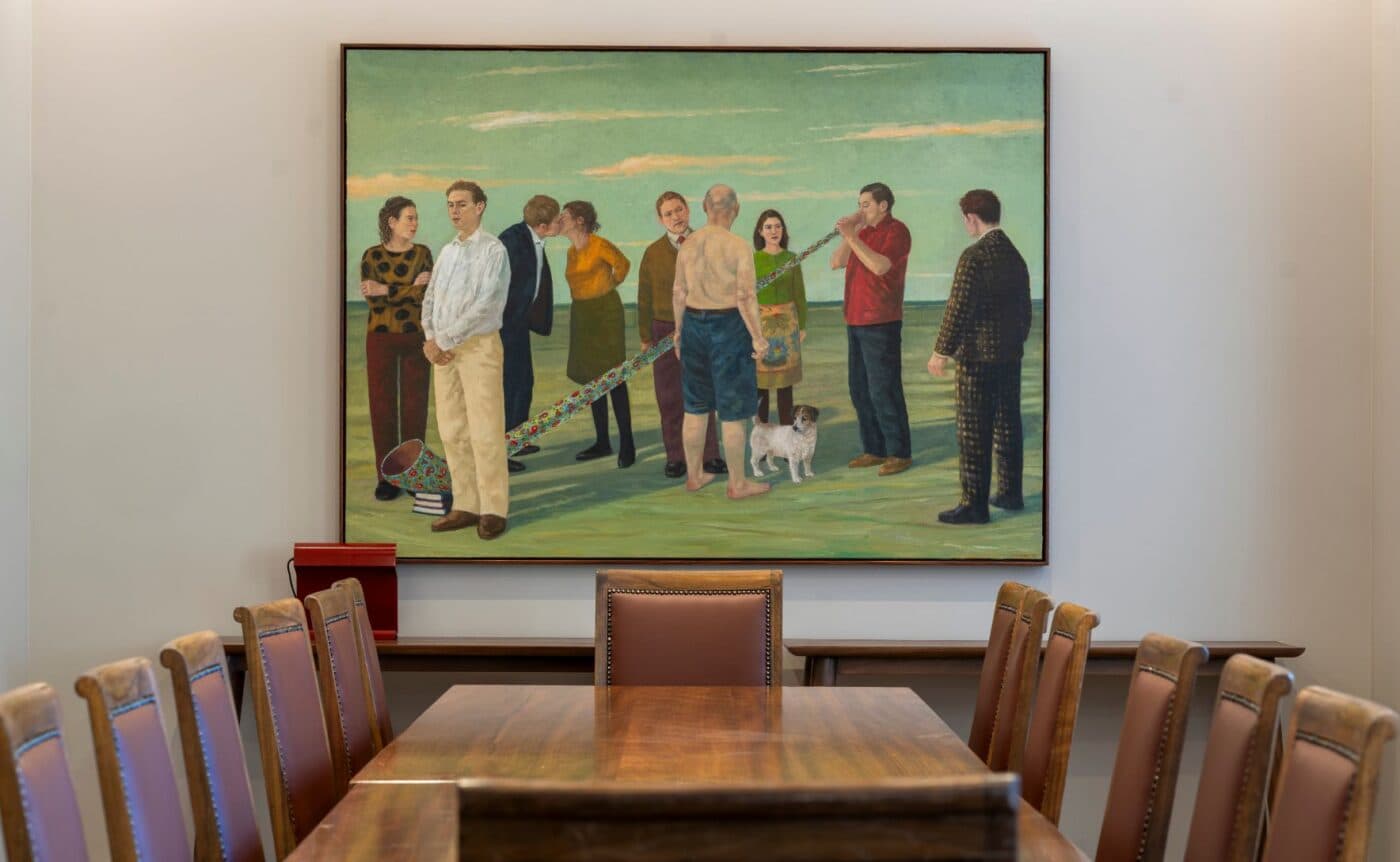
Set in tranquil grounds, University House includes a Great Hall decorated by the Leonard French mural Regeneration, multiple reception and dining facilities including a famous beer garden, 97 bookable hotel rooms and 60 rooms for postgraduate students.
The building was designed by Professor Brian Lewis and awarded the 1953 Sulman Medal for Architectural Merit. It houses Fred Ward-designed and built furniture and an art collection including works by Arthur Boyd, John Brack, John Olsen and Clarice Becke.
The restoration of the building included many operational enhancements, such as improved access for people with disability and, in accordance with the University's Net Zero targets, the building is now fully electric.
"What visitors will see is a building that looks as splendid as it did in 1954, but behind the scenes would be unrecognisable in that era," Professor Kanowski said.
Design and oversight of the restoration was undertaken by heritage architects Lovell Chen and the building work by Hindmarsh Construction Australia.
ANU Interim Vice-Chancellor Professor Rebekah Brown thanked the staff, contractors, donors and University House Friends and Members who contributed to the restoration and reopening of campus "Building Number 1."
"The hard work, dedication and creativity of many people over the past six years have ensured that University House will remain a vital part of the ANU well beyond the next 80 years," Professor Brown said.
Comments attributable to heritage architects Lovell Chen:
"It has been a privilege for Lovell Chen to deliver the architectural design and heritage consulting services to such a significant foundation building for ANU, working with a passionate and dedicated client, and team of specialist consultants, contractors and conservators.
"Our design focused on a rigorous and authentic conservation of the original fabric, maintaining and refreshing the restrained mid-century modern aesthetic while ensuring the amenity and services enables its continued use - as designed - for accommodation, ceremony and academic collegiality."
Comments attributable to Hindmarsh Construction Australia:
"Managing the construction for the restoration of University House has been a rare privilege and an extraordinary responsibility and represents a significant chapter in Hindmarsh's continuous relationship with the ANU spanning more than 35 years.
"The challenge was not simply to repair this Commonwealth Heritage-listed building, but to carefully integrate modern services, accessibility and sustainability requirements without diminishing the architectural character and craftsmanship that make it so significant. Delivering that outcome required meticulous planning, close collaboration and the skill of specialist artisans and tradespeople. Hindmarsh is immensely proud to have helped renew this important place for the ANU and the wider community, while preserving its legacy for generations to come"