
This story is part of an AI series looking at how WSU is driving innovation in research and teaching through artificial intelligence. View the entire series as it becomes available.
Yesterday's power grid was a one-way affair: A plant produced electricity and sent it crackling out along power lines to consumers.
Today's grid is much more complicated. Power is being generated at solar and wind farms. Energy is being produced - as well as consumed - in homes with solar panels or electric cars with "bidirectional" charging. Grids are becoming two-way systems with many control points, making it more difficult to maintain the crucial equilibrium between supply and usage. Washington State University has built an extensive foundation for pursuing solutions for these complex challenges.
Enter AI and machine learning. These technologies could help build and safeguard the grid of tomorrow. But they also present a major obstacle: AI data centers gobble up massive amounts of power, stressing energy grids and raising concerns about rising consumer prices. A single hyperscale AI data center can use as much power as 80,000 homes, and utilities foresee major increases in power usage - known as "load."
"We're expected to grow our load significantly going forward, and this growth is really happening because of AI data centers," said Anamika Dubey, Huie-Rogers Endowed Chair Associate Professor in Electrical Engineering in the School of Electrical Engineering and Computer Science and co-director of the Advanced Grid Institute, a joint institute of WSU and the Pacific Northwest National Laboratory.
"These AI data centers are very energy-hungry, electricity-hungry."
Addressing that hunger is one piece in the puzzle of how we produce and distribute energy in an era with rising demand, aging infrastructure, expanding energy alternatives, and a changing climate - a puzzle scientists at WSU are busily trying to solve.
AI itself might help researchers manage the data center power needs, as WSU scientists draw on the emerging technologies to enhance public safety and security, from protecting the electrical grid to forecasting wildfire risk to safeguarding the large data and computing systems that run the world.
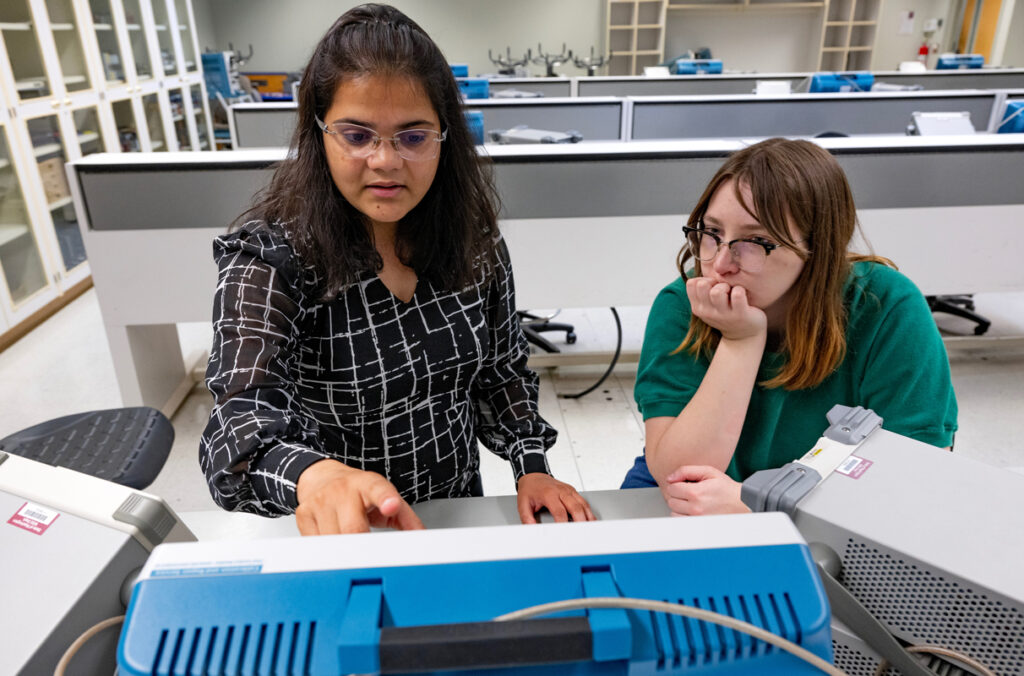
Dubey is working with colleagues to accelerate the evolution of power grids into a decentralized, "distributed" model. This includes development of applications to coordinate a grid's distributed assets for improved efficiency, help power systems recover from outages, using "microgrids," and support planning to better protect the grid against major disasters.
"The grid is becoming more complex and it's adding a lot more uncertainty and variability," Dubey said. "Managing a grid that is becoming more uncertain and variable requires a more sophisticated technology."
AI may help with that, though we're not there yet, she said. It offers promise for forecasting energy demand and supply, as well as long-term planning for where to add more power generation and what types, as well as where to build new transmission lines and other system infrastructure.
"You can always answer these questions using traditional methods, but they are slow, so people are migrating to these AI/machine learning models to answer: How do we efficiently solve these planning problems?" she said. "More importantly, AI can help drive operational decisions - but we need significant research to ensure these algorithms are reliable and trustworthy in real-time use cases."
There are several potential threats to the grid's stability beyond expanding complexity. Energy sources like wind and solar are not consistently available. Most of the grid infrastructure is decades old, and needs to be updated to withstand an expected increase in extreme weather. Protecting against cyber-threats is also increasingly important.
"Cybersecurity is a huge emerging issue," Dubey said.
Protecting vital networks
Just as it is with energy, AI is a two-sided coin for cybersecurity: A potential threat and tool to defend against threats.
AI-aided malware, deepfake scams and similar threats are a growing part of cybercrime - which has a global cost of trillions annually. But cyberdefense is increasingly reliant on automated systems that apply machine learning to sort through the stream of actions within any computing network and classify them as safe or malign.
WSU researchers are at the forefront of efforts to untangle these challenges. In September, WSU was named a National Center for Academic Excellence in Cyber Research by the U.S. National Security Agency, one of only five such centers in the Pacific Northwest.
That honor reflects the rapid recent growth of cybersecurity research and teaching at the university. In 2021, WSU established the VICEROY Institute for Cybersecurity Education and Research, or CySER. The institute is directed by Assefaw Gebremedhin, Berry Family Distinguished Associate Professor in the School of Electrical Engineering and Computer Science, and it includes other universities and industry partners.
It's one of the first three virtual institutes for cybersecurity and electromagnetic spectrum training established in the U.S., providing education in cyber basics, operations, and defense. WSU offers bachelor's degrees and specialized certificates in the field.

AI systems themselves can face cyberthreats. A bad actor could poison an AI system with inaccurate data, for example. Another concern involves the security of individuals' private information if it is fed into AI models.
Gebremedhin co-taught a new course on cyber law and ethics this Fall 2025 semester collaborating with Sherri Conklin, assistant professor of Philosophy in the School of Politics, Philosophy, and Public Affairs, where questions of privacy loom large.
"We have to bring up privacy as an important topic," he said. "It is just as important as security, and these two topics are related, but sometimes they work against one another."
An example of that tension: Cyberdefense systems need to continually classify actions within a system as benign or threatening. Training a machine-learning tool to spot a threat requires a lot of data. But security data - details about a cyberattack on a banking system, for example - is not widely available, in large part because it includes so much private information.
Gebremedhin is using AI to help address that data shortage in his lab, Scalable Algorithms for Data Science (which is separate from CySER).
"My lab works on how to synthetically generate cybersecurity data to augment existing data," he said. "Using machine-learning methods, you generate synthetic data that's not real, but comes as close as possible to what would have been cybersecurity data. Then once you've got the synthetic data, you're going to use machine-learning to do your classification algorithms."
It's one of many ways that WSU is helping develop tools to protect the systems that connect society, even as AI races forward.
"It is going at a very, very fast pace," Gebremedhin said.


