
The Australian Antarctic Program has arrived at the World Heritage listed Heard Island and McDonald Islands and has completed the first round of field activities on shore. The marine science program is also underway, and collecting significant data.
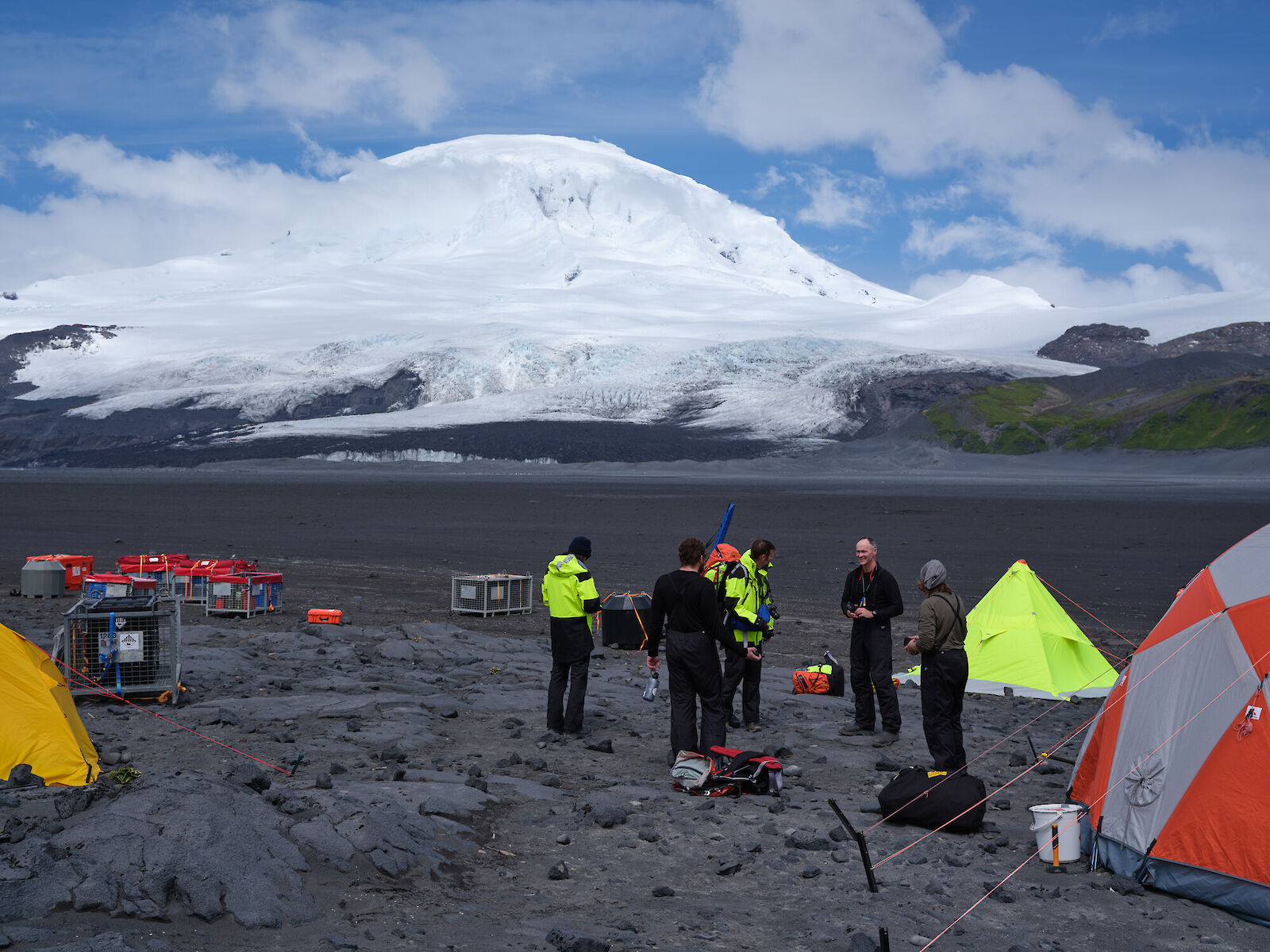
After running the gauntlet of 13 m waves on the voyage from Casey to Heard Island, we arrived to good weather - at least by sub-Antarctic standards! This enabled the establishment of four field camps on the island at Atlas Cove, Skua Beach, Paddick Valley and Josephine Beach.
Seal counting began and the seabird team at Paddick Valley did 21 drone flights, conducting bird population surveys, mapping and H5 bird flu assessments. Targeted surveys of threatened and endemic species are a high priority for the teams doing H5 bird flu assessments, following the confirmed detection of the virus in a southern elephant seal colony during the first visit to the island in October last year.
The seabird and seal teams also took scat samples, installed four acoustic recorders to record the calls of birds (particularly burrowing petrels) and took photos to compare with previous shots taken at the same location in 1926 and 2003.
From a camp at Skua Beach, the team from Securing Antarctica's Environmental Future (SAEF) surveyed Heard Island vegetation, invertebrates (largely weevils and springtails) and took lake water samples.
They also assessed the spread of the invasive grass Poa annua. Overall, the SAEF drone team did 15 flights, covering 130 km.
The marine debris team worked at Atlas Cove, Josephine Beach and Gauss Beach. They collected half a cage pallet of debris, including long line ropes.
The old Atlas Cove station was documented with geolocated photography as well as with LiDAR (remote sensing technology). Project teams recovered an old nest camera, took soil samples and cleaned up 150 kg of loose surface asbestos.
These terrestrial science teams were supported in camp by field training and aircraft ground support officers. The teams returned via helicopter to the ship where a dedicated group of staff worked to ensure biosecurity cleaning protocols were followed.
Terrestrial science by day, marine science by night
While terrestrial science teams were at work by day, marine science teams worked through the night. Beam trawls are being done and samples collected to get an insight into marine biodiversity and population distribution through the water column from just beneath the surface to the sea floor. This is vital for the management of the Heard Island and McDonald Islands Marine Reserve.
There is an exacting process of mapping, sample collecting, sorting, cataloguing and imaging. Marine scientists are regularly finding creatures that are difficult to precisely identify, and collaboration with colleagues on board and around Australia is required.
After a great start, the weather has turned and the terrestrial science teams have returned to the ship to wait it out.
Marine science continues, though the weather is slowing progress. Even when some of the work is paused, the ship continues to map the sea floor. There is never a moment wasted!
Thursday was a designated rest day (the work is 7-days-per-week otherwise), to manage fatigue levels and give everyone a rest before the weather improves and science work resumes on shore and at sea.
The HIMI Campaign is being delivered in collaboration with our partners including Securing Antarctica's Environmental Future (SAEF), Serco, the Bureau of Meteorology (BoM), the University of Tasmania (UTAS), the Institute for Marine and Antarctic Studies (IMAS), Department of Defence, the Sydney Institute of Marine Science (SIMS), Australian Border Force (ABF) and the Australian Fisheries Management Authority (AFMA).


