
From deploying peacekeepers to conducting quiet - but at times heated - diplomacy, the UN Security Council sits at the heart of global decision-making on war and peace. As of January, five new countries will have a seat around the iconic horseshoe table.
Bahrain, Colombia, the Democratic Republic of the Congo, Latvia and Liberia have begun two-year terms as non-permanent members , replacing Algeria, Guyana, the Republic of Korea, Sierra Leone and Slovenia, whose terms ended last month.
They join the other five non-permanent members - Denmark, Greece, Pakistan, Panama and Somalia - who will serve through the end of 2026, alongside the five nations who are a constant presence - China, France, Russia, the United Kingdom and the United States.
The P5, as permanent members are called, hold veto power, allowing any one of them to block the adoption of a substantive resolution, regardless of majority support.
What the Security Council does
Under the UN Charter , the Security Council has primary responsibility for maintaining international peace and security. It is the only UN body whose decisions are legally binding on all Member States.
It can investigate disputes, urge parties to resolve conflicts, impose sanctions, authorise peacekeeping operations and - in exceptional circumstances - approve the use of force. Its resolutions shape international responses to armed conflicts, terrorism and nuclear proliferation.
The Council's work unfolds both in public and behind closed doors: open meetings allow Member States, the media and the public, access to debates and briefings, while closed consultations give diplomats space to negotiate sensitive issues privately.
The Council has a calendar of meetings but can also convene emergency sessions at short notice.
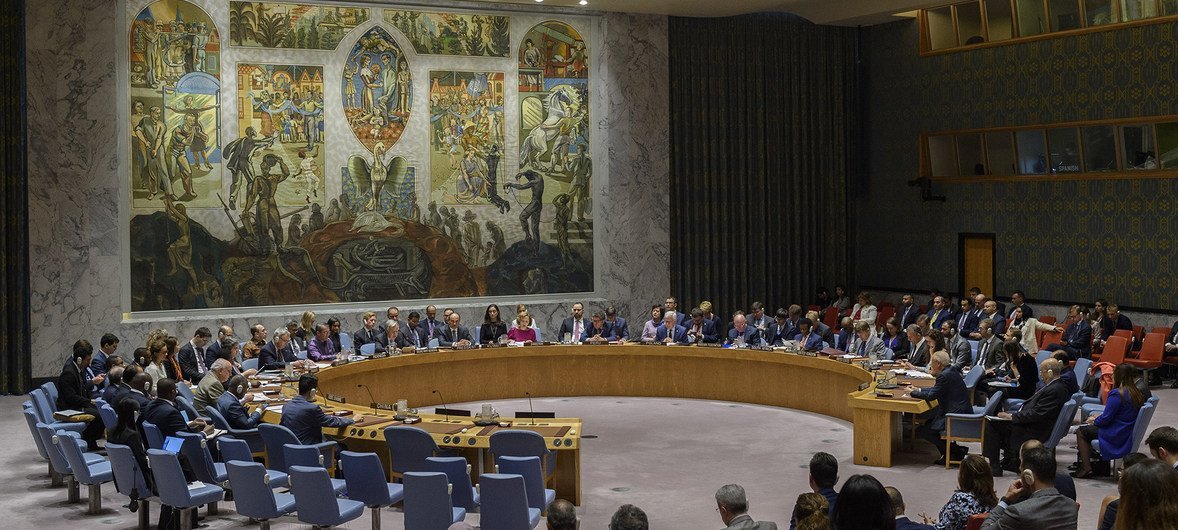
Inside the Security Council Chamber
- The mural: A vast painting dominates the chamber, depicting a phoenix rising from the ashes as a symbol of renewal - humanity's struggle from conflict toward peace.
- The doors: The heavy wooden doors, inlaid with images of torches and swords - symbols of war - emphasise the Council's responsibility to preserve peace.
- The horseshoe table: The curved table ensures there is no head position, symbolic of formal equality, even as diplomatic power dynamics play out in practice.


