
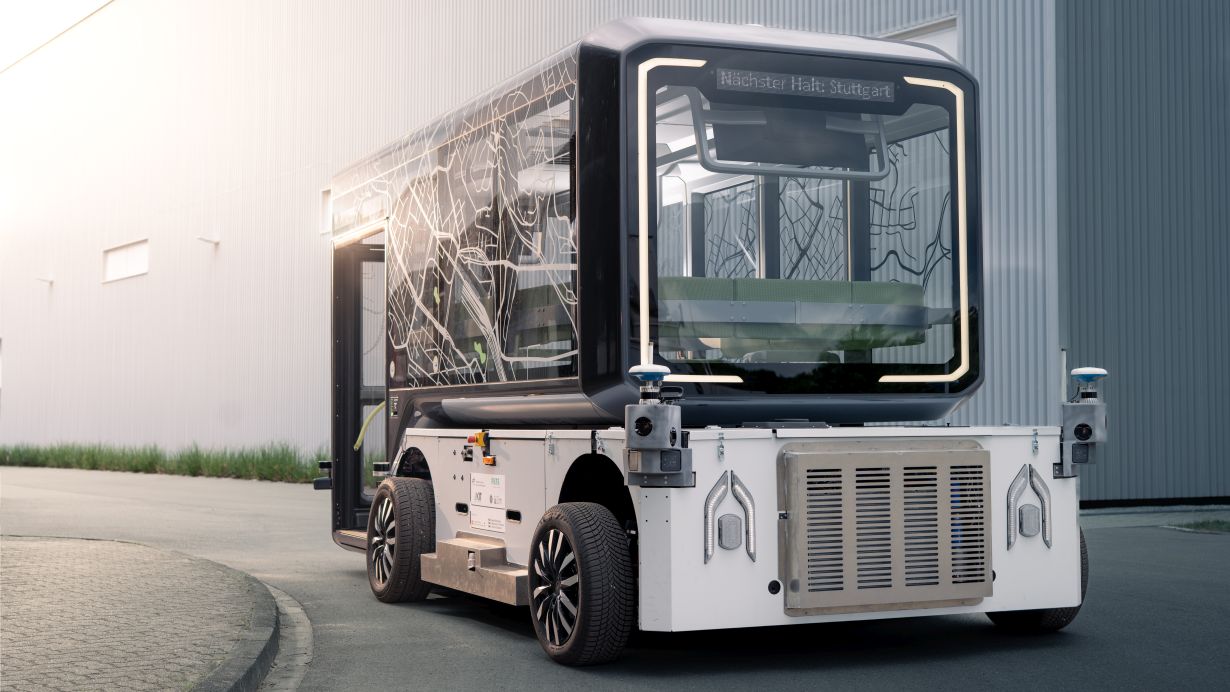
In a project called U-Shift II, researchers from several Baden-Württemberg research institutions have jointly enhanced a driverless vehicle concept that adapts itself quickly and automatically to different tasks. It ties in with previous U-Shift projects in which the basic principle was designed. The mobile platform is able to autonomously pick up and set down different superstructures, so-called capsules. Thus, a single vehicle can be put to various uses, such as transporting passengers in the morning, deliver parcels at noon, and serve as a mobile service unit in the evening. This is a way to make future mobility more flexible, efficient, and sustainable. The latest generation of this concept was presented at the Karlsruhe Institute of Technology (KIT) on Thursday, June 18, 2026, with Dr. Nicole Hoffmeister-Kraut, Minister of Economic Affairs, Skilled Trades and Tourism , in attendance.
There is a variety of possible applications: on-demand offerings in public transportation, delivery services, and mobile medical services or temporary accommodation. The concept, which features a rigorous separation of the vehicle from its function, was developed at the Institute of Vehicle Concepts of the German Aerospace Center (DLR) and has been pursued continuously across multiple projects at DLR for several years.
"Innovation is the key driver for tomorrow's value creation in the automobile sector. This makes the U-Shift II project so important for SMEs. With its focus on technology transfer and the targeted involvement of medium-sized partners, this research and development project systematically strengthens the long-term competitiveness of Baden-Württemberg's automobile industry when it comes to autonomous and networked driving," said Dr. Nicole Hoffmeister-Kraut, Minister of Economic Affairs, Skilled Trades
and Tourism.

FKFS; Prof. Kora Kristof, Vice President for Digitalization and Sustainability, KIT;
Dr. Nicole Hoffmeister-Kraut, Minister for Economic Affairs, Skilled Trades and Tourism;
Prof. Meike Jipp, Director of the Energy and Transport division, DLR;
Prof. Michael Buchholz, Head of the Electric Mobility and Connected Driving / Connected
Infrastructure research groups, Ulm University (photo: Magali Hauser, KIT)
"We want to make vehicles that suit more than one single purpose," said Professor Kora Kristof, Vice President for Digitalization and Sustainability at KIT. "A vehicle that adapts flexibly to different tasks saves resources. It's a building block of sustainable mobility, and creates innovative options for Baden-Württemberg as a mobility hub."
"The insights we gained in the U-Shift II project will help us to advance automated vehicle concepts and the technologies associated with them. With this research, we're supporting Baden-Württemberg as an automotive hub, establishing important baselines for taking these innovative mobility ideas to practical application, and preparing their transfer to the road," said Professor Meike Jipp, Director of the Energy and Transport division at DLR.
A Flat Drive Board at the Heart of the Concept
A key element of the concept is the flat drive board that includes the essential technical components such as the electric drive consisting of four hub motors, batteries, steering system, and central functions for control, monitoring, and energy supply. All of these were developed at the Research Institute for Automotive Engineering and Power Systems Stuttgart (FKFS). The drive board moves autonomously under the capsule intended for each task, lifts it up, and locks it in place. Human intervention is not necessary.
"The principle is similar to that of a swap container: Instead of designing dedicated vehicles for each task, the vehicle remains the same, only the superstructure changes," said Dr. Michael Frey from KIT's Institute of Vehicle Systems Technology (FAST). FAST was responsible for the design of the chassis with its integrated lifting system. It enables the vehicle to pick up and drop off the capsules without requiring additional infrastructure. "The implementation basically requires nothing more than a free space for the capsule and the vehicle," explained Frey.

replaceable capsule, thereby forming the underlying structure for various applications.
(Photo: Amadeus Bramsiepe, KIT)
Technology that Adapts to Function


