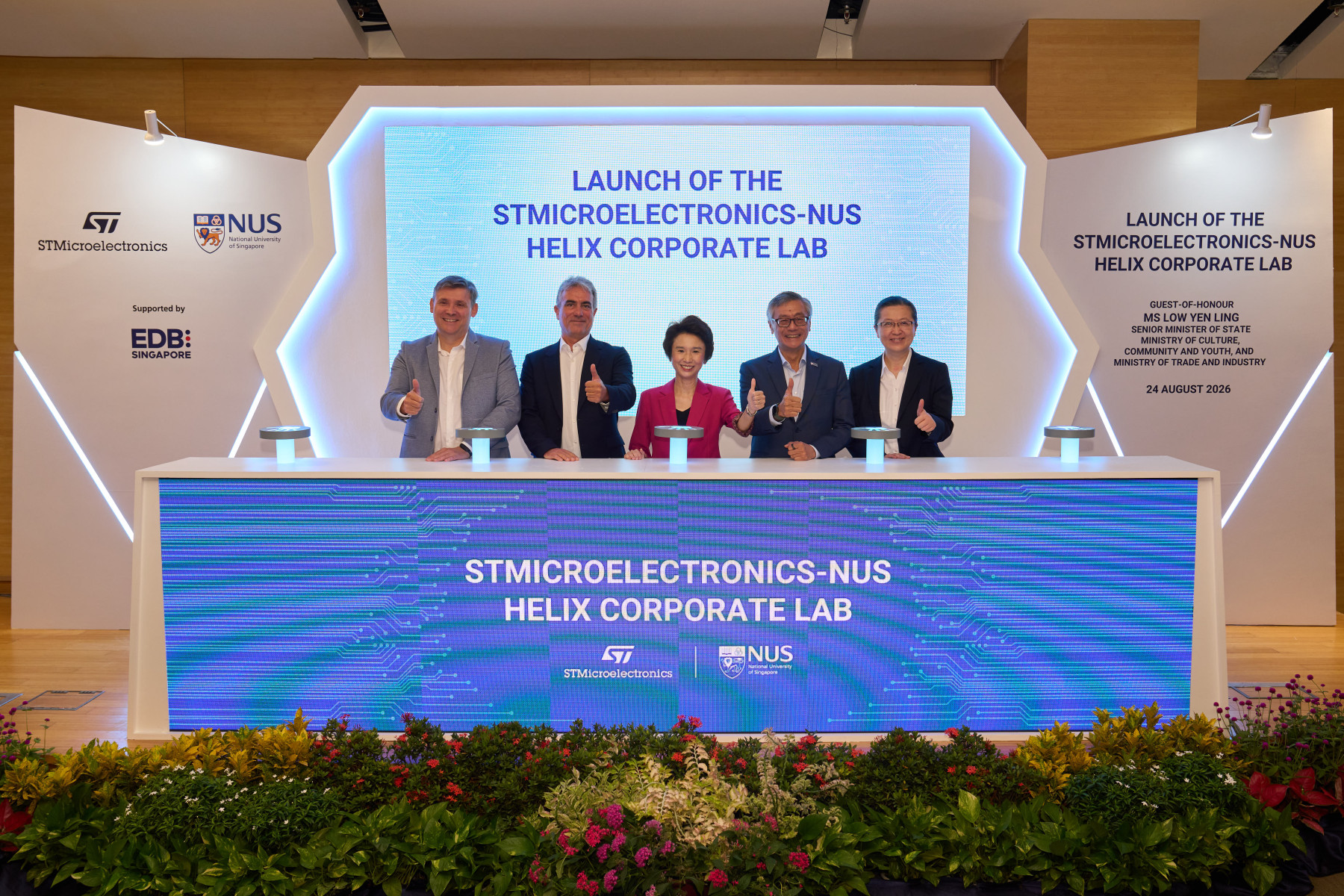
STMicroelectronics N.V. ("ST") (NYSE: STM), a global semiconductor leader serving customers across the spectrum of electronics applications, and the National University of Singapore (NUS) have officially launched the ST-NUS HELIX Corporate Lab, a four-year strategic research initiative focused on advancing the next generation of edge AI technologies. HELIX, which stands for Hardware for Embodied Low-power Intelligent Xcceleration, will enable new generative and embodied AI use cases at the edge through system-to-silicon innovation.
The Corporate Lab is supported under the Research, Innovation and Enterprise 2025 plan (RIE2025) and is hosted at the College of Design and Engineering and with participation from the School of Computing at NUS. The Corporate Lab brings together a multidisciplinary research ecosystem spanning AI algorithms, accelerator architectures, low-power memory systems, circuit design, silicon technologies, and application development. The programme will integrate NUS' pioneering research with ST's expertise in semiconductor technology, system development, and industry operations.
NUS President Professor Tan Eng Chye said: "The ST-NUS HELIX Corporate Lab is a testament to the value of industry-academia partnerships in translating research into innovation. By combining NUS' research strengths with STMicroelectronics' industrial capabilities, we are building not only advanced, cutting-edge edge AI hardware, but also the talent and ecosystem that will help define the future of Singapore's semiconductor and AI industries."
Laurent Malier, Executive Vice President, Global Technology R&D at STMicroelectronics, said: "ST's strength as an integrated device manufacturer lies in our ability to bring together advanced silicon technologies, embedded memory, circuit design, heterogeneous integration and chiplets. Through HELIX, we are creating an industrially relevant foundation to explore differentiated AI computing technologies and accelerate the translation of promising research into scalable semiconductor solutions."
The Corporate Lab was officially launched today by Ms Low Yen Ling, Senior Minister of State, Ministry of Culture, Community and Youth, and Ministry of Trade and Industry, as the Guest-of-Honour.
Building the future of edge
AI Edge AI processes data directly within or close to a device rather than relying exclusively on remote cloud infrastructure. This enables faster response times, stronger data privacy, improved energy efficiency, and greater resilience in environments with limited or intermittent connectivity. These capabilities are increasingly important for AI systems that must perceive, reason, and act in real time, in the real world - often described as Physical AI.
HELIX focuses on a key frontier within this space: embodied AI, where intelligence is built directly into a physical form - such as a robot, humanoid, or drone - combining multi-modal sensing, on-device computing, and real-time actuation. Delivering that intelligence efficiently, on compact and power-constrained hardware, is the challenge HELIX is built to address. Enabling these capabilities at the edge requires innovation across algorithms, software, system architecture, and hardware.
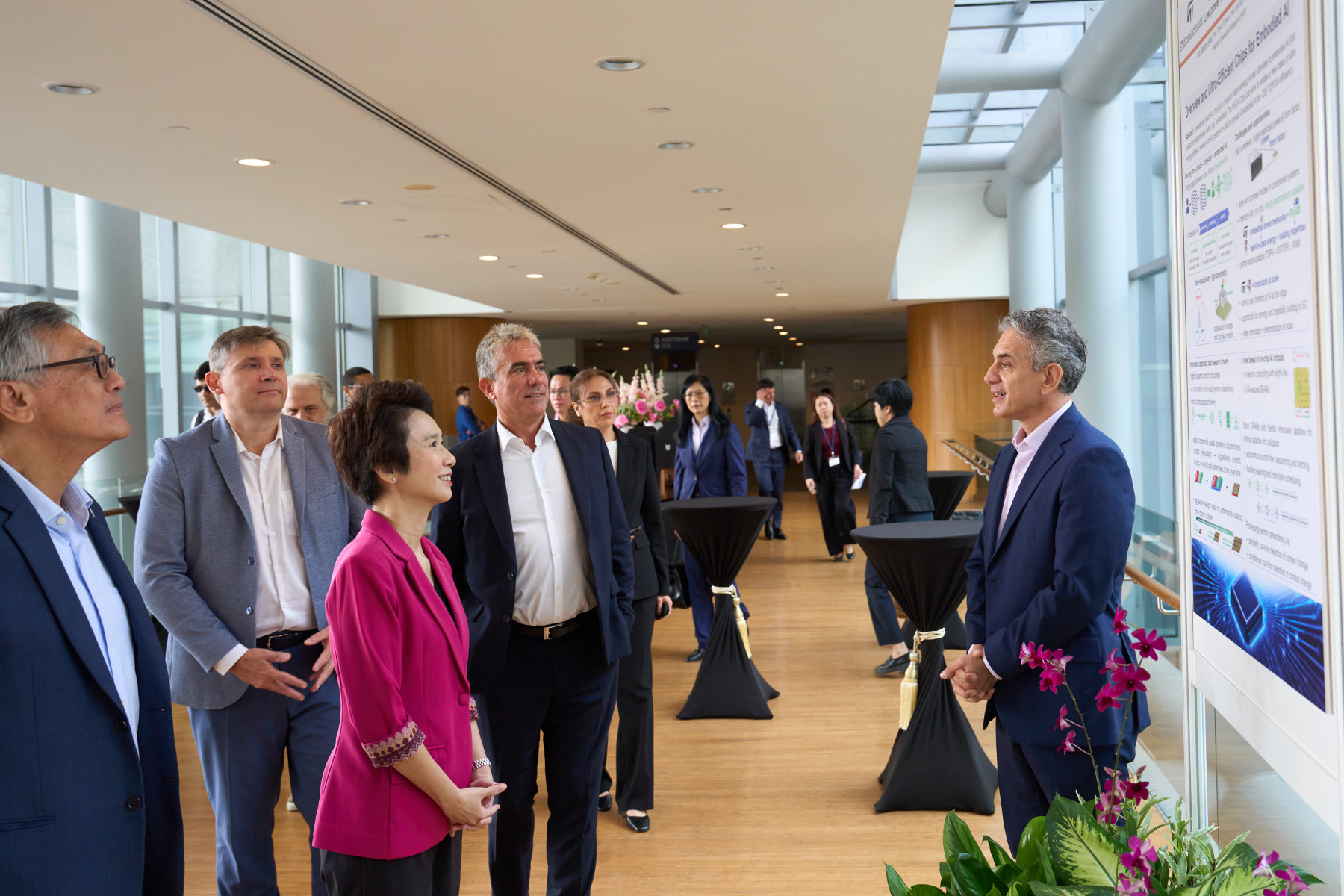
HELIX builds on ST's long-standing journey in AI and will help us explore new system-level solutions that combine efficient computing, advanced memory architecture, and application-driven design to address the requirements of future intelligent devices. Complementing ST's capabilities, NUS brings world-class expertise in integrated circuits, computer architecture, AI models, and system design. Under the partnership, researchers from NUS and STMicroelectronics will jointly work on research work packages, talent development, IP creation, and demonstration activities.
The research at HELIX will span the full technology stack, from AI models and system architecture to heterogeneous accelerators, on-chip memory hierarchies, circuit design, chip integration, and silicon implementation. It will focus on memory centric architecture, innovative in-memory computing, and scalable compute-and memory systems, supported by ST's P18 18nm Fully Depleted Silicon On Insulator (FD-SOI) technology and embedded Phase Change Memory (PCM). P18 FD-SOI enables ultra-low-power operation and adaptive body-biasing, while embedded PCM provides dense, non-volatile storage on the same die alongside the on-chip SRAM hierarchy. Together, these capabilities can reduce the off-chip data movement that dominates the energy consumption of memory-bound AI workloads.
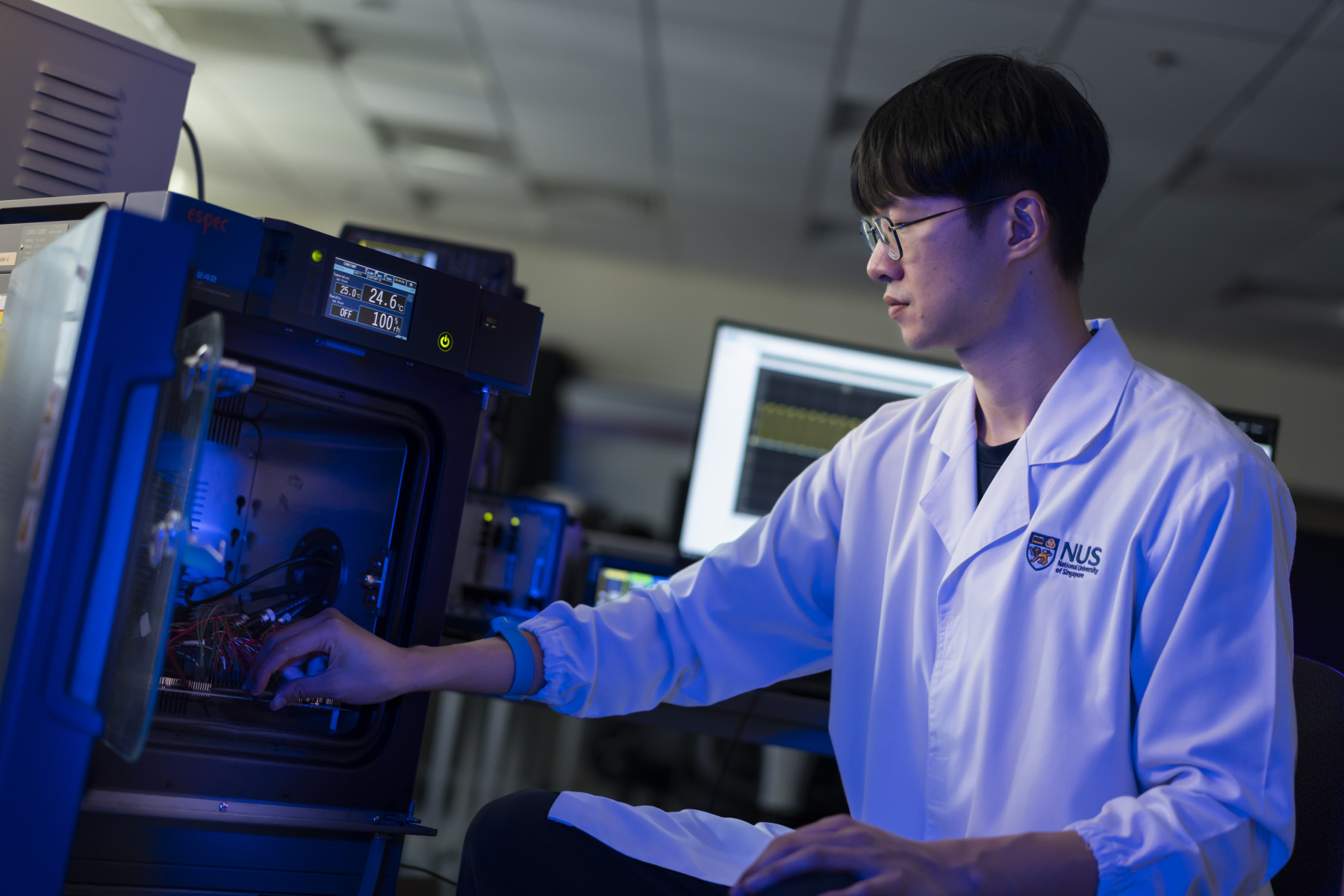
ST will make a substantial technology and engineering contribution to HELIX by providing NUS with a dedicated design chassis implemented in its proprietary P18 18nm FD-SOI technology. The platform will bring together ST's silicon, architecture, integration, and engineering capabilities to give researchers an industrial-grade foundation for developing, integrating, and validating new AI accelerator concepts. By eliminating the need to build the underlying infrastructure from the ground up, the design chassis will enable greater focus on differentiated innovation, accelerate system-level validation, and create a more direct path from technology pathfinding to industrialisation.
By combining advances across AI algorithms, accelerator architectures, memory systems, circuits, and semiconductor technologies, HELIX aims to address the energy-efficiency, memory-bandwidth, latency, scalability, and integration challenges associated with deploying increasingly capable AI systems at the edge.
Nurturing talent to drive Singapore's semiconductor ecosystem

The establishment of HELIX represents a strategic investment in Singapore's future competitiveness in edge AI and advanced semiconductor systems. By fostering industry-relevant R&D, HELIX will strengthen local capabilities and nurture a new generation of talent in AI systems and chip design.
Students, researchers, and professionals will have opportunities to participate in cutting-edge projects led by HELIX, gaining hands-on experience with the latest technologies, collaborating with industry leaders, and developing skills that meet the evolving needs of the sector. Through these initiatives, HELIX aims to build a robust talent pipeline and position Singapore as a global hub for innovation in edge AI and semiconductor technologies.