
Security and military forces affiliated with the Sudanese Armed Forces (SAF) have arbitrarily detained, tortured, and otherwise ill-treated civilians in areas under their control, and denied them due process rights, Human Rights Watch said today.
Security and army forces have detained civilians for allegedly collaborating with the Rapid Support Forces (RSF), in conflict with the military, particularly in areas over which the military has regained control, and often based merely on their ethnic identity, real or perceived political affiliation, or humanitarian work. Unlawful deprivation of liberty, ill-treatment, and torture of civilians may constitute war crimes and crimes against humanity.
"The Sudanese Armed Forces and its allies have led a campaign of fear and retaliation against people they label collaborators, because of their identity, humanitarian work, or political activity or simply for having lived under the Rapid Support Forces' control," said Mohamed Osman, Sudan researcher at Human Rights Watch. "Accounts by former detainees, their relatives, and lawyers paint a grim picture of arbitrary abuses emboldened by a climate of impunity."
The Sudanese military and affiliated forces have held detainees incommunicado, leaving families with limited information about, or access to, their loved ones, and in some cases forcibly disappeared people, Human Rights Watch found. Prosecutorial and judicial oversight is inadequate, and detainees have no or limited access to legal counsel. Human Rights Watch was told about at least two deaths from torture and ill-treatment in custody. The authorities are presumed responsible for deaths in custody, creating an obligation to conduct prompt, impartial, and effective investigations.
Human Rights Watch interviewed 28 people, including 7 former detainees, 9 relatives of detainees, 11 lawyers and activists, and a member of the security forces, between June 2025 and February 2026. They described abuses against men and women detained by the SAF and its affiliates in areas controlled by the army or that the army retook from the RSF since 2024, including Khartoum, Gezira, Gedaref, Red Sea, and Northern states.
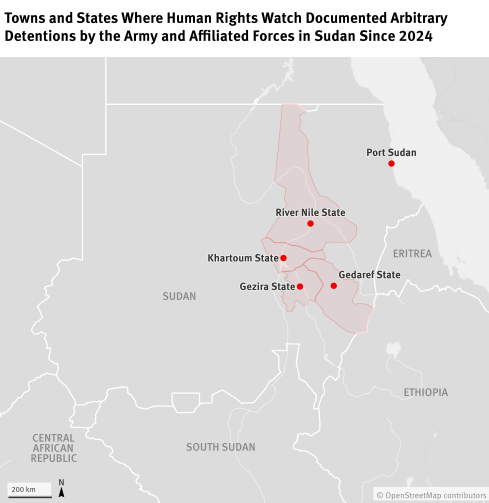
Human Rights Watch wrote to the office of the chairperson of the Transitional Sovereignty Council, and the Office of the Attorney General on March 18, 2026, about its findings. Both offices responded on April 2. In her response, the attorney general rejected the allegations of arbitrary arrests and custodial deaths with the exception of one case in which she acknowledged that criminal proceedings are ongoing but did not provide details on those accused.
While reports suggest that some of the abuse has been reduced, abusive detention persists with weak prosecutorial or judicial oversight.
Those interviewed said that multiple forces organized into so-called security cells have been involved in unlawful detentions. The security cells include the General Intelligence Service, Military Intelligence, and on occasion a military-affiliated militia, the al-Baraa Ibn Malik battalion.
A police officer who had been integrated into a security cell in Omdurman, part of Greater Khartoum, the capital, said that in April 2025, he saw his fellow cell members ill-treat a woman, accusing her of collaborating with the RSF: "We rode in three vehicles [to her house]. Two men from al-Baraa Ibn Malik battalion barged into her house, armed, and soon brought her out half naked, beating her, slapping [her] on the face, before throwing her in the back of one of our pick-up trucks."
Rights groups have also documented the detention of hundreds of women on charges of collaborating with the RSF based on their ethnicity or residence, with at least 25 sentenced to death. In January 2026, Abdel Fattah al-Burhan, the military leader, visited Omdurman's women's prison and ordered the release of 400 women, including some accused of collaboration, and instructed officials to review the status of detainees' case in prisons. However, lawyers and monitors said that many women remain in detention in Omdurman and other prisons without due process.
A 35-year-old woman and her two brothers fled to Port Sudan from Gezira state, which in late February 2024 was controlled by the RSF. Security cell officers in Port Sudan detained them, accusing them of being collaborators. "I was beaten everywhere, despite pleading that I have diabetes," the woman said. "They kept beating and slapping me with their hands and sticks and whips and insulting me. I felt so degraded, as if I was not a human anymore. They beat me until I involuntarily defecated on myself." The woman was released after a week, without charge, and fled the country.
Former detainees and lawyers said that security cells, as well as Military Intelligence acting alone, have unlawfully held people in military facilities, including military bases, as well as in homes converted into detention sites. The attorney general in her response denied both allegations, saying detainees are only held in police custody or prisons and subject to regular visits by public prosecutors to assess detention conditions in accordance with the law.
Among those recently arbitrarily detained is a 25-year-old man who was arrested by armed men, some in military uniform, at his home in early February 2026 and then forcibly disappeared: "They came into the house and started beating him badly, accusing him of being a collaborator," said his 40-year-old brother. "We asked where they are taking him, but they refused to say. One said: 'You better move on; your brother is not coming back.'" He said he believed his brother was detained because he took part in protests during the military coup in 2021. The last time the family saw the 25-year-old was in custody of the local security cell as they took him away, and as of March 9, despite multiple efforts to establish his situation and whereabouts, he remained forcibly disappeared.
The evidence indicates that the military has targeted individuals based on their identity, focusing on people from Darfur, western Sudan, whom they profile as collaborators since the RSF originates from Darfur. One detained man told Human Rights Watch that he and other Darfuris sheltering in Khartoum were beaten and detained by security cell members, who said: "You Darfuris are troublemakers; you brought the war to us here."
The military and affiliates have also appear to have targeted civil society members, including local aid responders, accusing them of collaboration. A responder working in east Khartoum said after the military regained control of the area in March 2025, security cell forces interrogated members of his volunteer group and forcefully evicted displaced civilians from their shelter. He said that in April, they detained him for 17 days, interrogating him about the soup kitchens the group ran and their funding sources. The attorney general denies such targeting.
The Office of the Attorney General, working with the judiciary, should immediately release all unlawfully detained people and grant independent monitors and investigators access to formal and informal detention sites. With April 15 marking three years since the conflict's outbreak, it is past time that authorities granted full and unfettered access to the country for the United Nations Independent International Fact-Finding Mission for the Sudan and the Joint Fact-Finding Mission on the Human Rights Situation in Sudan mandated by the African Commission on Human and Peoples' Rights. The attorney general has reasserted the position that there is no need for the Fact-Finding Mission as the office and local authorities are carrying out investigations and there is no need for any international investigative mechanisms.
International and regional actors and entities should publicly call on the military leadership and affiliated authorities to end their discriminatory targeting of communities and categories of people, including local volunteers, ensure that any legal proceedings are based on credible evidence, and strictly follow due process.
In late February, the United Kingdom, Ireland, Norway, Germany, and the Netherlands formed a Sudan atrocity prevention coalition. This body should take concrete steps to address the abusive detention practices, including ongoing arrests on the basis of ethnicity, humanitarian work, or political activism. They should support ongoing investigations and press for independent access to detention facilities, and support efforts to expand the jurisdiction of the International Criminal Court to cover the whole of Sudan.
"The authorities should end arbitrary detentions and provide redress to detainees and their families," Osman said. "International and regional actors should make clear to the Sudanese Armed Forces leadership that they will be held to account for these abuses."


