
Key Points
Information revealed about Renaissance drawing and inscription on rare copy of Dante's Commedia (1497) held by University of Sydney Library
The drawing was attributed to Renaissance artist Giorgione by an international team
X-ray fluorescence microscopy was used to reveal presence of metals in the drawing and inscription
The analytical power of non-destructive X-ray fluorescence microscopy (XFM) at the Australian Synchrotron has been highlighted in a book chapter in Giorgione, Dante and the Sydney Incunable* that features its use on an historic Renaissance work, Dante's Commedia.
Instrument scientist Dr Daryl Howard co-authored the chapter with Dr Paula Dredge (University of Melbourne), Analiese Treacy (Art Gallery of New South Wales), Julie Sommerfeldt (University of Sydney Library) and Kim Wilson (formerly University of Sydney Library).
The chapter features a case study based on research a copy of Dante Alighieri's Divine Comedy, published in 1497, that includes a red chalk was a drawing of a woman and baby, and an inscription in Italian that referred to the death of the artist on the last page.
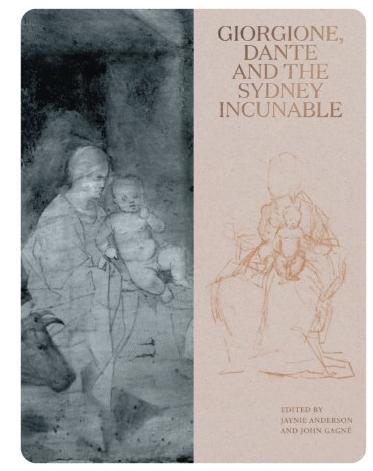
The drawing was attributed to the artist Giorgione Barbarelli of Castelfranco.
A librarian at the University of Sydney made the discovery of the drawing and inscription in 2017 in the rare volume held by the Library.
The inscription noted, "On the day of 17th September, Giorgione of Castelfranco, a very excellent artist, died of the plague in Venice at the age of 36 and he rests in peace."
"There were many questions about the drawing and the inscription," said Dr Howard.
The XFM beamline at the Australian Synchrotron has been used by those studying important cultural objects, such as paintings, as it can detect small amounts of metals that were used in paints, inks and paper.
In some cases, it has revealed paintings under paintings not visible to the human eye.
The red chalk used to do the drawing on the last page of the book was made of iron, the same elements found in paper and some other elements.
The investigation team used XFM because other analytical techniques used by conservators and experts were unable to distinguish the composition of the chalk drawing from the paper substrate.
The application of the technique increased the visual clarity of the original drawing, with only the marks made by the artist visible.
It determined the location of the elements and isolated them with false colour images.
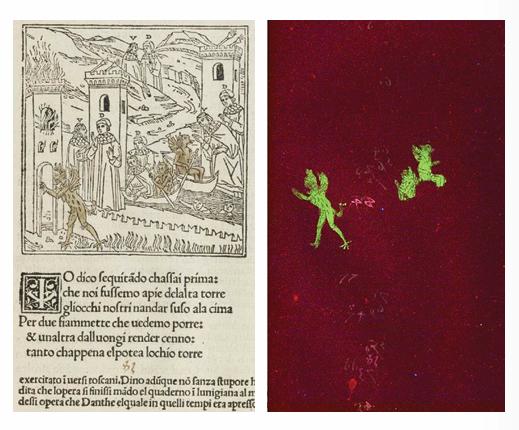
The make-up of the Iron gall ink used in the inscription was also analysed. Tannin based compounds used at the time, such as gall nuts with metallic salts, were mixed with a solvent, binder and other additives.
XFM could distinguish the metallic salts, sulfates of iron, copper or zinc, known as green blue or white vitriol.
It also identified that different inks were used throughout the book as the relative concentration of the elements varied significantly on different pages.
"Elements can provide information about authorship, document authentication and insights for conservation purposes," said Dr Howard.
The technique was also applied to identify a distinctive watermark depicting a cardinal's hat. Investigators found potassium on the watermark.
It also identified toxic arsenic and mercury around the outside of the pages.
The article authors suggested that in addition to their use as decorative colours for pages, the toxic pigments may have had the useful side effect of deterring pests such as silverfish, booklice, and powder beetles.
**Incunable refers to the very earliest form of printing books


