
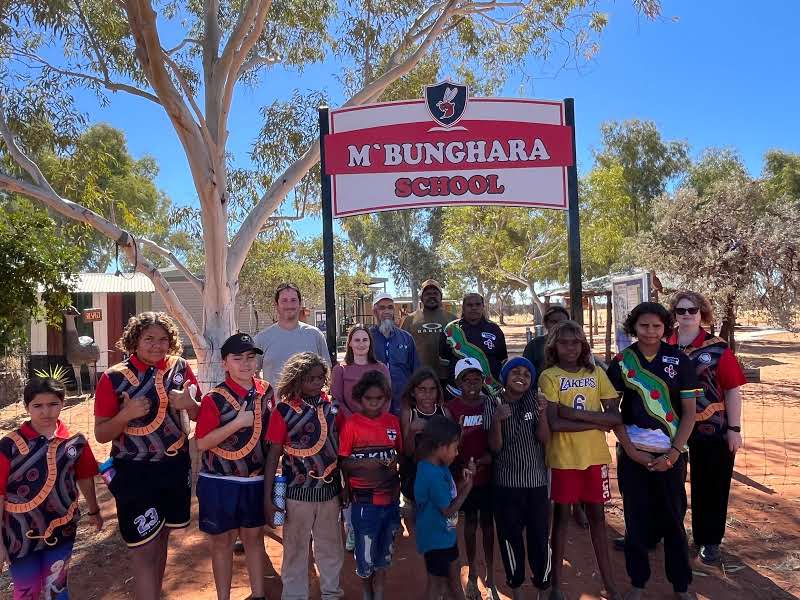
CSIRO scientists Kymberley Scroggie and Jim Harris visited the local M'Bunghara school in August 2025 - two thousand kilometres as the crow flies from their workplace in Melbourne on Bunurong Country, part of the Kulin Nation.
The visit was about more than a long trip north. It was about bringing hands-on science learning to students in a remote community, using simple materials and plenty of curiosity.
"M'Bunghara is a small, remote community," explained Kymberley.
"You've got the local's homes and the school. There is no general store and it's a five-hour round trip to Alice Springs to get bread or milk if you run out."
But the scientists weren't there with bread or milk. They were there to run science activities and experiments with the students at the school - designed to spark interest, build confidence and connect classroom learning to the real world.
"We wanted to fuel their curiosity and facilitate fun and positive experiences centred around science, technology, engineering and mathematics," Kymberley said.
Seeing the light

Kymberley and Jim ran hands-on activities and experiments on sound, friction, magnetism and light that aligned with the school's science curriculum. The activities also delved into the fascinating world of quantum.
One of the most familiar and easy ways to explore quantum science is light polarisation. It's a great starting point because it doesn't require a lab.
But first, what is light polarisation? The light around us is made up of waves that vibrate in every direction —up and down, left to right, or anywhere in between. This is unpolarised light.
When we add a polarising film, or filter, it only lets through waves that vibrate in one direction. This effect is useful for things like polarising sunglasses, for example, because they reduce glare. So next time you slide on your sunglasses, remember you're actually wearing a personal quantum device.
Kymberley explained the M'Bunghara students had the opportunity to polarise light themselves and see how it works through two different experiments.
"Our team at CSIRO designed the activities so that we didn't need to take any fancy scientific equipment on the trip with us," Kymberley said.
"Most of what's needed is available at supermarkets and hardware shops, and sheets of polarising film can easily be picked up online," she said.
"It means that the activities can be repeated later by teachers and students, even in a very remote setting."
The three-polarisation film experiment
Students worked through the following experiment:
Step 1: Hold up a sheet of polarising film and have a look around to see how it can reduce glare coming from different surfaces.
Step 2: Add a second sheet and rotate it around a bit in front of the first. When the two films are at right angles to each other, it's dark. This is because together they filter out both up/down and left/right waves.
Step 3: Insert a third polariser, oriented at 45 degrees, in between the two crossed films. It might be expected that no light would pass through three films, but in fact some light does.
This is a remarkable quantum effect, based on what's called superposition, where objects behave like they're in more than one place at the same time.
Here, polarised light can be thought of as not only made up of light vibrating in a particular direction, but also 45 degrees either side of it. So, light polarised at 45 degrees includes horizontal and vertical components as well.
In other words, there is an 'overlap' in the three films together but not with only the first two films.
The 'quantum measurement problem'
It's part of the magic of quantum - starting off with light polarised one way at the first sheet and polarised a different way by the last sheet.
The films effectively select what light gets through, which in quantum language is 'observing' or 'measuring' the polarisation.
Normally, looking at something doesn't alter it. But in the quantum world, measuring something fundamentally changes it. This is related to the ' quantum measurement problem'.
"The students were surprised by seeing the 'rules' change depending on what was placed in the path of the light," Kymberley said.
Sweet, sweet quantum

In the second activity, the students investigated how syrup can polarise light.
Step 1: Measure out equal parts sugar and water, pour them into a bottle, seal it up and shake it like crazy until all the sugar is dissolved.
Step 2: Look at what this syrup does to light. White light is made up of all the colours of the rainbow, and when light passes through sugar syrup, the constituent colours polarise differently.
Step 3: Pour the syrup into a beaker and place it on top of a light. Using two crossed polarisers (one above and one below the beaker), students were able to rotate the top polariser and see how different colours came through at different angles.
"This effect shows how white light is made up of different colours and also how they can be separated out using polarisation," Kymberley explained.
"It's also a reminder that 'invisible' properties of light can become visible with the right tools - even simple ones."
Communities learning together
Makhdoom Bhatti, M'Bunghara School Principal, said Kymberley and Jim's practical approach ensured that all students were actively involved and excited about science.
"It was amazing to see our students so enthusiastic and confident while exploring scientific ideas," Makhdoom said.
"We sincerely thank Kymberley and Jim for travelling all the way from Melbourne to support our students in this very remote Western Desert community. Their dedication and commitment to inspiring young scientists are greatly appreciated," he said.
"Local teacher aids and community leaders were very thankful as well and happy to see the kids engaged in science activities."
Students from the nearby Haasts Bluff community travelled to M'Bunghara to join in the fun and create more opportunities for sharing, teamwork and discovery.
In a similar visit, another team travelled to Ntaria school in September 2025, continuing CSIRO's work over more than a decade supporting science learning in the community. Ntaria (Hermannsburg) is also on Western Arrarnta Country.
Both Ntaria and M'Bunghara have been involved in CSIRO's STEM Professionals in Schools, a free national volunteer program that pairs teachers with STEM (science, technology, engineering, and maths) experts to provide engaging, real-world learning experiences for students.
"Engaging students in STEM activities builds their understanding of its impact and value to society. For young people, it can open doors to future study and careers they may not have imagined," Kymberley explained.
"Programs like this help show students that science can be part of their world wherever they live."
Watch a video of a researcher running STEM activities at Ntaria School.


