
Marianne Blake has lived in the same home for nearly half a century. She plays bridge regularly, drives to her hair appointments and, at 88 years old, enjoys her independence.
But her daughter who lives in a nearby neighborhood isn't quite as carefree when it comes to her mom's well-being: Patty Soulsby often worries about whether her mother is keeping up with her medication.
"Mom's pretty good about taking her morning pills, but sometimes she won't take them until 2 p.m. or not at all. The evening pills are the harder ones to remember to take," Soulsby said. "She forgets, then she says she doesn't feel good, it's a vicious circle."
Blake recognizes her memory is not what it once was, but she is convinced she has it under control.
"Ask me what I did yesterday and I couldn't tell you," Blake said. "But I feel I still have the mental capacity, I'm comfortable in my home and I feel I can keep on living here."
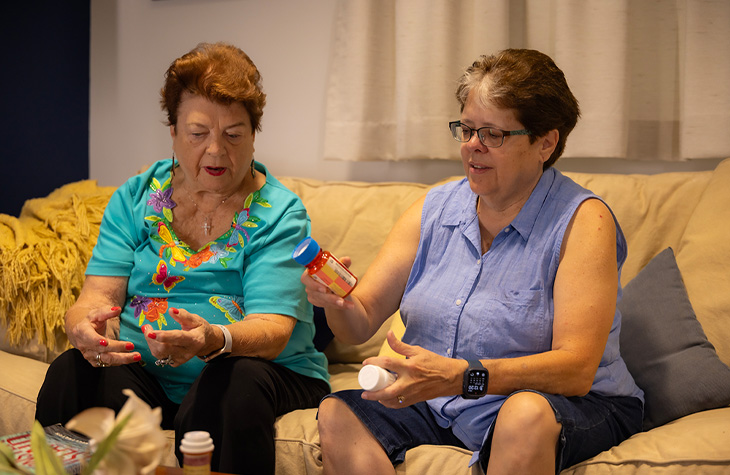
Researchers estimate that 4.3 million older Americans live alone and have memory and thinking problems, representing about a quarter of older adults with dementia or mild cognitive impairment. Researchers worry that these challenges can lead to a heightened risk of medication errors, which has been shown to increase the odds of being hospitalized by 71%.
For families like the Soulsbys, the constant uncertainty often revolves around a single question: Did Mom take her medication?
A new UC Davis Health clinical trial is testing whether leading-edge technology can provide the answers — and peace of mind.
Addressing one of dementia care's biggest challenges
Neuropsychologists Alyssa Weakley and Sarah Tomaszewski Farias want to learn whether an AI-assisted, home-based medication device can help people with mild cognitive impairment and dementia take their prescription drugs while reassuring caregivers that the medications were actually taken.
The study is funded by a $2.48 million grant from the National Institute on Aging (NIA) Phase II Small Business Innovation Research (SBIR) program.
Medication management is one of the most common challenges facing older adults with cognitive impairment. A national study found that more than 13% of older adults with dementia had difficulty managing medications.
Technology that goes beyond reminders
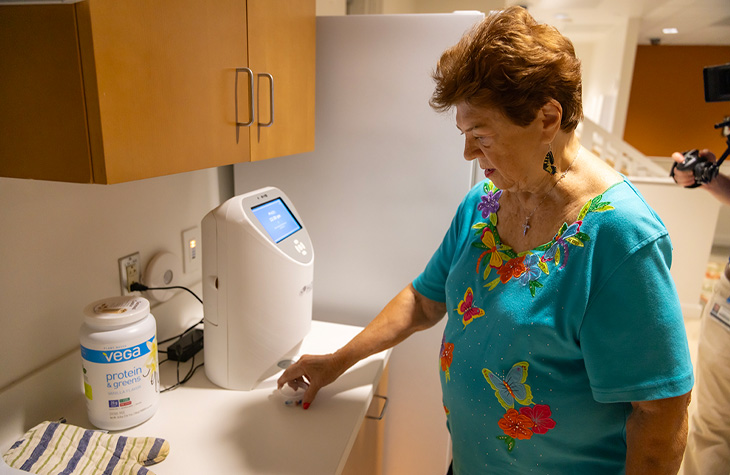
The device used in the study is roughly 17 inches high, sits on a countertop and fits easily beneath standard kitchen cabinets. It contains a 90-day supply of as many as seven different medications.
Created by HiDO Health, it goes beyond simple reminders or electronic pillboxes. It is designed to give the right medication at the right time, confirm who is taking it and record that it was taken, all while keeping approved caregivers informed.
Many low-tech medication tools already help people organize pills or remember when it's time to take them. Some sound alarms. Others, like the plastic pillbox Blake uses, only tell caregivers that medication has been removed.
But those systems may leave one critical question unanswered: Did the person actually take the medication?
The HiDO device is designed to close that gap.

"I feel like this is the biggest miss in health care. It's the last mile of care," said HiDO CEO Charles Gellman. "We don't know how many medication errors are happening in the home because no one's monitoring anything."
By giving approved caregivers a way to check medication use remotely, the system may reduce reminder calls, pillbox checks and worry about missed doses, while helping older adults remain independent.
For caregivers like Soulsby, who may live miles away, that information could reduce the daily uncertainty that often accompanies supporting a loved one with memory loss.
"If we can have a medication device deliver that medication and, as a caregiver, know it was taken at the right time, that's huge," Weakley said.
Why researchers want evidence, not marketing claims
The UC Davis trial will enroll 50 people with mild cognitive impairment, a condition associated with early changes in memory and thinking that can make some everyday tasks harder, to moderate dementia, which is when memory and thinking problems interfere with daily life and require more help from others.
Half will use the HiDO device along with training and support. The other half will continue their usual medication routine.
Researchers will follow participants for one year, measuring medication adherence, cognition and daily functioning. They will also collect blood samples to monitor health indicators for conditions treated with their medications such as cholesterol and glucose levels.
A UC Davis Health pharmacy team will carefully review the participants' medications as a safety measure before they begin the study.
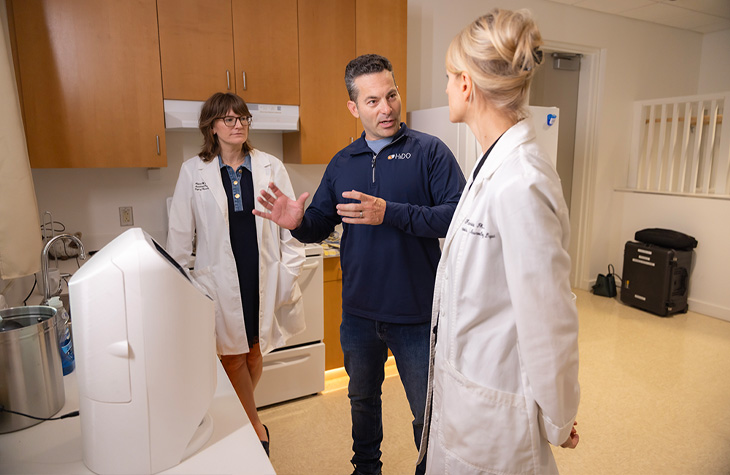
Rigorous testing is essential because consumers are increasingly being asked to trust technology without clear evidence that it works, said Tomaszewski Farias.
"There are a lot of devices out there to support lots of aspects of daily function or promote better cognition, but many are sold to the public with no evidence that they actually work," she added.
Peer-reviewed research shows early evidence that HiDO is practical, accurate and easy to use for people living with dementia and their caregivers. This study will help researchers determine not only whether the device helps people take medications as prescribed, but also which patients benefit most and how caregivers can be supported to use it most effectively.
Can the technology deliver?
For HiDO's Gellman, the study is about more than evaluating a single device. It is an opportunity to generate rigorous evidence about whether technology can help people with cognitive impairment manage medications and remain independent longer.
"I think a lot of people are definitely very skeptical of whether or not this actually works," Gellman said. "So, it'll be a very, very good, strong data source."
Gellman said the UC Davis team is uniquely positioned to evaluate whether the technology can make a measurable difference in the daily lives of people with cognitive impairment.
"Together, this research has the potential of demonstrating that these folks can actually use it over a long period of time," he said.
Helping older adults stay independent longer
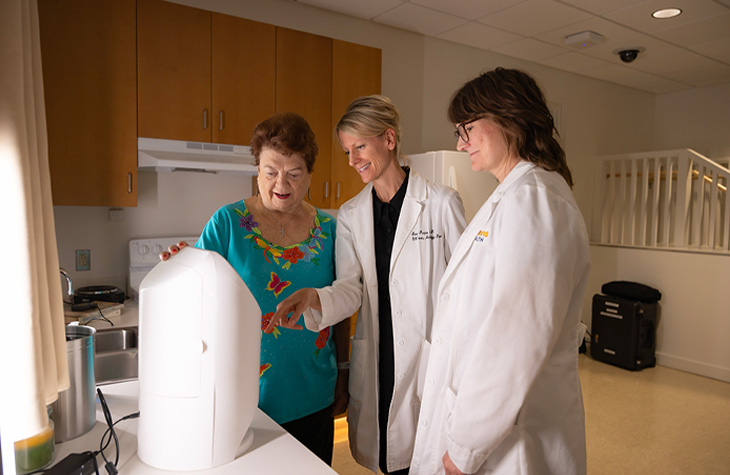
Weakley is excited about the study because her research focuses on people with cognitive impairment who live alone, and whose family members try to support them from a distance.
"This could help people with cognitive impairment remain more functional and even stay in their homes longer potentially," Tomaszewski Farias added.
For Soulsby, the hope is simple: She wants her mother to continue living where she feels most comfortable without constantly wondering whether she's taking her medication.
"Right now, I have to go over there at least once a week to fill her pill case, and that's really the only way I know whether she's taking her medication," Soulsby explained. "If I could know she was taking it without constantly checking, that would be a huge relief."
For the millions of families helping older adults navigate memory loss, the study may help answer an increasingly urgent question: Can technology provide enough support to preserve both independence and peace of mind?
From Labs to Lives
This work was supported by federal research funding, which helps transform promising discoveries into real-world breakthroughs that save lives and improve quality of life.
Learn more about how public investment in UC Davis research powers innovation, strengthens the economy and advances human health in From Labs to Lives.


