
The year 2026 presents itself as a year of deterioration in human rights, marked by the increase in militarism, the use of force, the erosion of international law, and the impact of connected crises such as climate change in contexts of armed conflict. However, despite this scenario, opportunities for peace also emerge. Based on the monitoring of armed conflict and peace processes around the world, the UAB School for a Culture of Peace (ECP) analyses 12 key contexts for 2026, combining criteria of international relevance with attention to less visible cases.
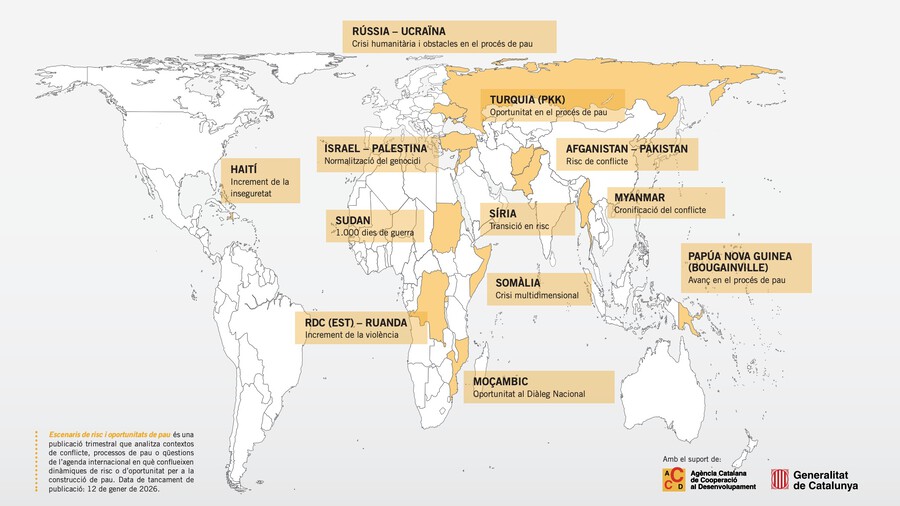
In a special edition of the publication "Escenaris de risc i oportunitats de pau", the ECP delves deeper into three contexts in which converging factors could lead to a positive transformation: the inclusive dialogue in Mozambique, the negotiations on the political status of the island of Bougainville in which the autonomous government and the authorities of Papua New Guinea participate, and the peace process involving Turkey, the Kurdish group PKK, and political parties in the country.
Risk scenarios in Africa include the situation in the Democratic Republic of the Congo (DRC), where the failure of U.S. mediation and growing regional involvement signal an escalation of the conflict; Somalia, where a set of dynamics could lead to the collapse of the federal government and the capture of the capital by the armed group al-Shabaab; and the risk of the war in Sudan worsening and the country's de facto partition, with devastating impacts on the population. In the Americas, the possible deepening of the crisis in Haiti stands out, due to factors such as the expansion of armed gangs and uncertainties surrounding the electoral cycle. In Asia and the Pacific, the focus is on the intensifying tension between Afghanistan and Pakistan, and the armed conflict in Myanmar, with a risk of prolonged violence and possible regionalisation. In Europe, attention is paid to the Russia-Ukraine war, particularly the challenges from a humanitarian perspective, and the obstacles in the negotiation process. Finally, in the Middle East, Israel-Palestine is analysed, and the risks that the Trump plan and other dynamics will accentuate the normalisation of genocide, apartheid, and the violation of international law are examined; as is the situation in Syria, where a set of security challenges and governance issues threaten the transition just over a year after al-Assad's overthrow.
Beyond the cases analysed in this publication, there are many other risk and deterioration scenarios in the international landscape for 2026 that will continue to require attention, such as the conflict in Western Sahel; the war in the Lake Chad region and the US involvement in this scenario; the crisis in Venezuela and the illegal armed intervention of the US; and the severe repression of protests in Iran and the uncertainties about the future of the regime. These and other risk scenarios, as well as possible opportunities for peace, will continue to be analysed in future ECP publications. Given the complex prospects for 2026, greater local, regional and international efforts are required to prevent violence, address crises, reduce major risks, strengthen inclusive negotiations and dialogues, support the humanitarian response, and support civil society organisations and actors working for human rights and peacebuilding.


