
On 23 and 24 April, the UAB will host the tenth edition of the international conference of the Botstiber Institute for Wildlife Fertility Control (BIWFC), organised in collaboration with the Faculty of Veterinary Medicine. At the inauguration of the event, UAB Rector Javier Lafuente spoke of his support for "dailogue between academic research, applied management and decision-making in the publci sphere, while contributing to solving complex global problems from an ethical, comprehensive and socially responsible perspective".
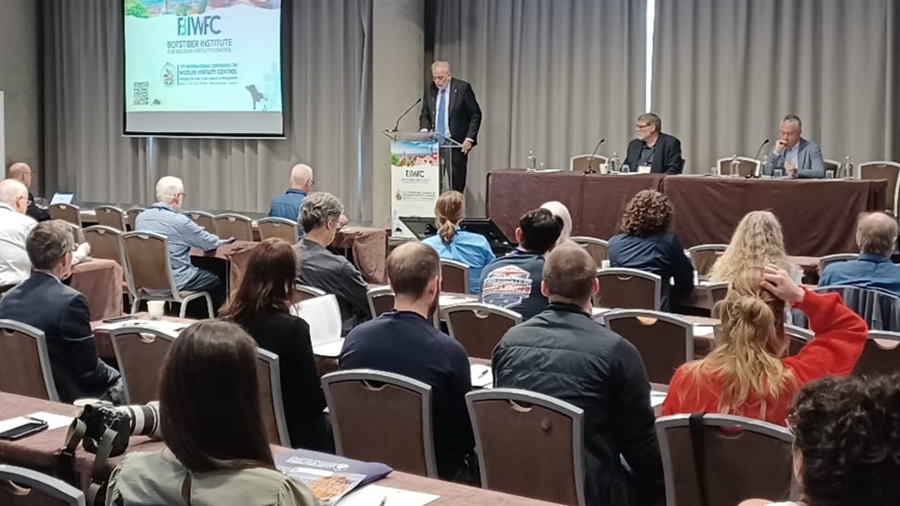
According to Rector Javier Lafuente, "this approach perfectly matches the will of our university", which he described as "eminently multi-disciplinary". In addition, the UAB "has led the introduction of the One Health strategy in our country and has been a leader in the training of professionals with an integrative knowledge of health from all its components: human, animal and environmental". The rector valued the fact that the organisation of this conference "consolidates the Faculty of Veterinary Medicine as an international reference space in research, knowledge transfer, and debate on the sustainable management of wildlife".
Josep Maria López Martín, deputy director general of Game, Hunting and Continental Fishing of the Government of Catalonia, also spoke at the inauguration, praising the outstanding scientific contribution of the Faculty of Veterinary Medicine and congratulating the UAB on hosting this event with the participation of speakers from all over the world and a multitude of contributions. Monique Principi officially handed over the reins to Derek Rosenfield as director general of the BIWFC and both thanked the work of the congress organisers and the participation of attendees, dedicating special words of gratitude to Manel López Béjar, dean of the Faculty of Veterinary Medicine.
Mitigating conflicts between humans and wildlife
The congress once again brings together the international scientific and professional community in this specialised field to provide continuity to previous international forums dedicated to the control of wildlife fertility and the role that these strategies can play in mitigating conflicts between humans and wildlife.
With the title "Bridging the Gap: From Science to Management", the meeting aims to bring scientific research closer to practical management on the ground. Professionals from various disciplines gather to share the latest advances in areas such as research and development of new strategies, improvement of existing methods, ongoing and completed field studies, identification and management systems, practical application case studies, the human dimension of wildlife management, stakeholder participation, scientific communication, and the social, regulatory and political challenges associated with this field.
The plenary session programme features the participation of four prominent international voices in the field of wildlife fertility control: Giovanna Massei, director of BIWFC in Europe and professor of Human Interactions with Wildlife at the University of York, United Kingdom, who will present the paper "Too many? Wildlife fertility control in the future". Jordan Hampton, senior professor of Veterinary Physiology at the School of Veterinary Medicine Harry Butler Institute of Murdoch University, Australia, who will give the conference "Navigating contemporary animal welfare expectations in wildlife fertility control". Cameron Kovach, head of programmes at The Wildlife Society (TWS), will give a presentation on "Transforming wildlife management: making space for new ideas". And John Boone, research director of the Great Basin Bird Observatory, United States, addressing the management of free-roaming cat populations with the session "Making the most of fertility control: Insights from free-roaming cat population management".
Attendance at the conference will allow participants to obtain up to 14.5 Category I continuing education credits (CEUs) within the Certified Wildlife Biologist title renewal and professional development programme, offered by The Wildlife Society, with the equivalence of one credit for each hour of training.
The fact that this conference is being held at the UAB consolidates the Faculty of Veterinary Medicine as an international reference space in research, knowledge transfer, and debate on the sustainable management of wildlife.


