By Joey Garcia, University Communications and Marketing
A special white paint developed at the University of South Florida could offer a new way to cool buildings, reduce energy consumption and lessen reliance on air conditioning.
Created in the lab of Distinguished University Professor Yogi Goswami, the innovative self-cooling paint is applied to roofs and reflects up to 98% of sunlight. It has been demonstrated to cool surfaces by up to 13.5 degrees below ambient air temperature during outdoor testing. By reducing the amount of heat buildings absorb, the technology could help lower cooling costs and energy use.
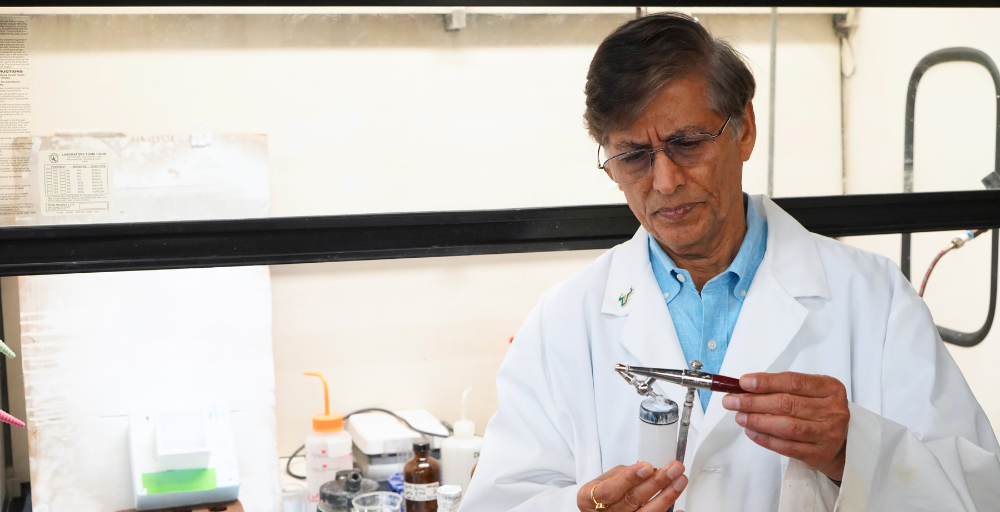
Climbing global temperatures and growing demand for energy-efficient cooling solutions inspired Goswami to invent the self-cooling paint. He noted that 25% of all energy used in the United States goes toward cooling buildings. At the same time, air conditioning is becoming more common in Europe, where it has not traditionally been the norm, while countries with large populations, such as India and China, are gaining greater access to cooling technologies.
It won't be difficult for this paint to reduce energy bills by 50%. That would be a huge win for energy use in this country and the world.
Yogi Goswami
USF Professor
How does self-cooling paint work?
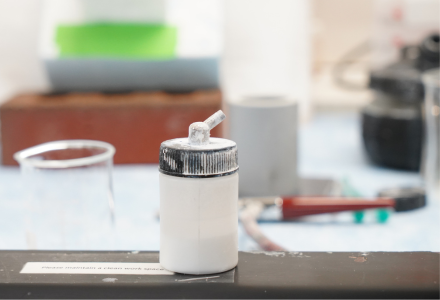

What makes the paint unique is its ability to use outer space's absolute zero temperature as a heat sink. Earth's atmosphere has a natural window that allows certain wavelengths of heat to pass through instead of becoming trapped near the surface. Goswami's team engineered the paint to release heat in those wavelengths, allowing it to escape toward outer space and helping surfaces stay cooler.
USF researchers take self-cooling paint from the lab to the field
The paint Goswami and his research team developed in his USF TECO Clean Energy Research Center is made from natural materials designed to reflect sunlight.
To evaluate its performance under real-world conditions, researchers conducted outdoor testing using three samples. Each sample consisted of thermal insulation at the base with aluminum foil on top. In one test, researchers applied the self-cooling paint over the foil, another had a commercial cool-roof paint and the third sample had bare foil.
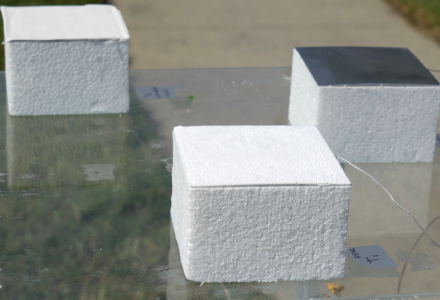
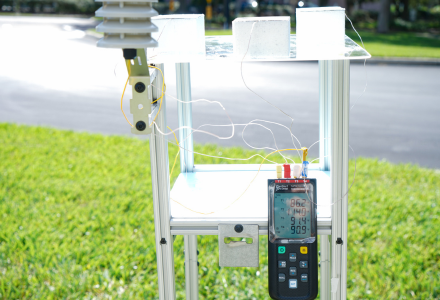
USF's self-cooling paint achieved the lowest temperatures during field testing
Thermometers attached to each sample recorded temperatures from 10 a.m. to 5 p.m. over a 28-day period in Tampa, Florida.
Previous external studies only tested the paint in an indoor controlled setting. That is not where you need cooling. Our paint has been proven to work in the field, and now that we have achieved success, we are working to make it commercially available.
Yogi Goswami
USF Professor
The results showed that the self-cooling paint consistently maintained temperatures below ambient air temperature, reaching a peak temperature reduction of 13.5 degrees during the outdoor testing period.
Unlike conventional cool-roof paints, which primarily reduce heat absorption, the technology demonstrated the ability to cool surfaces below the temperature of the surrounding air.
A CLEAR PATH TO COMMERCIALIZATION
With a provisional patent application protecting the technology, Goswami's lab is now working to develop a transparent protective coating that can be applied over the paint. This application is intended to help the product withstand environmental conditions, such as wind and rain, while preserving its cooling performance.

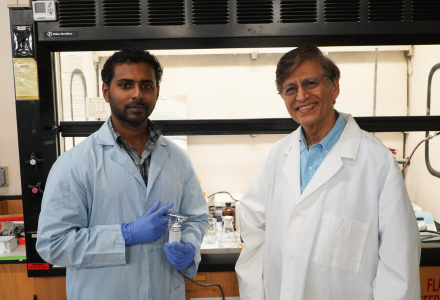
Yogi Goswami with members of the USF TECO Clean Energy Research Center
Goswami anticipates that commercial buildings will be among the first to adopt the innovation, followed by residential buildings. Its potential to reduce cooling costs and energy consumption could make the paint an important tool for improving building efficiency and addressing the growing demand for sustainable cooling solutions.