
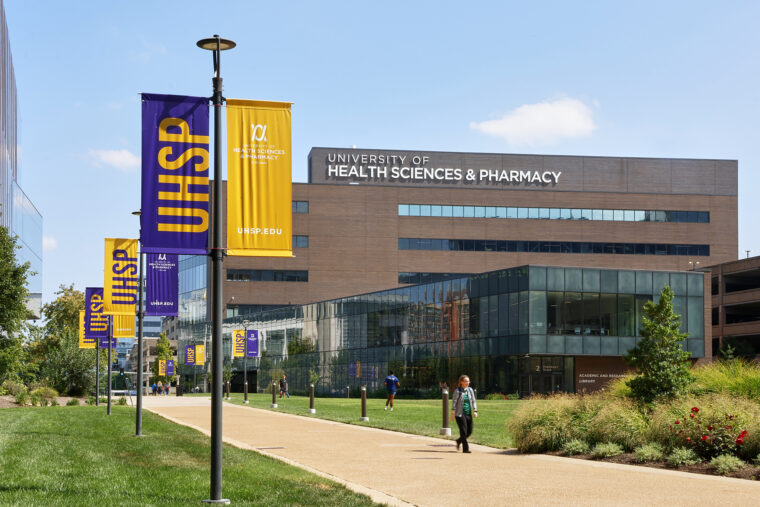
Washington University in St. Louis (WashU) and University of Health Sciences and Pharmacy (UHSP) today announced they have entered into an agreement whereby WashU will assume control of UHSP, ensuring the legacy of the 162-year-old institution and first college of pharmacy founded west of the Mississippi River. UHSP's central program, the Doctor of Pharmacy (PharmD), will become WashU's 10th academic school, to be known as WashU St. Louis College of Pharmacy. Other UHSP programs will continue through the end of the academic year in spring 2027, when some will transition to WashU. The agreement remains subject to regulatory approvals.
The move marks a significant milestone in the long-standing relationship between the two institutions and reflects WashU's continued investment in advancing health sciences education, research and clinical collaboration. It will enable WashU to expand its academic portfolio and strengthen interdisciplinary connections across medicine, public health and the life sciences.
"This moment reflects the best of who we are as an institution - thoughtful, mission-driven and committed to strengthening health sciences education for the long term," Chancellor Andrew D. Martin said. "By integrating UHSP's pharmacy program, we are building on a legacy of partnership and taking a forward-looking step to ensure that pharmacy education in St. Louis continues to thrive."
Bringing a pharmacy school into WashU represents a long-term academic investment aligned with WashU's mission and health sciences priorities, made possible by the university's strong financial foundation and bolstered by its long-standing affiliation with BJC HealthCare. Built on decades of collaboration between WashU and UHSP, transitioning the St. Louis College of Pharmacy to WashU reflects the evolution of a partnership that positions pharmacy education at the center of interdisciplinary discovery and impact.
"This acquisition builds upon the 162-year history of St. Louis College of Pharmacy," said Brian Seiz, president of University of Health Sciences and Pharmacy. "STLCOP was the first college of pharmacy to be founded west of the Mississippi River and through Washington University's stewardship, we believe students will continue to be on the forefront of pharmaceutical and pharmacy practice innovation, research and service to patients."
"At WashU Medicine, we often talk about the virtuous cycle of academic medicine, where research, education and clinical care strengthen one another in service of better health," said David H. Perlmutter, MD, executive vice chancellor for medical affairs and dean of WashU Medicine. "Integrating a pharmacy school deepens that cycle. Our long-standing collaborations with UHSP, including the Center for Clinical Pharmacology, have demonstrated how aligning our expertise advances discovery and patient care, and this next step builds on that strong foundation."
"The integration of a pharmacy school further deepens WashU's interdisciplinary approach to health and population sciences," said Sandro Galea, MD, DrPH, dean of WashU's School of Public Health. "Pharmacy plays a critical role in improving health outcomes, and this integration creates new opportunities to advance education, research and collaboration across medicine, public health and the life sciences."
Beyond its academic impact, the combination represents an investment in St. Louis and the broader region - strengthening the future of pharmacy education, supporting jobs and economic activity, and reinforcing St. Louis' role as a national center for bioscience innovation. As plans move forward, WashU and UHSP remain committed to a transparent and thoughtful transition, with ongoing engagement among students, faculty, staff, alumni and partners to ensure continuity, clarity and shared purpose.
Frequently Asked Questions
Why is WashU integrating UHSP's pharmacy and health sciences programs now?
Higher education and health care are evolving rapidly, particularly in pharmacy education. This integration allows UHSP to act proactively, preserving a strong pharmacy education legacy while positioning the PharmD program for long-term relevance, stability and growth within WashU's academic environment.
What UHSP programming will integrate with WashU?
UHSP's PharmD program will transition to WashU, subject to required regulatory approvals. Other UHSP programs will continue through the end of the academic year in spring 2027, when some will transition to WashU.
How does this integration benefit WashU?
Bringing a pharmacy school to WashU strengthens WashU's leadership across health sciences education, research and clinical collaboration. It expands interdisciplinary teaching and discovery across medicine, public health and the life sciences while advancing the university's long-term academic priorities.
How does this integration benefit UHSP?
The integration provides long-term stability for UHSP's PharmD program along with access to the resources of a leading research university. It preserves UHSP's legacy while extending its mission and impact on a larger, national and global platform.
How does this integration benefit the St. Louis region?
This integration strengthens St. Louis' role as a leader in health care and bioscience innovation. By uniting pharmacy education with WashU's research and clinical partnerships, the region benefits from a stronger workforce pipeline, expanded research collaboration, and greater capacity to address community and public health needs.
How will this affect current and prospective UHSP students?
UHSP's PharmD students will continue to receive the high-quality pharmacy education they expect, with additional opportunities available through WashU's research infrastructure and interdisciplinary programs. Current PharmD students who are on track to finish their program by spring 2027 will graduate from UHSP. Current PharmD students who expect to graduate after the spring 2027 semester will graduate from WashU. Individual transition pathways for students whose programs are not continuing will be communicated to support continuity and minimize disruption. All UHSP pre-pharmacy students who complete all prerequisites for admission to the PharmD program and meet UHSP's minimum admissions standards will be offered admission to the PharmD program by WashU should they apply.
What happens to UHSP faculty and staff?
WashU and UHSP are working together to develop clear, individualized transition plans for faculty and staff. Details will be shared directly as planning progresses, with a focus on transparency, respect and thoughtful implementation.
Will the UHSP campus remain open?
All USHP programs will continue on the UHSP campus through the end of the 2026-27 academic year. Following the transition, the PharmD program, as part of WashU, is expected to continue operating within its current facilities for the foreseeable future, subject to WashU's future campus planning oversight, just as its other schools and departments are.
How does this integration align with WashU's recent financial measures, including layoffs?
This integration reflects a long-term academic investment aligned with WashU's mission and strategic priorities, not a response to short-term financial actions. It builds on the university's financial strength and supports growth in a critical area of health sciences education.
What does this mean for the St. Louis region?
The integration strengthens St. Louis' position as a national hub for health-care education, bioscience research and innovation. It supports the regional workforce, advances pharmacy education in Missouri, and deepens connections across the city's academic and clinical institutions.
How will WashU keep stakeholders informed?
WashU is committed to ongoing, transparent communication throughout the transition process. Regular updates will be shared with students, faculty, staff, alumni and community partners as plans advance and approvals are secured.


