
Students from Wageningen University & Research, HZ University of Applied Sciences, and Scalda come together in Zeeland to rethink the future of local food.
Over four days in the small fishing town of Vlissingen, students gathered along the Zeeland coast to take part in the Coastal Food Hackathon. Bringing together participants from Wageningen University & Research, HZ University of Applied Sciences, and Scalda, with the support of the Delta Climate Center, the challenge focused on one central question: how can local food become an attractive and appealing part of the coastal experience for an international audience?
A region full of food, but not on the plate
Despite its rich agricultural and coastal landscape, Zeeland faces a disconnect between what is produced and what is consumed locally. Farmers, fishers, and hospitality businesses are willing to collaborate, but practical barriers such as logistics, time pressure, and seasonality often stand in the way.
"We export a lot, but we want more of our products to actually be eaten here," explains Jelle de Swart, one of the initiators of the challenge. The question is not only how to shorten the supply chain, but also how to make local food more visible and appealing, especially for visitors who are often unaware of the region's culinary offerings.
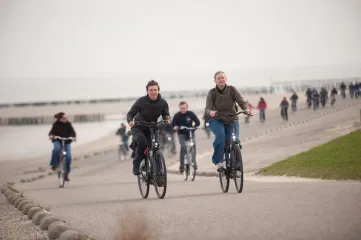
Participants exploring Zeeland by bike.
Different perspectives, one shared challenge
What made this hackathon stand out was the way students worked together across different educational backgrounds. Participants from a research university, a university of applied sciences, and vocational education were placed in the same teams, each contributing their own approach to problem-solving.
"I think you get better ideas when you bring different perspectives together, If you only work within one educational level, you often end up with similar outcomes"
- Jelle de Swart
- Co-initiator of the Coastal Food Hackathon
This difference became visible throughout the process. Some students focused on research and structure, while others brought in practical insights or questioned whether ideas would work in reality. One of the winning team members described it simply: "We filled each other in. One person came up with an idea, someone else challenged it, and another built on it. It just worked."
That collaboration was not always smooth, but it proved valuable. Having someone familiar with the local context also helped ground ideas. "Sometimes we would suggest something and then hear that farmers are not going to like this," the team explained. These moments helped sharpen the concepts and made them more realistic.
Outside of the working sessions, students also explored the region together. They visited local businesses, spoke with entrepreneurs, and experienced Zeeland beyond the workspace. These shared moments contributed to a strong sense of connection within teams, which was visible again during the final presentations.
Working with what the land offers
After four days of workshops, field visits, and intensive teamwork, the students presented their ideas during the final pitches. The winning concept, Zilt, Zeeuws & Zalig, was developed by Dries ten Have (WUR), Kyra Lockefeer (Scalda), and Sterre Streefland (WUR).
Their proposal approached the food system as one connected chain. It combines a local food hub, experimental saline agriculture, a test kitchen, and collaboration with education and hospitality. The idea is to create a system where production, learning, and consumption reinforce each other, while also making local food more accessible to both residents and visitors.
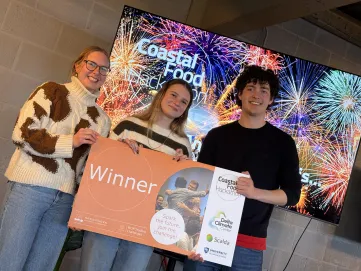
The winning team: Sterre Streefland (WUR), Kyra Lockefeer (Scalda), Dries ten Have (WUR). (Left to right)
At the core of the concept is a response to a growing challenge in the region. "Salinization is increasing, and it is not sustainable to keep fighting it forever," the team explained. "We have to find a way to use this land in a way that is useful in the future." By working with the conditions of the region rather than against them, their idea offers a long-term perspective for Zeeland.
More than one solution
The other teams explored the same challenge from different angles. Many focused on making local food more visible through experience. Ideas ranged from interactive food events and storytelling concepts to new ways of connecting producers with hospitality and tourism.
What stood out was not just the diversity of ideas, but the shared intention behind them. Each team worked on strengthening the relationship between people and local food, whether by making it easier to access, more engaging to experience, or more clearly connected to the region itself.
Rethinking how we solve problems
Beyond the concepts themselves, the hackathon highlighted a different way of learning and working. "When students work together and actually do something, they learn more and they remember it," says Jelle.
In Zeeland, the focus was on coastal food. At the same time, the process revealed something broader. Bringing together different ways of thinking does not slow things down. It creates stronger, more grounded ideas.
Rather than reinforcing differences between educational levels, the hackathon showed how they can complement each other. Each perspective played a role, and it was precisely that combination that made the outcomes stronger.


