
When Tony LaMark experienced sudden sweating and jaw pain at home, he trusted his instincts and called 911, a decision that helped save his life.
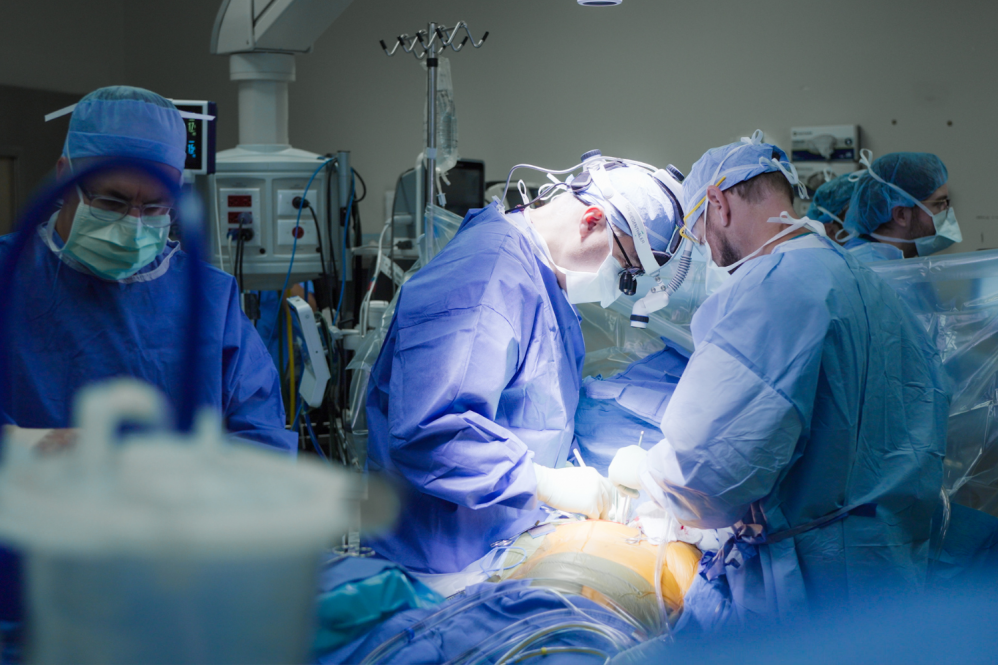
Dr. Michael Siegenthaler and team perform surgery. (UConn Health photo)
Tony LaMark was feeding his cats and talking on the phone with a friend when an ordinary day suddenly took a frightening turn.
After ending the call, LaMark walked over to his dining room table to organize some paperwork. Without warning, he became sweaty and clammy.
"It happened immediately," LaMark recalls. "I just knew something wasn't right."
At first, he wondered whether he was coming down with the flu. But as he walked to another room to check his blood pressure, he developed intense pain in his jaw. LaMark remembered learning years earlier that pain in the jaw, chest or arm could signal a serious heart problem.
That memory prompted him to call 911.
Emergency medical responders arrived at his home within minutes and transported him to UConn John Dempsey Hospital's Emergency Department. Tests revealed that LaMark was experiencing an aortic dissection, a life-threatening emergency caused by a tear in the inner layer of the aorta, the body's largest artery.
He needed surgery immediately.
"The aorta is normally about the size of a garden hose and carries high-pressure, oxygen-rich blood from the heart to the rest of the body," explains Dr. Michael Siegenthaler, cardiothoracic surgeon at UConn Health.
The wall of the aorta is made up of several layers. When a tear develops in its inner layer, blood can force its way between those layers and separate them.
"You can think of the wall as having layers similar to an onion skin," Siegenthaler says. "Once the innermost layer tears, the blood can shear those layers apart along the aorta."
The resulting separation can interfere with blood flow to the heart, brain, intestines and other vital organs. Depending on the location and extent of the dissection, it can cause a heart attack, stroke, organ damage or sudden death. When the portion of the aorta closest to the heart is involved, emergency open-heart surgery is generally needed.
"As soon as we see these patients in the emergency department, we go directly to the operating room," Siegenthaler says. "There is no time to wait."
LaMark arrived at UConn Health just as Siegenthaler was beginning his cardiac surgery practice there. He was called to the hospital that evening to perform the emergency operation.
LaMark became his first patient at UConn Health.
"Everything aligned," LaMark says. "Thank God he was there, because he saved my life."
The operation required stopping LaMark's heart temporarily and lowering his body temperature while the damaged portion of his aorta was repaired. Following surgery, he remained in the intensive care unit until Siegenthaler determined that he was ready to return home.
LaMark remembers Siegenthaler as compassionate, attentive and exceptionally thorough.
"He is such a wonderful person," LaMark says. "He is very kind and very detailed. From the time I was discharged, he made sure that everything was followed closely."
LaMark's recovery was complicated by the fact that he had undergone back surgery only three weeks before his aortic emergency. After spending time in the hospital and undergoing major heart surgery, he was surprised by how quickly he had lost strength.
"When I got home, I was incredibly weak," he says. "It was hard for me to walk, and I needed to use a walker."
Home nursing and therapy helped him begin rebuilding his strength. Siegenthaler and his team continued to monitor him closely through follow-up appointments and imaging, including MRI, CT and ultrasound examinations.
LaMark experienced additional setbacks that required two brief returns to the hospital. Despite those challenges, he continued to improve. Today, his aortic repair is doing well, and his follow-up visits have become less frequent.
Aortic dissection is not the same as an aortic aneurysm, although the two conditions can be related. An aneurysm occurs when an area of the aorta becomes enlarged or weakened. A dissection occurs when a tear develops within the artery's wall.
Some people with an enlarged aorta can be monitored and treated before a dissection occurs. However, many patients do not know their aorta is enlarged because it may not cause symptoms and is sometimes discovered incidentally during imaging for another condition.
High blood pressure is among the most common risk factors for aortic dissection, according to Siegenthaler. Certain inherited or genetic conditions can also weaken the aortic wall and increase a person's risk.
Symptoms can vary. Some people experience sudden, severe pain in the chest or back, but others may have less dramatic discomfort. Symptoms can also include shortness of breath, sweating, weakness, fainting, stroke-like symptoms or pain that travels to the neck or jaw.
Siegenthaler emphasizes that new or unexplained chest discomfort should never be ignored, even when it seems bearable.
"People often seek help when the pain is severe, but some patients have symptoms that are less intense and may be easier to dismiss," he says. "If you experience new chest pain or discomfort, it is important to have it evaluated."
Regular primary care visits, good blood pressure control and appropriate monitoring for those known to have an enlarged aorta can all help reduce risk. Patients diagnosed with an aortic aneurysm should be followed by a specialist who can determine how frequently imaging is needed and whether medical or surgical treatment is appropriate.
LaMark credits his survival to recognizing that his symptoms were unusual and seeking emergency care without delay. His jaw pain was the warning sign that convinced him not to wait.
"That was the trigger for me to call," he says. "I knew something was wrong."
LaMark hopes sharing his experience will encourage others to listen to their bodies and take unfamiliar symptoms seriously.
"If something doesn't feel right, get it checked," he says. "It's better to find out that it's nothing than to wait."
For Siegenthaler, LaMark's story demonstrates what can happen when a patient recognizes a warning sign, emergency responders act quickly and an experienced cardiac surgery team is ready.
For LaMark, it is much more personal.
"Dr. Siegenthaler saved my life," he says.


