Imagine sitting across from someone describing two movies to you. You listen attentively, trying to decide which one interests you more - but during that time, without noticing, your face already reveals what you prefer. You smile slightly when they smile, raise your eyebrows when they surprise you, tense your muscles when they emphasize something. This phenomenon is called facial mimicry - and it turns out to be a better predictor of your choice than anything else.
This is the central finding of a new study from the School of Psychological Sciences at Tel Aviv University, led by doctoral student Liron Amihai in the lab of Prof. Yaara Yeshurun (together with Elinor Sharvit and Hila Man), in collaboration with Prof. Yael Hanein of TAU's Fleischman Faculty of Engineering. The study was published in Communications Psychology.
Tracking the Smallest Facial Movements
The study was conducted with dozens of pairs in which one person described two different films to their partner, after which the participants had to choose which film they preferred to watch. Using unique technology, the research team was able to track micro-movements of the face that are not visible to the naked eye.
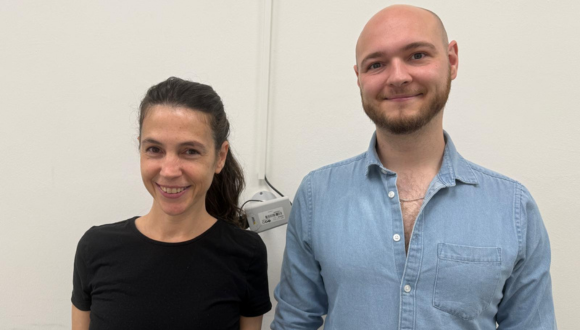
Research team - Left to right - Prof. Yaara Yeshurun & Liron Amihai
The findings showed that participants consistently preferred the option during which they showed more mimicry of the speaker's positive expressions . They did so even when they were explicitly instructed to choose according to their personal taste and not according to the speaker.
This finding is particularly interesting given that the listeners' own facial expressions (for example, how much they smiled in general) did not predict their choice, but rather the degree to which they mimicked the speaker.
Even Without Seeing a Face
In another phase of the experiment, participants listened to an actress reading the movie summaries using audio only, without any video. Even though they could not see her face, the researchers found that the participants mimicked her "smile in the voice" and this mimicry again predicted their choice.
The research team: "The study indicates that facial mimicry is not only a social mechanism that helps us connect with other people. It likely also serves as an 'internal signal' to the brain that is indexing agreement."
More Than Politeness
Liron Amihai explains: "The study showed that we are not just listening to a story - we are actually being 'swept' toward the speaker with our facial expressions' mimicry, and this muscular feedback might influence our decisions. This mimicry often happens automatically, and it can predict which option we will prefer long before we think about it in words. Facial mimicry, therefore, is not merely a polite gesture, but also a part of the decision-making system."
Liron concludes: "With the help of this technology and these findings, we may be able in the future to build systems that identify emotional preferences naturally - without asking a single question.
In conclusion, the study illustrates that decision-making is not only a matter of thought - but also of feeling, bodily response, and unconscious communication. Facial mimicry emerged as a significant predictor of our preferences. This is a meaningful step toward understanding how we choose, feel, and empathize with others, and it has many implications for the worlds of advertising, marketing, and decision-making processes."