
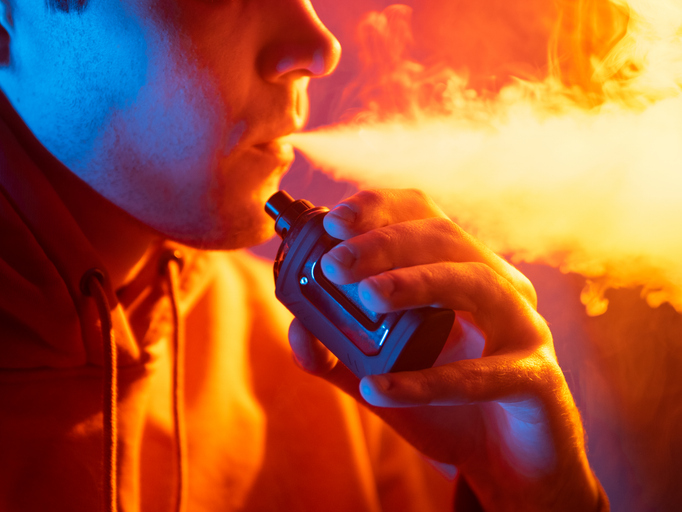
Vaping remains prevalent among Australian adolescents and young adults, despite increasing evidence of associated health risks and evolving regulatory restrictions.
While some youth acknowledge potential harms, many continue vaping, which raises serious questions about the role of uncertainty tolerance in their sustained use.
Flinders University researchers conducted a study to examine how young people perceive vaping-related health risks, experience uncertainty, and tolerate known and perceived harms.
"We need to understand how – and if – uncertainty about long-term health risks of NVPs is a factor among youth who vape, to measure the potential influence of messages to reduce vaping prevalence," says Dr Joshua Trigg, from Flinders University's College of Medicine and Public Health.

Vapes continue to be easily accessible from peers and stores, regardless of recent regulations, with more than 13 million illegal vaping products seized since new Australian legislation was imposed in 2025.
To better understand the motivations of young people who vape, Flinders researchers conducted seven online semi-structured focus groups comprising a mix of people who vaped, who smoked tobacco, those who did both, and those who neither vaped nor smoked - all aged between 16 and 26 years.
Discussions examined perceptions of vaping-related health risks, exposure to public health messaging, and tolerance of uncertainty combined with their views on health risks.
Participants rarely considered health risks unless prompted, and they described vaping as normalised and socially embedded, also noting high product accessibility.
Participants discounted prevention messages, citing low personal relevance and limited credibility. Many framed warnings on health harms as distant or hypothetical, which enabling their continued use of vapes. Their uncertainty about long-term consequences of health damage was not only tolerated but often used as evidence to justify their risk-taking to continue vaping.
"Australian youths navigate vaping by rationalising and deferring their engagement with risk," says Dr Trigg. "Uncertainty tolerance plays a role in continued vaping, particularly in the absence of visible harms - so prevention strategies should address this tolerance directly and use social and peer-based messaging to counteract their belief that vaping is normalised."
Findings from the study highlighted a need for tailored messages to disrupt youths downplaying the risks of vaping.
"People frequently downplayed potential harms, which allowed them to continue vaping without a sense of urgency or threat, particularly in the absence of visible health harms," says Dr Trigg.
"Vaping risks were often viewed as a distant possibility, and this ambiguity, in the context of mixed public messaging and low experience of harms, allowed them to think risks are minimal."
Social norms also shaped uncertainty tolerance, as participants rarely discussed health harms with peers and reported that messages from authorities are easily dismissed. In contrast, user-generated content was perceived as more credible, reinforcing the importance of promoting relatable messages.
"Views expressed by participants show that young people employ a variety of ways to avoid, minimise, discount and negotiate potential health risks of vaping - and these tactics allow them to tolerate any uncertainty they have about vaping risks."
The research – "In My Social Circle, We Don't Discuss Health risks": A Qualitative Study of the Role of Uncertainty in Adolescent and Young Adults' Perceptions of Nicotine Vaping Risks, by Joshua Trigg, Ella Vallelonga, Billie Bonevski, Svetlana Bogomolova, Kylie Morphett and Julia Morris - has been published by the journal Substance Use and Misuse. DOI: 10.1080/10826084.2026.2633227


