In much-needed good news for the environment, scientists have announced that the 2025 Antarctic ozone hole was relatively small and short-lived, confirming the long-term trend towards the recovery of Earth's protective shield against the sun.
The US National Oceanic and Atmospheric Administration and NASA said that the ozone hole was the fifth smallest since 1992, the year that the Montreal Protocol, a landmark international agreement to phase out ozone-depleting chemicals began to take effect.
The Copernicus Atmosphere Monitoring Service (CAMS) concurred that the 2025 Antarctic ozone hole came to an end on 1 December, marking the earliest closure since 2019. The 2025 ozone hole was also the smallest in five years.
Each year, the ozone hole season - during austral spring - is shaped by temperatures and winds in the stratosphere over the Southern Hemisphere and the presence of human emitted Ozone Depleting Substances (ODS).
During the height of this year's ozone depletion season from September 7 through October 13, the average extent of the 2025 ozone hole was about 7.23 million square miles (18.71 million square kilometers). That's about 30% smaller than the largest hole ever observed in 2006. The ozone hole is already breaking up nearly three weeks earlier than average over the past decade, according to NASA and NOAA.
"The scientific monitoring of this year's ozone hole confirm our predictions that the ozone layer is well on track to recovery thanks to the Montreal Protocol and its phase out of the vast majority of ozone depleting chemicals which were once used in refrigeration, air conditioning, firefighting foam and even hairspray," said Paolo Laj, Paolo Laj, Chief of WMO's Atmospheric and Environment Research Section.
"We are confident that the ozone layer will return to 1980s levels by the middle of this century, significantly reducing risks of skin cancer, cataracts, and ecosystem damage due to excessive UV exposure," said Paolo Laj, who represented WMO at the United Nations Environment Assembly in Nairobi 8-12 December.
Montreal Protocol
A dedicated Multilateral Environmental Agreements Day was held at UNEA, which is the big tent which gathers all environmental actors. The Montreal Protocol on Substances that Deplete the Ozone layer is widely regarded as the most successful ever environmental treaty. It was adopted on 16 September 1987 and is one of the rare treaties to achieve universal ratification.
WMO and the UN Environment Programme co-sponsor a quadrennial Scientific Assessment of Ozone Depletion, which assembles and assesses the best available scientific knowledge.
If current policies remain in place, the ozone layer is expected to recover to 1980 values (before the appearance of the ozone hole) by around 2066 over the Antarctic, by 2045 over the Arctic and by 2040 for the rest of the world, according to the most recent assessment in 2022 . The next assessment will be in 2026.
Since peaking around the year 2000, levels of ozone depleting substances in the Antarctic stratosphere have declined by about a third relative to pre-ozone-hole levels, according to Stephen Montzka, senior scientist with NOAA's Global Monitoring Laboratory .
"This year's hole would have been more than one million square miles larger if there was still as much chlorine in the stratosphere as there was 25 years ago," said NASA scientist Paul Newman.
Laurence Rouil, Director of the Copernicus Atmosphere Monitoring Service (CAMS ), commented: "The earlier closure and relatively small size of this year's ozone hole is a reassuring sign and reflects the steady year-on-year progress we are now observing in the recovery of the ozone layer thanks to the ODS ban. This progress should be celebrated as a timely reminder of what can be achieved when the international community works together to address global environmental challenges."
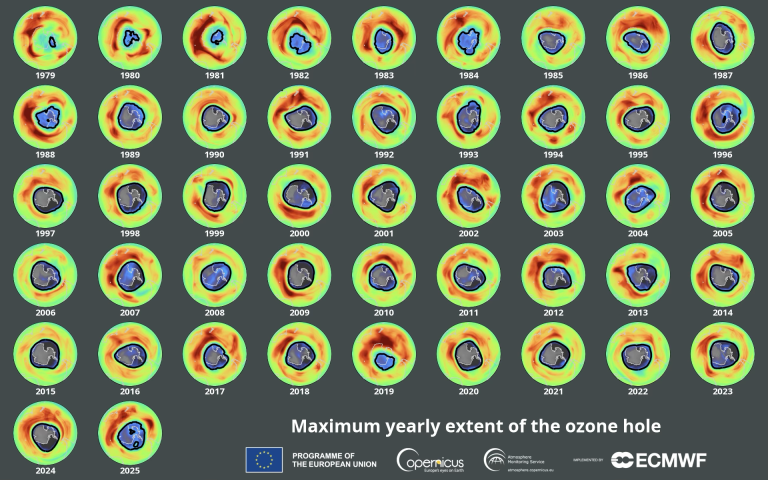
Copernicus Atmospheric Monitoring Services press release is here .
To get the latest status of the Antarctic ozone layer, visit NASA's ozone watch webpage.
WMO's Ozone Bulletin on the 2024 ozone layer is here
The UNEP Ozone Secretariat is here