
This coral spawning season, AIMS is all about scaling up. As part of the Pilot Deployments Program , we are trialling the techniques and technologies needed to do reef restoration at scale, alongside industry and research partners in the Reef Restoration and Adaptation Program.
Coral aquaculture is a key part of this effort, with the National Sea Simulator (SeaSim) alone raising over a million young corals and delivering them to the Great Barrier Reef. That's on top of our work in field trials and with industry partners!
This coral-rearing feat cannot be achieved with human power alone. Several technologies have been developed to automate and step up coral aquaculture efforts. We're very excited to see many of them making their debut at the SeaSim in 2025.
AutoSpawner
Think of it as...
An all-in-one maternity ward for corals.
What does it do?
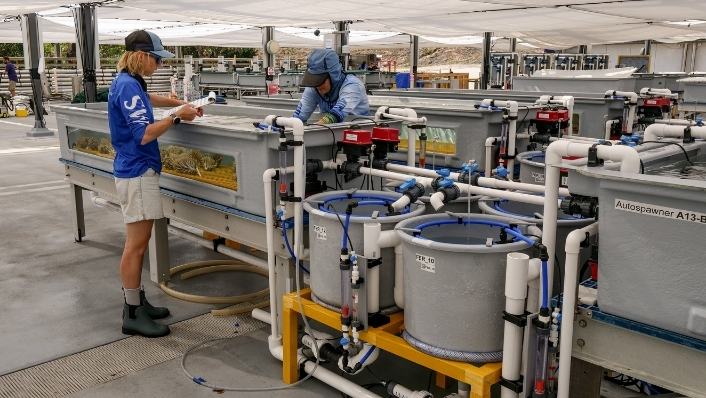
The AutoSpawner is a fully automated aquaria system, designed to harvest coral eggs and sperm from spawning corals, and produce fertilised eggs in large numbers with minimal human interference.
When corals in the Autospawner begin spawning, the egg and sperm bundles (gametes) are skimmed from the water's surface. These are collected in a fertilisation tank, where the bundles are broken up and mixed to ensure different eggs and sperm meet. The Autospawner can calculate the sperm concentration in the water, which determines the optimum time for the fertilisation process to run. The excess sperm is eventually washed off, leaving the fertilised eggs which will develop into larvae.
How does it boost our research?
On busy spawning nights, the Autospawner allows us to breed more corals with less human input, freeing scientists up for other important work. Comparisons with manual coral fertilisation methods found the Autospawner:
- Collected more gametes (egg and sperm) in a shorter amount of time.
- Had similar fertilisation success.
- Reduced labour costs between eight and 100-fold (depending on the coral species).
- Each Autospawner can produce 7 million or more fertilised eggs in a single night of spawning.
What stage are we at?
Last season the SeaSim had two Autospawners - we now have eight.
Who's behind it?
The AutoSpawner has been developed by an AIMS team led by Andrea Severati and Dr Mikaela Nordborg. The research is supported by the Reef Restoration and Adaptation Program , funded by the partnership between the Australian Government's Reef Trust and the Great Barrier Reef Foundation .
Coral Spawn and Larvae Imaging Camera System (CSLICS)
Think of it as...
The ultimate baby monitor for millions of coral larvae.
What does it do?
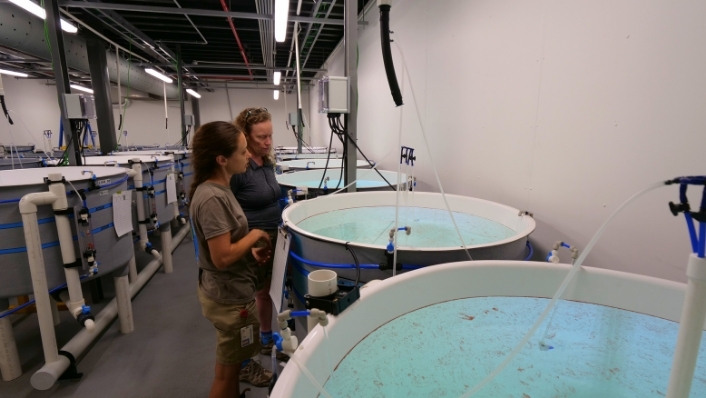
This system can estimate the number of free-floating coral larvae directly in their rearing tanks. These typically hold around half a million larvae.
CSLICS does this using computer vision, a type of AI that allows machines to interpret real-world images. A series of networked, computised cameras each use AI algorithms to continuously assess the number of larvae in each tank and feed data to a centralised computer server that synchronises the cameras, processes the data and displays the results. Humans can manage the cameras, lighting and other installations, and collect real-time data to monitor batches of larvae being reared.
How does it boost our research?
Coral larvae are highly sensitive and can suffer population crashes over just a few hours. They therefore need careful and regular monitoring.
Previously, this was done by taking a water sample from the tank and counting larvae by hand under the microscope. CSLICS therefore reduces labour and speeds up the monitoring process - giving us a better chance of catching problems early. More accurate counts will also help us evenly distribute corals across experiments, avoid over- or under-stocking, and give us far more fine-grained insights into how coral larvae react to, for example, different environmental conditions.
What stage are we at?
Twenty-four CSLICS tanks have been installed at the SeaSim, to be put through their paces in their first spawning season this year. A prototype desktop version of CSLICS is also being trialled, which will be useful for remote work in the field, as well as tasks such as stocking density and fertilisation assessment, and smaller experiments that don't require continuous monitoring.
Who's behind it?
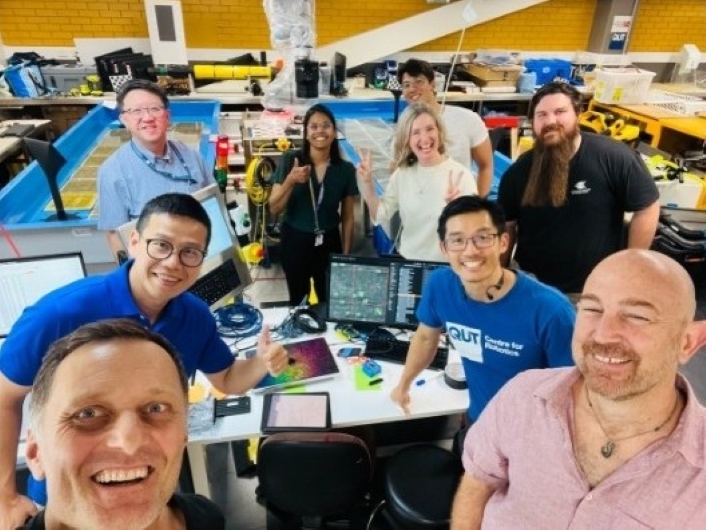
Both CSLICS and CGRAS (see below) have been developed by Dr Dorian Tsai and the Research Engineering Facilities Team at QUT, in collaboration with AIMS teams led by Andrea Severati and Dr Mikaela Nordborg. The work is developed by the Reef Restoration and Adaptation Program, funded by the partnership between the Australian Government's Reef Trust and the Great Barrier Reef Foundation.
Coral Growout Robotic Assessment System (CGRAS)
Think of it as...
If CSLICS is a baby monitor for coral larvae, CGRAS is childcare for baby corals.
What does it do?
A new camera system is needed once coral larvae abandon their free-floating lifestyle and settle on specially prepared tiles.
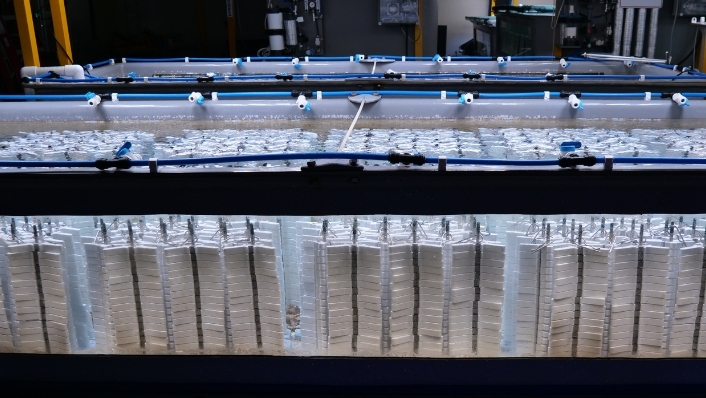
CGRAS uses a high-resolution submersible camera with a macroscopic lens - basically a waterproof microscope - mounted at the end of a robotic arm. This allows CGRAS to take consistent, repeated close-ups of the coral babies on their tiles, currently across two tanks holding 25 tiles each. It uses AI to automatically detect the tiny corals on their tiles, count them, and track their growth over time.
How does it boost our research?
Just as when they were larvae, these tiny young corals (initially about 1mm in diameter) need monitoring to make sure they are healthy. It takes roughly one hour for a human to count corals on a single tile. With the goal of eventually producing thousands of these tiles, the hours and labour costs required for a 12-week coral growout period become infeasible without automation technology.
Another benefit of collecting data via CGRAS is the ability to look in finer detail at the patterns between our rearing strategies and the performance of the baby corals, helping make decisions leading to higher survival rates.
What stage are we at?
After a few years of development and testing for the Reef Restoration and Adaptation Program, CGRAS is being employed full time at SeaSim for the first time this spawning season.
Radio Frequency Identification (RFID)
Think of it as...
An ID card for our baby corals on their journey to the Reef.
What does it do?
This year, we are using RFID to keep track of which corals are where, both in SeaSim and back on the Reef. RFID transmitters, each with a unique identifier, are scanned as the corals move from one stage to the next, digitally keeping tabs on their progress.
For example, each of the large tiles upon which larvae settle and grow into tiny polyps has an RFID chip. These tiles are broken into small squares and inserted into coral seeding devices. The devices are then slotted onto metal spikes called spigots for transportation, with 18 devices per spigot. It's a bit like a coral device kebab!
Each spigot also has an RFID transmitter so we can track our corals through transit, by road then boat, to specific reefs. Once the devices are deployed to the Reef, the same unique identifier is associated with GPS coordinates.
RFID is a quick and accurate way to track the coral parents used and coral recruits produced from the SeaSim and our industry partner facilities from their settlement tiles, through transit, and finally to their new home on the reef.
How does it boost our research?
During spawning season, AIMS staff run many different experiments involving different species of corals from different locations across the Great Barrier Reef. And yet all the coral devices look the same, and the corals are still very small. Without a failsafe ID system in place, things could quickly become confusing.
RFID is a quick and accurate way to do this, especially with the sheer number of devices heading back to the Reef this year.
What stage are we at?
Every coral device spigot heading to the Reef will be RFID enabled this year.
Who's behind it?
AIMS technology development team and coral reproduction and aquaculture team, in collaboration with QUT.
Deployment Guidance System (DGS)
Think of it as...
An AI-powered delivery service for baby corals, direct to the best reef locations.
What does it do?
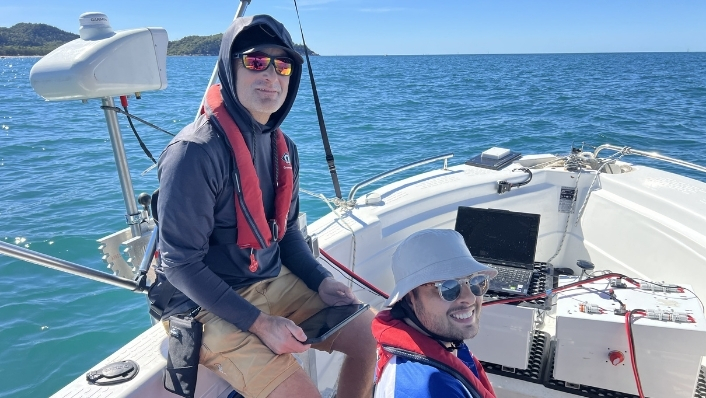
The only tech in this list that is fully ocean-based, the DGS combines the latest in marine robotics and AI. Capable of being used from a variety of vessels, it will place coral seeding devices across the Reef in locations where they are likely to grow to adulthood.
The system is not so much one technology as many brought together. It can pre-select promising sites using computer models based on research by reef ecologists as part of the Reef Restoration and Adaptation Program (RRAP) . Once on the water, cameras and real-time AI analysis can guide the deployment of devices. It will provide autonomous vessel guidance, and geotagging to help monitor devices later.
How does it boost our research?
The Great Barrier Reef is vast. While the DGS is not replacing human scientific knowledge, it can dramatically speed up the decision-making process for where to deploy young corals to give them the best chance of success. It will also automate device deployment (currently, devices are dropped over the side by hand) and could ultimately be used from autonomous surface vehicles, thus reaching ever more remote parts of the Reef.
What stage are we at?
The DGS has been undergoing on-water testing since earlier this year, looking at how it performs on different types of vessels and in different parts of the Reef.
Who's behind it?
The DGS has been developed by a collaboration between AIMS and QUT, led by AIMS project engineer Dr Ben Moshirian. The system was originally developed under the Translation to Deployment subprogram of the Reef Restoration and Management Program.


