
Key points
- Synthetic nitrogen fertiliser underpins the food supply of billions of people globally, yet Australia depends entirely on imports to meet its needs.
- Disruptions to global shipping and production have brought fertiliser supply chains into sharp focus for Australian grain farmers ahead of winter crop planting.
- Our researchers are developing ways to use nitrogen fertiliser more efficiently and lose less of it to the environment.
When lightning strikes a paddock, it does more than scorch grass and scare the cows.
The electrical discharge breaks apart nitrogen molecules in the atmosphere, converting them into a form that falls to earth in rain and becomes available to plants. It is a natural process, primordial and efficient, which has been fixing nitrogen into soils long before humans began to farm them.
For most of human history, we relied on it entirely. Then we learned how to do it ourselves.
The Haber–Bosch process, developed in the 1910s, combined atmospheric nitrogen with hydrogen under intense heat and pressure to produce ammonia – the basis of most synthetic fertilisers. Crop yields climbed, food production accelerated and today the process underpins grain production that feeds billions across the globe.
It is also, increasingly, a source of vulnerability for us all.
Australia's fertiliser comes from far away
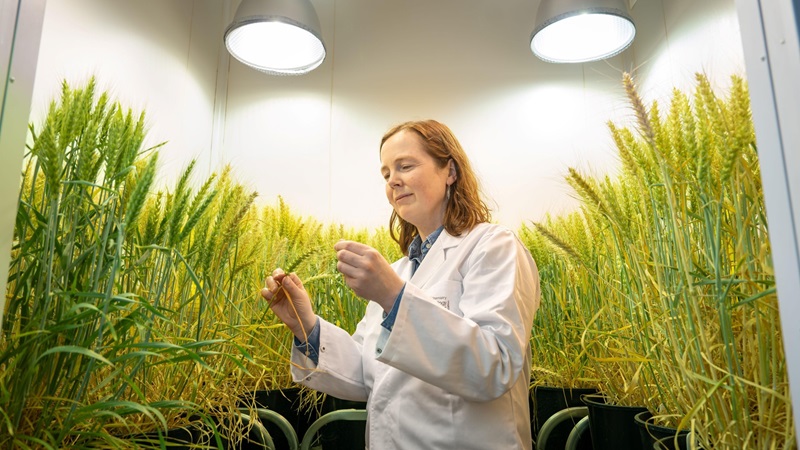
Dr Alison Bentley, Deputy Director of the Agriculture and Food research unit at CSIRO, Australia's national science agency, points out that all of Australia's synthetic nitrogen fertiliser arrives on a boat.
"Simultaneously, most of our grain leaves Australia on a boat as an export commodity. We are deeply embedded in global supply chains on both sides of the equation," said Dr Bentley.

Research by Javier Navarro, a Senior Research Scientist at CSIRO, shows just how concentrated that dependence has become.
"In 2025, 56 per cent of Australia's nitrogen fertiliser imports originated from the Middle East, up more than 20 per cent from 2011," Dr Navarro said. "We have since steadily shifted our sourcing away from domestic production, and that shift has real consequences when supply chains come under pressure."
When those supply chains are disrupted, the effects flow quickly to the farm gate and in turn to supermarket shelves. The Arab Spring, the war in Ukraine and more recent tensions in the Middle East have all triggered sharp price spikes.
"The world has stockpiles of emergency fuel," Dr Bentley said. "But nitrogen fertiliser doesn't store well – so unlike fuel, you can't simply build a reserve and draw on it in a crisis."
"The resulting restrictions have a very real effect for the season that is about to be planted – one that will be felt across winter crops, including cereals such as wheat, barley and oats and oilseeds like canola."
Why nitrogen matters so much to grain crops
Plants need nitrogen to build proteins, produce chlorophyll, and fuel the growth processes that ultimately generate grain. In its absence, yield and grain quality both fall. For wheat in particular, grain protein content determines milling quality and the price a farmer receives. It is directly tied to nitrogen availability through the growing season.
"Nitrogen has been really important for unlocking the ability to feed the number of people we now have on this planet," Dr Bentley said. "But we still have a conversion problem. We have to add a lot of nitrogen to get the required productivity out of our cereal crop plants."
The conversion problem
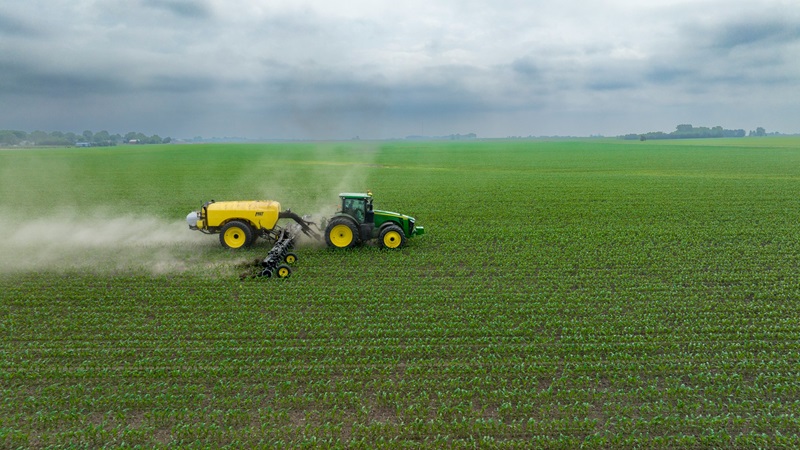
Around 100 teragrams of synthetic nitrogen is applied to agricultural land each year. Only 17 teragrams ends up in the food people eat. (One teragram is equivalent to one million metric tonnes.) The rest is lost.
For every dollar invested in nitrogen fertiliser, farmers effectively recover only 30 to 50 cents in harvestable product. What is lost can carry real environmental consequences It's true water availability limits how much can be applied in dryland cropping systems in Australia – but careful use is not the same as efficient use.
Organic fertilisers – derived from manure, compost and other natural sources – can supplement or partially replace synthetic nitrogen in some systems. But there is still the issue of scale – modern agriculture requires a great deal – and their nutrient content is far less concentrated and predictable.
Dr Navarro laid out the challenges producers face.
"Farmers must secure nitrogen fertiliser months before sowing, committing to quantities based on seasonal forecasts that are inherently imperfect. If a crop receives less rain than expected, it takes up less nitrogen than anticipated – and the remainder doesn't simply sit waiting."
Understanding the plant as a user of nitrogen
One of the most promising avenues in nitrogen research focuses not on how fertiliser is supplied to crops, but on how the plant itself uses it.
Agronomists have long worked on what are known as the Four Rs of nitrogen management: applying the right source, at the right rate, at the right time, in the right place. This framework has improved precision considerably.
However, supplying the plant with nitrogen is just half of the equation, Dr Bentley said.
"The plant is a user of nitrogen. It has a demand for nitrogen to fuel its growth and yield and productivity that changes throughout its lifecycle. That demand side is really where we have been focusing."
In research conducted in the United Kingdom prior to joining CSIRO, Dr Bentley and her colleagues uncovered significant variation in how different wheat and barley varieties take up and convert nitrogen – and that the grain itself provides important signals to the rest of the plant on how much nitrogen to take up. Some plants are far more efficient than others, creating a window of opportunity for plant breeders.
Keeping nitrogen where crops can use it
A second strand of research focuses on reducing the nitrogen lost from soil before the plant has even had a chance to access it. When fertiliser is applied to a paddock, microbial processes begin converting nitrogen from the form plants can use into forms that leach away or are emitted as gases. But some plant species have a way to naturally slow this down. Their roots produce compounds that keep nitrogen in a plant-available form for longer – a phenomenon known as biological nitrification inhibition (BNI).
"BNI is a natural property of plants," Dr Bentley said. "It was first described in a tropical forage grass, but it has since been shown that most of our important crop species can produce this phenomenon. It gives us a really interesting lever to pull: a way to reduce nitrogen losses that does not require additional chemical inputs."
CSIRO researchers are working to enhance BNI through breeding, selecting varieties that are better natural managers of the nitrogen around them.
Cold plasma and the seeds of an idea
Dr Bentley also revealed that CSIRO is working with an unexpected tool – one that takes its cue from the same natural phenomenon described at the opening of this piece.
When lightning discharges, the extreme energy creates a plasma state – a fourth state of matter beyond solid, liquid and gas – that breaks apart atmospheric nitrogen bonds and converts them into forms plants can use. Researchers have found a way to replicate this in the laboratory using cold plasma, which can interact with biological material without the destructive heat of a real strike.
Seeds are exposed to cold plasma before planting, with the aim of releasing nitrogen bound within the grain that would not otherwise be available to the emerging seedling. The goal is a targeted boost during the critical early weeks before root systems are developed enough to absorb fertiliser efficiently.
"We want to use it as a nitrogen burst to fuel the plant for the first couple of weeks when it is planted," Dr Bentley said. "That is the point where the plant does not yet have enough roots to stop nitrogen being lost from the field."
Breeding for efficiency, enhancing natural soil processes, developing new seed treatments: these are complementary approaches that, over time, could meaningfully reduce what farmers need to import.
A system in need of a longer view
Synthetic nitrogen will remain central to Australian grain production for the foreseeable future. But the research points toward a different way of thinking – one in which the plant is an active partner in managing nitrogen rather than a passive recipient of inputs.
"The tools to reduce our dependence on imported nitrogen will not be available overnight," Dr Bentley said. "They require sustained and coordinated investment in agricultural research and a long-term view of what our farming systems need. But the science tells us that less really can be more."
The current period of supply chain pressure is a reminder that fertiliser security and food security are not separate issues. Dr Bentley recalls a recent conversation with a journalist who said she had never known the price of bread had anything to do with fertiliser.
"Getting even that level of understanding, making that link visible, I think is really important."
Because understanding the link between conflict half a world way, fertiliser supplies and food prices, highlights the importance of work to reduce our reliance on important nitrogen.


