
The UConn chapter of the Alexander Hamilton Society was brought to campus this fall, bringing conversation about American foreign, economic and national security policy to Storrs
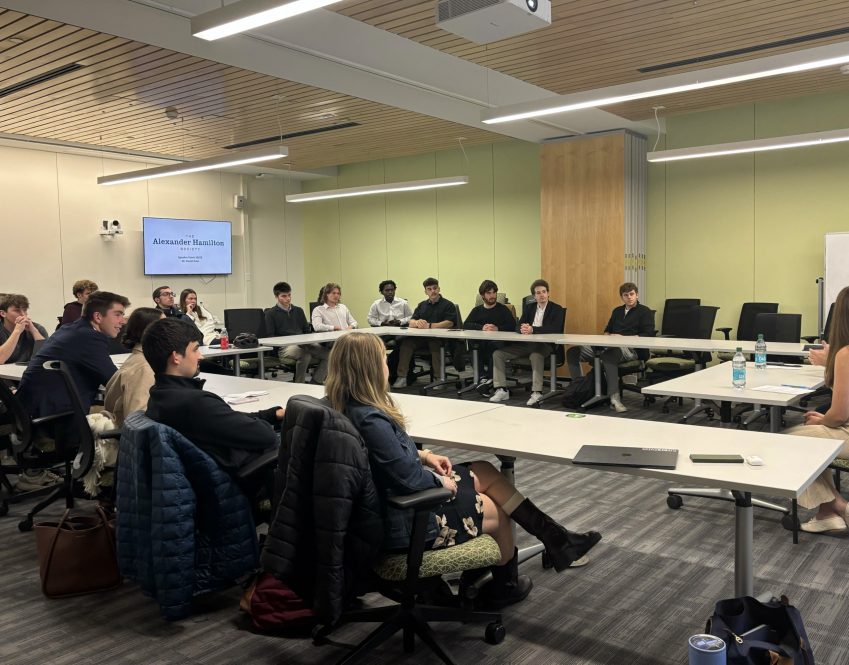
Members of the Alexander Hamilton Society listen to guest speaker Daniel Fata '94 at a meeting.
After a recent meeting of the newly formed Alexander Hamilton Society (AHS) at UConn, three members approached the chapter founder and president to tell her how happy they were that a club like this exists on campus. In that moment, Kate Czajkowski '26 (CLAS) saw her goal of creating opportunities for others come to fruition.
The Alexander Hamilton Society is a national organization dedicated to educating and launching students into careers in foreign policy and national security. Through a network of over 80 college chapters, its mission is spread through debates, group discussion, and professional events. Czajkowski founded UConn's chapter of the AHS to give students the opportunity to join an organization specifically dedicated to rational and informed discussion about foreign policy and international relations in general.
"I was motivated to create a space where people could discuss and debate foreign policy on campus. As we see on the news, foreign policy is something that we see in our everyday lives. It's something that we experience, no matter if we could feel the tangible effects of it or not," says Czajkowski.
International relations has piqued Czajkowski's interest since she was young.
"My high school had an exchange program in which we had students from all over the world come in to our high school for a year to interact with all of our programs. I made friends from Japan, Montenegro, Romania, so many of these different places, and became fascinated with how the world worked and how government worked on an international level," says Czajkowski.
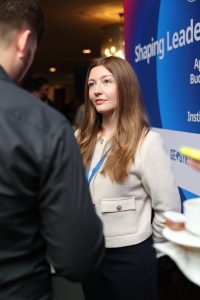
When she started college, Czajkowski took every opportunity she could to get involved in international relations. From living in the Global House Learning Community for two years to taking a plethora of world government and international classes, Czajkowski eventually earned a seat representing UConn at the University Scholars Leadership Symposium at the United Nations in Thailand, the NATO Youth Summit in Montenegro, and as a National Defense Fellow with the Alexander Hamilton Society in conjunction with the Ronald Reagan Institute.
"It's not every day that I'm able to meet somebody like the deputy secretary of NATO, or not every day that I'm able to meet a retired four-star general that still has influence in today's presidential administration," says Czajkowski. "It's nice to be treated like an adult who has opinions of their own, and who has goals that they want to achieve."
Though Czajkowski has worked towards many accomplishments in the international relations field, she understood how selective these opportunities are, and knew there was more that could be done.
"I knew there wasn't any organization on campus that was specifically dedicated to talking about foreign policy in general. It's one thing to watch policies get presented on the news, but it's another thing to talk about it with other people who are interested in the topic and want to discuss the possible repercussions not only to everyday people in America, but also the repercussions to America's prestige or presence on the global stage, and that's the atmosphere I wanted to bring here," says Czajkowski.
After learning about the Alexander Hamilton Society, Czajkowski and Carter Morton '27 (CLAS) collaborated to work with the University and the national organization to create a chapter at UConn.
"With the Alexander Hamilton Society, the idea that Kate and I had was to fill that international relations void on campus and provide a space for UConn students to have opportunities in international affairs," says Morton, who currently serves as vice president.
AHS campus programs are founded on three pillars: Host Distinguished Scholars and Practitioners; Lead Group Discussions on Key U.S. Foreign Policy Issues; and Organize Reading Series & War Games. Czajkowski and Morton attended an AHS leadership conference in the summer to meet other campus leaders and learn the best practices of organizing their chapter.
Czajkowski and the rest of the leadership board work to host weekly meetings and an optional additional reading group outside of its usual club meeting time.
At its weekly meetings, members of AHS have an open discussion about two new topics each week.
"As far as foreign policy goes, it often doesn't get discussed or it gets talked about in a way that it is uninformed. The Alexander Hamilton Society is a great opportunity to have informed discussions that specifically focus on foreign policy rather than it being a backdrop to the domestic," says Morton.
During meetings, everyone sits in a circle and has a discussion together. No one is at an elevated status, explains Czajkowski, which fosters respectful discussions about a wide breadth of topics.
In addition to its weekly meetings, AHS hosts an optional reading group outside of its usual club meeting time. This extra opportunity allows members to expand upon topics discussed during their weekly meetings while exploring texts that the national chapter sponsors.
"There are really tough topics that aren't actually tough to talk about. They just need a space to be worked out and to be discussed," says Czajkowski. "I wanted to create a club that doesn't only attract people who already have established, clear interests in these topics, but attracts everyone."
The club brings together students across various majors, including political science, accounting, mechanical engineering, computer science, history and philosophy.
"It's a very multidisciplinary club because we don't just talk about governments. We don't just talk about history. We talk about the technology that's fueling conflicts. We talk about the infrastructure that can prevent conflicts," says Czajkowski. "So, in some regards, there are many cases where these majors other than political science are not just great to have them there, but necessary in order to have a fair and balanced conversation."
In fulfillment with its first pillar, UConn's AHS hosted Daniel Fata '94 (CLAS) as their first distinguished speaker in October.
Fata's experience working in Congress, as deputy assistant secretary of defense for Europe and NATO, and as a vice president at the Cohen Group evinces his expertise in U.S. national security, government relations, strategic risk, European foreign policy, the global aerospace and defense industry, the industrial base supply chain, technology, and third-party advocacy campaigns, among other issues.
"It was cool to have him here, not only because of his clear expertise, but because he knows what it's like being a UConn student. He can speak to having a clear interest in college and building upon his education at UConn to do amazing things in the world," says Czajkowski.
The extracurricular opportunities that led Czajkowski to meeting eminent scholars and enhance her education inspired her to do the same for other UConn students.
"It's very important to me, as somebody who's struggled to find opportunities, to give other people opportunities, or at least lead them in a direction that they can benefit from," says Czajkowski. "I apply to anything and everything that even remotely relates to my interests, because it's difficult to find opportunities, especially for college students that go to school in rural areas. It's important to me to be somebody on campus that people can go to to ask for advice, just as I was able to ask my mentors for advice."
As Czajkowski continues to plan AHS meetings and guest speakers for the next semester, she is also preparing to represent UConn at the Reagan National Defense Forum (RNDF) in December.
"These are just wonderful opportunities to engage with esteemed leaders and recognized experts as a 20-year-old. Having access to these experts has been really empowering and has really motivated me to bring more experts to UConn so other people can learn," says Czajkowski.


