
If you're feeling fed up with the way things are in the world, then, no matter your politics, you are experiencing an emotion people have felt for millennia.
Author
- Konstantine Panegyres
Lecturer in Classics and Ancient History, The University of Western Australia
Perhaps you feel helpless. Maybe you feel like the character in the Roman dramatist Terence 's play The Brothers (160 BCE), who exclaims :
we're enclosed by so many things from which there's no escape: violence, poverty, injustice, loneliness, disgrace. What an age we live in!
What can you do? As we will see, ancient people had different ideas about how to act.
One popular option was to retreat - or try to retreat - from the world, renouncing involvement and avoiding society. A less common option was to try to sort things out in the world by yourself, as one person facing all its woes.
Heraclitus' escape
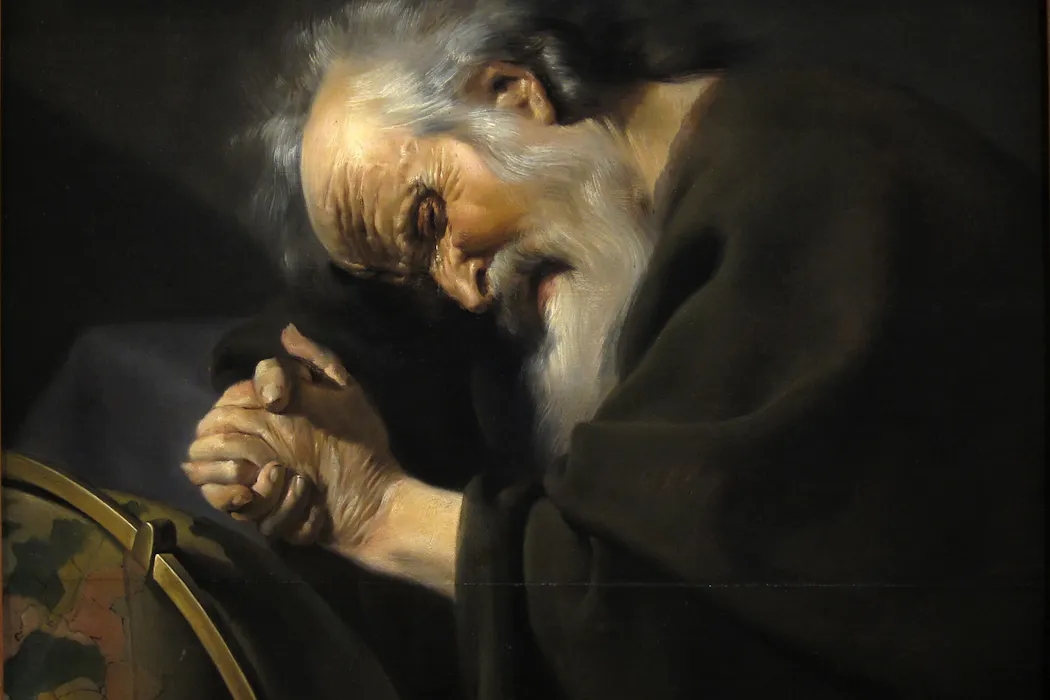
Heraclitus of Ephesus (c.540-480 BCE) is one of the most prominent Greek philosophers known for becoming disillusioned with worldly affairs.

His main gripe was with politics. He disliked the insolence and stupidity of politicians and the laws they created. He was also tired of the foolishness of the people, who didn't defend their laws and constitutions: "the people," he said , "must fight for the law as for city-walls".
When his friend Hermodorus was banished from Ephesus, Heraclitus condemned the city for elevating foolish men and destroying good men. As the historian Diogenes Laertius informs us , Heraclitus told the leaders of Ephesus that they were so worthless they should kill themselves:
The Ephesians would do well to end their lives, every grown man of them, and leave the city to beardless boys, for that they have driven out Hermodorus, the worthiest man among them, saying, "We will have none who is worthiest among us; or if there be any such, let him go elsewhere and consort with others."
When the people of Ephesus asked why an intelligent man like Heraclitus ignored politics and preferred instead to play games of knuckle-bones with children, he apparently said civil life was no longer worth an intelligent man's time:
Are you astonished? Is it not better to do this than to take part in your civil life?
Eventually, Heraclitus couldn't bear it any more. As Diogenes Laertius continues the story, Heraclitus "became a hater of his kind". He took to wandering in the mountains, living on grass and herbs, but "when this gave him dropsy, he made his way back to the city and put this riddle to the physicians, whether they were competent to create a drought after heavy rain". He then tried to cure himself by repairing to a cowshed and burying himself in manure.
Living his life in the mountains away from society, Heraclitus' health quickly deteriorated. He died soon after at the age of 60.
Sertorius' dream of escape
Quintus Sertorius (123-72 BCE) was a Roman statesman who distinguished himself by his rhetorical skill and his military victories as a commander against tribes in Gaul.
During the political unrest in Rome in the 90s BCE, Sertorius was sent to command the empire's Spanish provinces. While there, he became an enemy of the ruling faction at Rome and effectively established his own independent rule of Spain for eight years.

Sertorius' enemies at Rome sent armies to Spain to defeat him, but were unsuccessful in dislodging him. Sertorius set up his own senate of 300 members. This included a mix of Romans and members of Spanish tribes. He consolidated his popularity by appealing to local superstitions - he went everywhere accompanied by a white fawn, a symbol of divine power.
After years of threats and toil, Sertorius became sick of it all. According to the Greek historian Plutarch (c.46-119 CE), Sertorius met some sailors "who had recently come back from the Atlantic Islands". The sailors spoke of a land off the coast of Africa with a warm climate and plentiful food and water. Most importantly, it was far away from all the political and military turmoil.
Plutarch tells us that the words of the sailors made an impression:
When Sertorius heard this tale, he was seized with an amazing desire to dwell in the islands and live in quiet, freed from tyranny and wars that would never end.
Nobody today knows for sure what islands these sailors were referring to. Some possibilities are Madeira, Porto Santo or the Canary Islands.
Unfortunately for Sertorius, he never found his "escape". He endured many more years of political and social strife, until he was murdered by conspirators in 72 BCE.
Can happiness come from disengagement?
Many people living in ancient Greece and Rome appear to have recognised that happiness can come from removing oneself from worldly affairs. The Greek philosopher Epicurus (c.341-270 BCE) advised people to seek obscurity and avoid the world. His famous saying is two words: "live unknown".
Some disagreed, of course. Plutarch, for example, thought Epicurus' idea was a mark of defeat and a waste of the potential of living:
he who casts himself into the unknown state and wraps himself in darkness and buries his life in an empty tomb would appear to be aggrieved at his very birth and to renounce the effort of being.
Others, however, seemed to favour the idea that disappearing into a a quiet and hidden life, ignorant of the world's affairs, could bring happiness. The Roman poet Horace (65-8 BCE), for example, wrote :
Happy the man who, far from business concerns, works his ancestral acres with his oxen like the men of old, free from every kind of debt; he is not wakened, like a soldier, by the harsh bray of the bugle, and has no fear of the angry sea; he avoids both the city centre and the lofty doorways of powerful citizens.
For Horace, someone who is happy is far from cities and armies, living simply on his ancestral farm with animals and loved ones - with no debt.
Taking matters into your own hands
Some, of course, don't want to retreat from things. They want to solve problems and make the world around them better. But how can you do this if you're just an ordinary person?
The Athenian playwright Aristophanes (450-388 BCE) had a comical, tongue-in-cheek solution. In his play Acharnians, first performed in 425 BCE, he depicts a man called Dicaeopolis who is fed up with politics.
Dicaeopolis is not only tired of politicians lying and starting endless wars; he is also tired of people voting selfishly for handouts and for harmful policies. The people, he says , "can be bought and sold".
So Dicaeopolis comes up with a personal solution. He will "make a treaty with the Spartans for me alone and my children and the missus" so his family can live in peace .
His efforts are a triumph. He successfully negotiates the treaty and lives freely, enjoying privileges other citizens cannot, like farming, trading with other states and drinking.
The play is not meant to be taken seriously - it is a comedy, after all, and no private individual would really be able to negotiate a treaty with another city. But its plot reveals something about the political frustration ordinary citizens can often feel.
So what can you do if you are fed up with politics?
Two thousand years later, the options haven't improved much. The ancient advice is clear: you can withdraw, endure, or laugh. Preferably the last option. It seems to have the best survival rate.

Konstantine Panegyres does not work for, consult, own shares in or receive funding from any company or organisation that would benefit from this article, and has disclosed no relevant affiliations beyond their academic appointment.


