
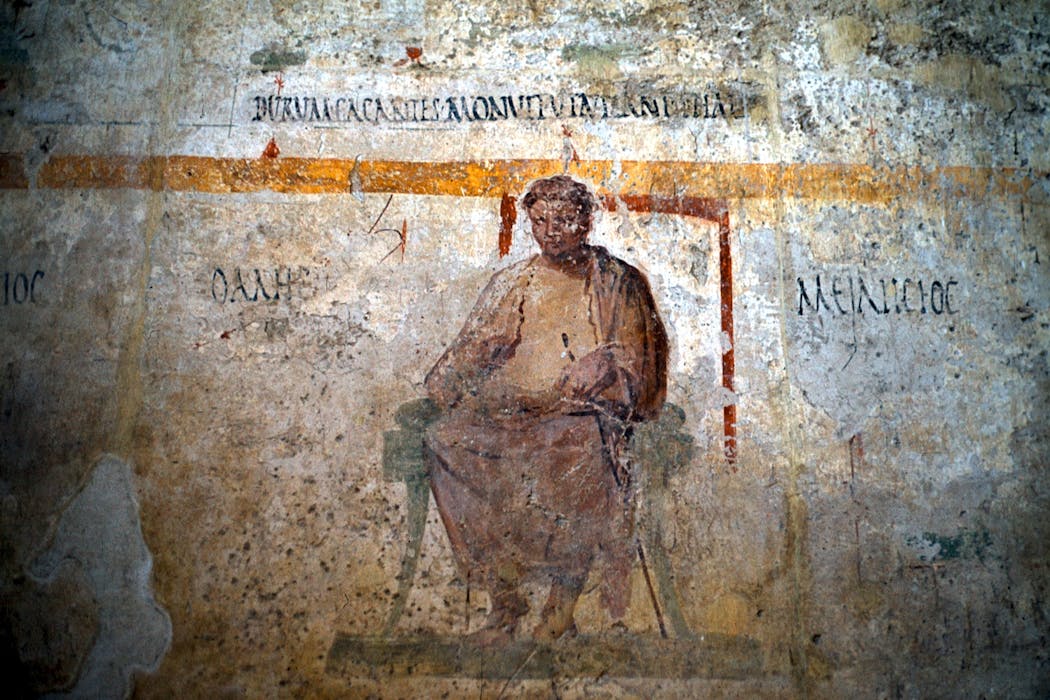
Ancient scientists can be easy to dismiss.
Author
- Jemima McPhee
PhD Candidate (Classics), Australian National University
Greek philosopher Thales of Miletus , often described as the West's first scientist, believed the whole Earth was suspended on water. Roman encyclopaedist Pliny the Elder recommended entrails, chicken brains, and mice cut in two as topical remedies for snakebite.
The lone ancient Greek thinker who believed Earth orbits the Sun - Aristarchus of Samos - was universally dismissed by his contemporaries.
Because these scientific beliefs are so different from our own, it may seem we have nothing to learn from long-dead scientists. However, thinkers 2,500 years ago already faced many problems that are today amplified by social media and artificial intelligence (AI), such as how to tell truth from fiction.
Here are five lessons from ancient Greek and Roman science that ring surprisingly true in the face of misinformation in the modern world.
1. Start with observations
Almost every ancient scientific text offers advice about observing or collecting data before making a decision. For example, in a 1st century CE text about astronomy, author Marcus Manilius explains that his scientific predecessors learned via detailed, long-term observations. He says
they observed the appearance of the whole night sky and watched every star return to its original place […] by doing this repeatedly, they built up their knowledge.
Ancient astronomers, Manilius says, would look around and gather evidence before drawing any conclusions. Greek and Roman scientists wanted their readers to do the same, and to be suspicious of any claims that are not backed up by data.
2. Think critically
Ancient scientists insisted their readers think critically, encouraging us to analyse the claims made by other people.
The Aetna is an anonymous text that explains how volcanoes work. Its unknown author warns readers about two potential sources of misinformation: other authors and other people.
Whether these groups intend to mislead their audiences or are simply misinformed, the book urges us to scrutinise their claims carefully and think about whether they are consistent with the evidence of our own senses and ratio (the Latin term for the powers of reasoning).
Ancient scientists encourage us to think critically about information we read or hear, because even well-meaning sources are not always accurate. Writers like the Aetna author want us to think before accepting other people's claims.
3. Acknowledge what you don't know
Another skill ancient scientists encourage is acknowledging our limits. Even Greek and Roman scientists who claimed to be experts in their field frequently admitted they didn't have all the answers.
In On the Nature of Things , Roman philosopher Lucretius proposed three different explanations for solar eclipses:
- the Moon passing in front of the Sun
- some other opaque body passing in front of the Sun, or
- the Sun's light temporarily growing dim for some reason.
Lucretius says he cannot determine which is more likely without additional evidence. In fact, he says it would be "unscientific" to eliminate any of these theories just for the sake of appearing more certain.
Multiple explanations seem unsatisfactory to us because they make ancient scientists' theories seem less precise. Yet writers like Lucretius should be praised for their honesty in admitting they simply don't have all the answers.
Greek and Roman scientists knew that people who claim they have no doubts can be very persuasive. However, as Lucretius demonstrates, a source that acknowledges its limits may actually be more trustworthy.
4. Science is part of culture
An ancient medical text from the school of Hippocrates called On the Sacred Disease sought to explain the causes of epilepsy. Contrary to what the title might lead us to expect, the author argues vehemently that there is nothing "sacred" about epilepsy or any other illness, and is determined to discover its physical causes.
Ancient Greek doctors were divided on the causes of disease, and on whether they were supernatural or not. A patient might be given very different answers and advice depending on the perspective of the person they consulted.
Ancient thinkers understood that science was part of culture rather than separate from it, and that an individual's beliefs and values will have a significant impact on the information they promote as "factual" or "truthful". Greek and Roman scientists remind us about this because they want readers to think about where information is coming from.
5. Science is for everyone
Our Roman astronomer Manilius says the only essential for students of science is "a teachable mind". In other words, the ability to acquire new knowledge is all about interest and willingness to learn, rather than possessing any innate skill.
The anonymous Aetna author says something similar: "Science is no place for genius."
Ancient scientists understood the importance of deferring to specialists and listening to expert advice. However, they were also keen for their readers to understand where scientists acquire knowledge and how scientific facts can be verified.
These hard-won lessons about how to figure what's true and what's not helped build the foundations of modern scientific knowledge - and they can still help us navigate a world where truth is just as slippery as it was for ancient Greeks and Romans.

Jemima McPhee receives funding from an Australian Government Research Training Program (RTP) Scholarship.


_(4687819515).jpg)