
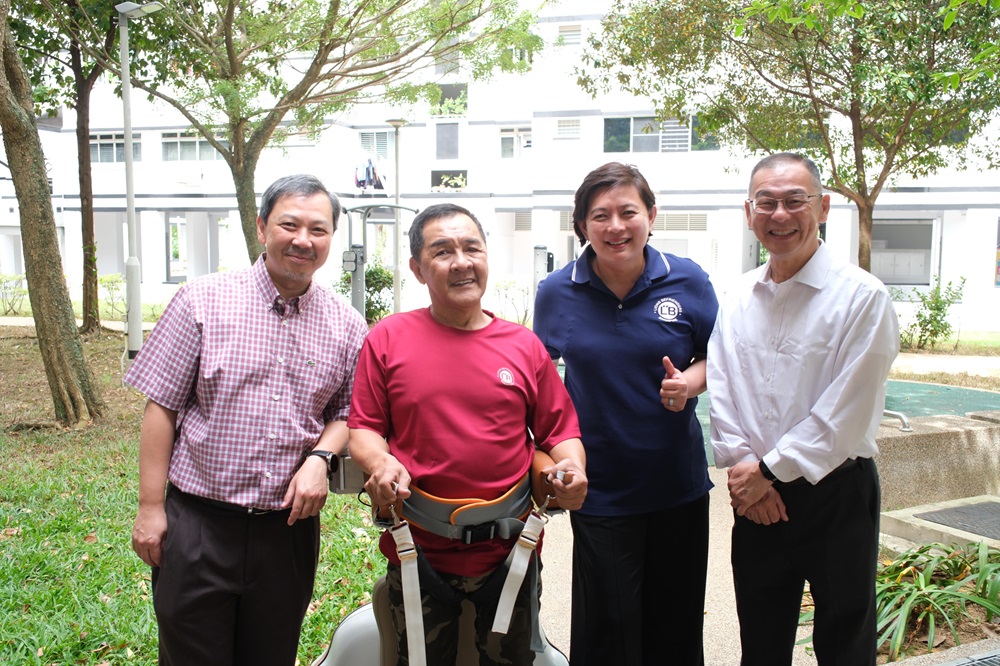
NTU Singapore, Lions Befrienders (LB), the Smart Urban Co-Innovation Lab (SUCIL), and Lumens have announced a landmark multi-sector collaboration to deploy a new rehabilitation robot that supports seniors with mobility issues, allowing them to exercise without fear of falling.
As Singapore journeys toward becoming a super-aged society, how do we help our seniors move beyond the fear of falling and reclaim their independence? This initiative marks a milestone in answering that question, representing a true blueprint for community building in Singapore through a "Triple-Helix Innovation". By uniting the private sector, academia, and social services, the partners have successfully translated high-tech research into life-changing community care.
Called the Data-driven Robotic Balance Assistant (DRBA), the robot was developed in collaboration with Tan Tock Seng Hospital at the Rehabilitation Research Institute of Singapore (RRIS) - a joint research institute between NTU Singapore, Agency for Science, Technology and Research and NHG Health. The robot aims to support elderly users by improving their balance, assisting with daily activities such as standing and walking, and reducing the burden on caregivers. If a potential fall is detected, the robot provides immediate stability support to catch its user and prevent injuries.
Community trials have successfully concluded at Lions Befrienders' Active Ageing Centres in Tampines. During these sessions, seniors participated in Zumba and other group exercise classes, with some of them testing DRBA, which provided "intelligent" support that restores confidence without compromising autonomy.
Associate Professor Ang Wei Tech from NTU's School of Mechanical and Aerospace Engineering, who invented DRBA, said: "Falls often result in serious injuries and loss of independence for seniors. With DRBA, our goal is to give seniors confidence to stay active, while enabling caregivers and community partners to provide effective support. By taking rehabilitation beyond hospitals and into neighbourhood centres, we hope to make healthy ageing more accessible for all."
Ms Karen Wee, Chief Executive Officer, Lions Befrienders, said the partnership has created a safer and more inclusive environment for seniors. "Many seniors may refrain from participating in certain exercises or social activities because they have a risk of falling. By working with NTU and introducing DRBA into our active ageing centres, we are creating a safer and more inclusive environment where seniors can regain confidence, stay active and enjoy a better quality of life."
This collaboration was made possible through the unique contributions of each partner. While NTU provided the technological soul of the project, Lumens ensured the "mobility of quality of life" by facilitating the logistical transport and deployment of the units, and the Smart Urban Co-Innovation Lab acted as the catalyst to bridge the gap between high-tech research and industry scalability.
Mr. Chiam Soon Chian, Chief Operating Officer, Lumens Pte Ltd, said: "Mobility is the bridge between independence and quality of life. As Singapore ages, Lumens' role is not just to move people from place to place, but also to use of our fleet to help transport quality of life to the people. Helping transport DRBA to Lions Befrienders is a showcase of using mobility to transport quality of life."
Mr. Koon Kok Kwong, CTO of the Smart Urban Co-Innovation Lab, added: "Addressing global mobility challenges and the need for better support for patients, caregivers, and physiotherapists, DRBA has shown it can enhance post-hospital rehabilitation in familiar settings. By integrating eldercare and robotics innovations, the Smart Urban Co-Innovation Lab is proud to partner with Lions Befrienders, Lumens, and Nanyang Technological University in this trial and is encouraged by today's results."
Preventing falls and improving quality of life
The development of DRBA, powered by advanced algorithms and robotics, is aligned with NTU's goal of driving innovations with societal impact, tackling some of humanity's greatest challenges through technology.
Falls are among the top causes of injury-related hospitalisations among seniors in Singapore. With the nation's population ageing rapidly, there is a real need for innovative solutions that promote mobility and prevent accidents among seniors.
DRBA addresses these challenges by combining robotics with real-time data analysis to personalise rehabilitation programmes for each senior. It collects and analyses data from users to create customised training plans. It can also assist seniors with activities such as sitting, standing, and walking, and quickly intervenes if a fall is detected.
The success of this program is a testament to the cross-sector partnership between NTU, Lions Befrienders, SUCIL, and Lumens, showcasing how collective action across different industries can solve deep-seated societal challenges for Singapore's elderly.
Commercialisation efforts
The robot is now being commercialised through Assoc Prof Ang's spin-off company, Ability Robotics. The start-up is supported by the NTU Innovation and Entrepreneurship initiative and is co-founded by Assoc Prof Ang and his former researcher, Dr Li Lei.
They hope to scale the technology for wider use in Singapore and to enter other rapidly ageing markets in the region. The deep tech start-up is seeking to partner and work with community centres and healthcare organisations to deploy DRBA robots for institutional use, so that more seniors can benefit from the technology. Concurrently, they are also working on MRBA - short for Mobile Robotic Balance Assistant - which is expected to reach the market by 2026.
This collaboration between NTU Singapore, Lions Befrienders, Smart Urban Co-Innovation Lab, and Lumens is a great example of how Singapore can promote healthy ageing by leveraging innovation to help seniors remain active, independent, and engaged in the community.


