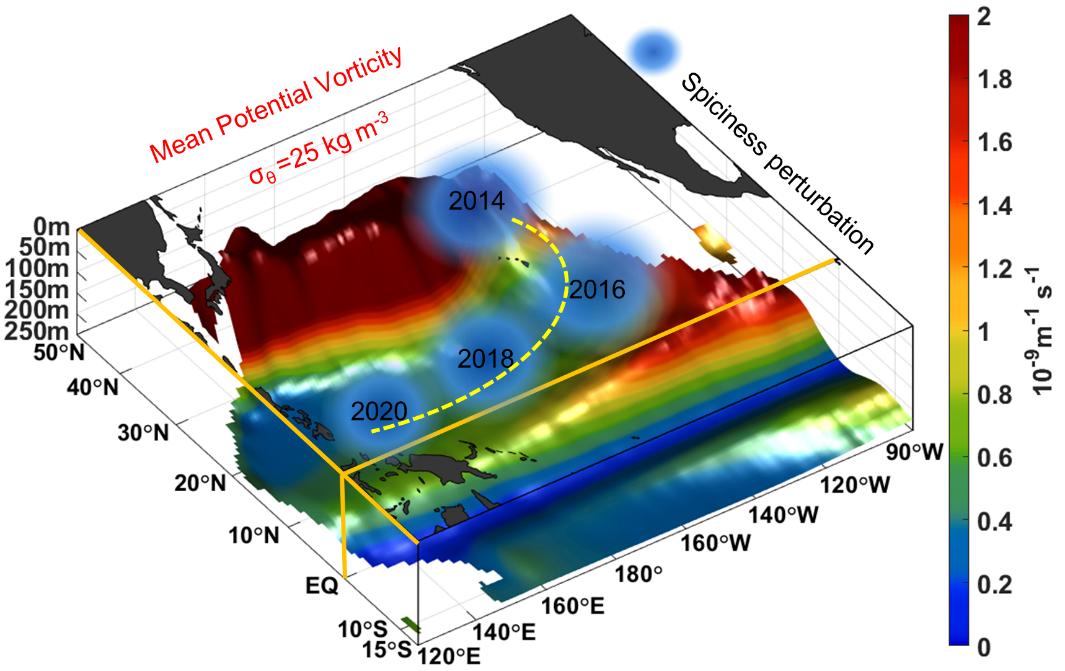
Ocean spiciness is referred to as density-compensated temperature and salinity variations with warm (cool) and salty (fresh) waters having high (low) spiciness, respectively.
However, the structure and evolution of density-compensated spiciness anomalies are not well understood in the North Pacific.
Recently, Ph. D. student ZHOU Guanghui of Prof. ZHANG Ronghua's team from the Institute of Oceanology of the Chinese Academy of Sciences (IOCAS) identified a full cycle of decadal spiciness variability in the North Pacific using Argo observations during 2004-2020.
The study was published in Advances in Atmospheric Sciences on Mar. 2.
The researchers adopted isopycnal analysis method to depict the coherent three-dimensional patterns of spiciness variability on the 25 kg m-3 isopycnal surface. Temperature and salinity variabilities in the thermocline appeared to be well organized, with their perturbations being nearly density-compensated along the subduction pathway on decadal time scales.
During the analysis period, two well-defined spiciness advection events were detected in the North Pacific Ocean. One warm/salty spiciness anomaly was advected clockwise around the subtropical gyre from 2007 to 2013, with obvious signal weakening when it arrived at the western boundary region in 2014-2015.
The other cold/fresh spiciness anomaly was advected in a similar pathway during 2014-2020. The subduction pathway could be adequately determined by the mean stream function on the isopycnal surface from the outcrop region to the tropical western boundary in the North Pacific through trajectory due to the advection of the yearly spiciness anomalies.
"The identification of these spiciness signals and their propagation pathways clearly illustrates oceanic connections from the extratropics to the tropics in the Pacific, which helps us to understand El Nino-Southern Oscillation (ENSO) diversity and complexity," said ZHOU Guanghui.
"Much more research is needed to improve our understanding of decadal-interdecadal spiciness variability and its effect on the Pacific ocean-atmosphere system," said Prof. ZHANG.