
'People make this crazy distinction between art and science, but they're really just two sides of the same coin to me'
'People make this crazy distinction between art and science, but they're really just two sides of the same coin to me' ()
To hear Derrick Li explain why his favorite color is terra rosa – a certain shade of red blended together from brown and burnt sienna - is like getting to know both sides of the painting and drawing major who's also premed.
Red is "alive," he says, the color of blood, the color of muscle, and as versatile on his artist's palette as any other color next to it. He adds white to a smear of terra rosa to get the color of skin. Fresh from the tube, he builds a rock canyon stroke by stroke.
One layer of paint at a time, he adds variations of terra rosa to his canvases, building up images from his mind's eye: people who've come to mean so much to him, people who've put their trust in him.
They're people. Not sick people or well people or in remission people. Just people he's studied, like a doctor would, only he does so now as an artist learning the shape of their mouth and curve of their shoulder.
"It's such an intimate experience, painting a person," Li '28 (SFA) says. "It's so intimate and so universal at the same time. The surfaces of our body are so complex, but when you think about it in terms of painting, it's just a blob that light is hitting. The same way you paint a sphere is the same way you paint a nose. You find the highlight and see how the light interacts with it."
Li has been painting only a handful of years, starting as a sophomore at Avon Old Farms School in a requisite art class he thought would be easy, no final exam. Mr. Calibey and Mrs. Pinton, he thought, would be just any old teachers, certainly not two he'd come to know in the art studio after the final bell rang each day, certainly not two he'd think to thank at graduation.
After all, he's a self-described "STEM kid," both he and his brother Spencer, thriving on the challenge of science labs and math assignments. Li says he always wanted to be a doctor, early on because of a desire to help others, later on because of how the doctors helped Spencer.
UConn's Special Program in Medicine drew him to Storrs with the ability to grow his love of art by majoring in it, while taking premed classes like anatomy and physiology, physics, and organic chemistry almost for fun.
"People make this crazy distinction between art and science, but they're really just two sides of the same coin to me," he says, using the analogy of putting a newspaper under a microscope to see the dot matrix that gives letters their form – that's science. Then, zooming out to see the full word, full sentence, full page – that's art. And "that balance is really important to me."
'I found a place to throw my thoughts'
Like most young artists, Li says he started off by simply drawing a circle, a half-interested teenager's scrawl, one end of the shape connecting to the other. But after adding shadow to one side, highlight to the other, that circle popped off the paper into three dimensions, "and then I fell in love."
Four years on, he's immersed in figurative painting, awarded an IDEA Grant from UConn's Office of Undergraduate Research to create a series of works featuring people who've overcome critical illnesses, not in hospital beds or with IV drips, but in everyday situations doing everyday things.
"My brother was diagnosed with acute myeloid leukemia when he was 17," Li says. "I was a freshman in high school, it was mid-COVID, and he spent around four months in the ICU and then a year in and out of inpatient oncology units. Only one parent was allowed in the room at a time, so my parents would switch back and forth. Siblings weren't even in the picture."
That was around the time he drew a circle, and it leapt from the page to bop him with an "aha" moment.
"I spent a lot of time in my head, and my mental health probably wasn't the greatest," he admits of that time. "But when I found painting, I found a place to throw my thoughts. It was an escape for me. I wouldn't have to think about anything else. The only thing that mattered was the canvas that was in front of me, and that was very therapeutic. This project is a reflection of that."
Slowly his brother regained health, remission achieved, and Li came to know other young people, made friends with those near his age, who too were sick, really sick. As a counselor at The Hole in the Wall Gang Camp the last two summers, he bore witness to the time a 12-year-old stepped into a swimming pool – for the first time ever.
"Their whole lives before coming to camp have been characterized by their disease, like that's who they are, it's core to their identity, and I just think that's so sad. You're so much more than that," he says. "My brother is so much more than the disease he had. I'm trying to paint these people in a way that shows who they are, normal people."
Contemplative, Quiet, Wholly Focused
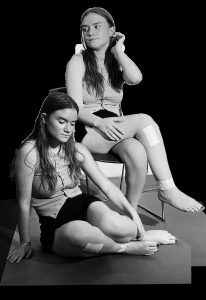
Using the oldest of teens from his newfound friend group as live models, he asks them to take a pose – just an average pose, legs crossed on a chair, head cocked to the left, or laterally lying on the floor. He picks up a camera and snaps a shot.
Photography, he says, is much like painting: finding your frame, composing the image within it. He employs a computer to edit in a vase of flowers or overstuffed armchair, getting onto paper the full scene he sees in his head. Sketching that modified image precedes the actual painting of it.
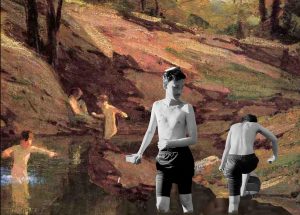
Spencer never actually stepped in a river when he posed for Li in a studio at UConn, but that's how he's portrayed in the centerpiece of the series, facing forward hand resting on a rock with a second version of him from behind, lifting his legs as he climbs toward shore.
"I thought it would be a cathartic moment," Li says of the photoshoot, "but it was just like any other time I hung out with him, which, I suppose, is kind of the whole point of the project. When you're taking photos, you want your models to feel natural. If you ask your model to pose like this, it's going to look posed when you paint it. It's best to just ask them to sit, and if they're a really good model, they fold into these gorgeous poses naturally."
Alone in a dark studio, only a spotlight directed on the canvas, Li unloads from his black- and-yellow toolbox tubes of terra rosa paint, brushes wide and narrow. He's contemplative as he works, quiet, wholly focused.
He describes the process as somewhat surreal, tranquil even. Just him and the person on the canvas together for hours, as he sculpts their nose and gets right the lift of their brow. It's given him an appreciation for life, he says, as he studies the way their clavicle connects to their neck.
There's no such thing as permanence in painting. If something's not quite right, Li says he embraces its "fluidity," being able to sand off what he just painted and start again. His UConn professors have helped him see that as opportunity.
"It's a mental exercise," he says of painting. "You're balancing how the figure interacts with other objects in the painting. There's also the emotional side of it as well, like 'How does this make me feel? Why am I painting in this way?'
"You would think there's a crazy big gap between drawing a circle and painting a person, but, honestly, when you paint you have to think about these things as just forms," he adds. "Your face is just a more complex sphere."

Capturing the essence of a person means getting right the curl of their mouth. An errant brushstroke can make someone skeptical, irritated, hurried, innocent, he maintains. In an instant, a subject is morphed.
Li says that's one reason – for him at least – art is harder than science.
Twenty hours on a painting doesn't guarantee satisfactory work, let alone great. Flip that, he says, and an equal amount of time studying for a science exam can almost ensure a grade that's near the top of the scale. Art is unpredictable, science is factual.
But both take root in the human condition.
"Science is a huge field. I was always interested in helping people, but you can help plenty of people with science in plenty of different ways," he says. "Seeing the doctors, the way they presented themselves and the way they made my parents, who were in an extremely stressful situation, feel better - it was admirable, and I want to embody that trait."
One might say, if Li was the subject of a painting instead of the artist, he'd be the one behind the boulder, flanked by patients and their families, helping to push the rock out of a red canyon.
"The doctors were there for us every step of the way," he says. "And that's the kind of person I want to be."
The series of paintings that comprise Li's IDEA Grant project, "Study of Disease Through Oil Paint," will be on display Feb. 5-14 in the VAIS Gallery, Room 109, in the Art Building.


