
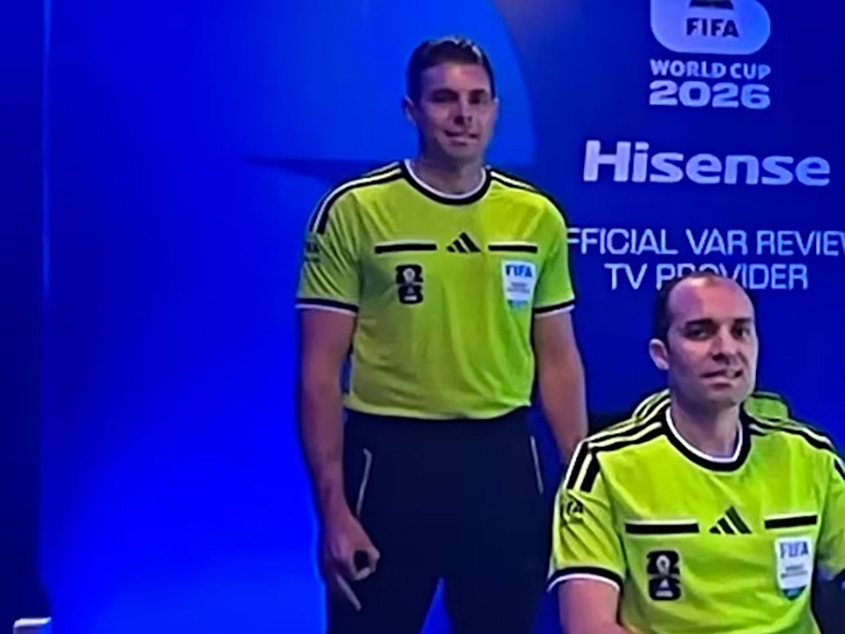
Australian referee Shaun Evans pictured during the Germany vs. Curaçao FIFA World Cup match on Monday.
Soccer fans watching Germany's 7-1 win over Curaçao were expecting controversy to come from a decision made on the pitch.
But when video assistant referee Shaun Evans was captured on camera making what appeared to be an upside-down "OK" sign against his thigh, social media feeds erupted.
FIFA's anti-discrimination monitor at the World Cup called for Evans to be removed from the tournament. Fare (Football Against Racism in Europe) deploys trained match observers to monitor stadiums and broadcasts at major tournaments for racist chants, far-right flags, and discriminatory symbols.
"Advice from our experts is that the gesture used clearly resembles an upside down 'OK' hand symbol used as a 'white power' symbol in global far-right circles," the network said.
In a statement to FIFA, Evans adamantly denied intentionally communicating any hate symbol or message. He explained the movement as an "involuntary, subconscious twitch," which he says he even repeated later in the match while holding a pen.
"The only explanation I can offer is that the movement was an involuntary, subconscious twitch and I was unaware I had done it at the time. Images taken later during the match showed that I repeated this movement many times while holding a pen between my fingers," he said.
"The coverage following this incident simply does not reflect who I am. Of course, I understand how the gesture has been interpreted, and I regret this. However, I want to be very clear and categorically say that I did not knowingly or deliberately make the hand symbol suggested."
Following the statement, FIFA's independent disciplinary committee said it "found no evidence of breaches of the FIFA disciplinary code".
Historic uses of the "OK" sign date back to at least the early 17th century, with different meanings across cultures, including as a pose during yoga and meditation. In the early 2000s, sitcom Malcolm in the Middle popularised the gesture as a game, where characters flashed the symbol below the waist and punched anyone who looked at it.
But in recent years, another highly provocative meaning of the symbol has emerged. The inverted OK sign has become associated with far-right racism, with appearances in internet memes, social posts and public events.
In 2019, Marine Le Pen was criticised after being spotted making the gesture in a selfie, but responded that she understood it to mean "Everything's OK". Brenton Tarrant, the gunman who massacred 51 people in the 2019 Christchurch Mosque shootings, also displayed it during a televised court appearance.
At the 2024 Paris Olympics, an unnamed official had his accreditation revoked after he was accused of making the symbol during the skateboarding final.
"The idea is that when you make the gesture, the three fingers represent a 'W', and when you close your thumb and index finger it makes a 'P'," Macquarie University extremism Research Fellow, Associate Professor Kurt Sengul explains.
"It's one of those interesting trolling gestures and slogans that emerged around 2017 on far-right message boards like 4chan, along the same lines as the 'It's Okay to be White' slogan."
The inverted OK symbol was adopted by online alt-right groups "to essentially troll journalists and left-wing figures into an overreaction to a seemingly innocuous gesture," Associate Professor Sengul says. "People who know what the intent is react and then look a bit silly to those who don't."
Right-wing groups have adopted gestures and slogans such as this one precisely because they appear innocuous and provide plausible deniability.
Against a background of intensifying online hate speech and culture-war conflict, the New York-based Anti-Defamation League added the OK sign to its hate symbols database in 2019. However, it cautioned that the gesture is highly ambiguous and has other "innocuous and harmless" meanings.
Professor Julian Droogan, Head of the School of International Studies, argues the resurgent far-right playbook is to adopt signs and symbols from popular culture for their own purposes.
"This really relies on a strategy of ambiguity," Professor Droogan says. "In 2017, the style guide for The Daily Stormer, an American neo-Nazi message board, was leaked. They made it quite clear in that style guide that using ambiguity was an important part of mainstreaming their messages to the broader public.
"Symbols of the far right and white supremacy should be couched to look innocent because they are aware that your average Australian is turned off by neo-Nazism. A swastika is not going to land for the public as well as something that is more ambiguous," Professor Droogan said.
In addition to being a political tactic, Professor Droogan points out appropriation is also a cultural process that far-right activists have successfully exploited to engage digital audiences.
"Often these symbols begin as forms of irony or trolling on sites such as Reddit, 4chan, 8kun, the Gab ," he says. "These sites feed off meme culture and inside jokes and symbols that signal insiders versus outsiders."
Professor Droogan warns that the rapid take-up and dissemination of memes, gestures and symbols means individuals and organisations, including FIFA have to be incredibly careful to understand that simple actions and objects can carry loaded, toxic meanings that can spread negative messages rapidly if not properly addressed.
He says elite sporting competitions — where national pride and global attention are part of the mix — are an obvious target for white supremacists and other extremists hoping to draw attention to their causes.
"Symbols are tricky and context is always king," he warns. "I do think we have to be aware of how even very innocent symbols can be co-opted by these movements.
"We have to always remember that the far right, and I'm not referring to Evans here, do try to find any means to align their messages with the broader public. And so we must be very vigilant in trying to call out these forms of propaganda when we see them."
For its part, FIFA says it is working to combat racism through stronger rules, tougher sanctions, education and closer monitoring of discrimination at its tournaments. The controversy proves even ancient gestures can acquire toxic new meanings, powerful enough to disrupt the spectacle of a World Cup.


