
CSIRO
Key points
- The Atlas of Living Australia (ALA) brings together Australian biodiversity data from many different data providers and makes that data publicly accessible and reusable.
- Data visualisations show stories of the data across space and time.
- ALA intern Gullara McInnes explored how traditional art can be used as way to visualise occurrence data and cultural knowledge.
Making hard data easy to understand
Gullara is a proud Wallara woman of the Koko-Muluridji people from Far North Queensland. She studies science and law, and is a graduate of the CSIRO Young Indigenous Women's STEM Academy .
During her career, Gullara has led projects to bring together ancestral cultural knowledge with Western technologies and science to care for Country.
Gullara's project with the ALA was to investigate an ecological topic using ALA data. She spent weeks getting an understanding of ALA data and how to use R programming tools to access and display that data.
She experimented with ways to summarise data, and became curious: do patterns or trends in the data match what she sees on the ground in her local area?
The story of seasonality
One of the trends Gullara became interested in was seasonality, or when species occur more or less frequently over the year.
"My mum is an artist and painted a mural in the Mareeba airport about the seasons, using birds," Gullara said.
"It made me wonder what the data would show - if the trends I see seasonally in my local environment would match the ALA data."

From coding to canvas: data is an artform
Gullara was also thinking about data visualisation, and what makes a visual summary of data engaging and informative.
"In one of my side quests with the ALA, I helped make a data visualisation about Christmas beetles," Gullara said.
"Each dot represented an occurrence record, and a colour key represented the state it was found in.
"It got me thinking—once upon a time graphs were hand drawn. What if I combined both worlds?
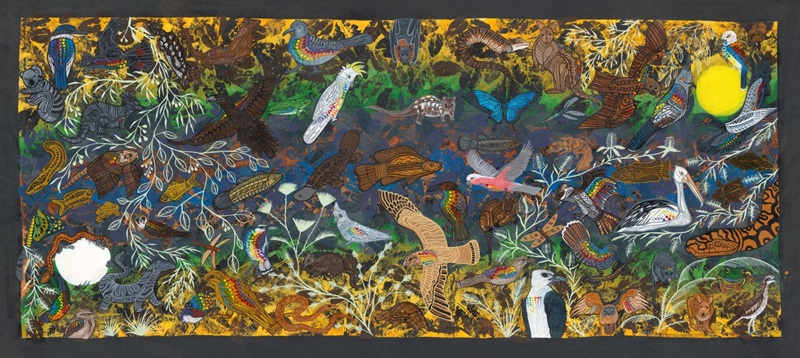
"So, could I create a painting that not only told the story of the traditional knowledge handed down in my family but also displayed the occurrence record data for animals in Mareeba."
The art of combining knowledge systems
Working alongside her mum, Ann-Marie Keating, the artwork took shape as a bridge between culture and data.
Over nearly two months, Ann-Marie and Gullara painted more than 60 different species of animals and plants onto the canvas, each with their own cultural significance.
Each species is overlaid with dots of different sizes and colours, representing the number and season of occurrence records from this area in the ALA.
Ann-Marie said she was always mindful and respectful of the animal she is painting.
"We belong to birds so there are a lot of birds in here," Ann-Marie said.
"We pay attention to these animals, and we talk to them, and we receive all their messages all the time.
"We have to uphold our lore. We look after the Country so it looks after us."
Painting in motion: making animals move
Ann-Marie used different painting techniques, layering and compositional elements to bring life to the painting.
"Instead of being just a side or an aerial view, I tried to make the animals move," Ann-Marie said.
"They're in the positions you might see them out in nature."
Gullara said her mum painted in a way that makes her paintings look three- dimensional.
"The painting moves when you stare at it for too long - it's got to do with how Mum layers her colours," Gullara said.
"For me it was a tutorial on how to execute this type of illusion in art. I also got the run down on why Mum selects the colours she does. It's the first big piece that she's ever done that I've gotten to be there for from start to finish."
Straight from the art: a first of its kind painting
Ann-Marie said the painting was also a way of preserving culture and keeping knowledge together, and the first of its kind.
"What I am most proud of is that it's the first artwork Gullara and I have done together with the different meanings the animals have," Ann-Marie said.
"It also incorporates many layers and many hidden meanings that are blended together with the data, and when further explored it gives greater meaning and appreciation to the painting.
"It's the collection of culture, art, knowledge and data."
Preserving cultural knowledge with art and data
Gullara said everything she does is about how she can use Western technologies and systems to house and preserve cultural knowledge.
"This painting is the perfect overlap--there's what the data tells you and then there's what culture tells you and what you can expect from these animals.
"This painting truly is the first of its kind; it combines data with cultural knowledge.
"Once this painting goes online, this part of knowledge is protected forever, and we can share that knowledge with current and future generations."
Showing a bigger picture of biodiversity on Country
ALA Director Andre Zerger said the ALA aims to make biodiversity data findable, accessible, interoperable and reusable (FAIR) for use in research, policy making, environmental planning and land management.
"Effective biodiversity visualisations have always been one part art, and another science, but this takes them to another level," Andre said.
"Layering cultural knowledge with biodiversity occurrence record data in one holistic overview of this local ecosystem is so innovative.
"It takes the stories of these species beyond point-in-time occurrence records to tell stories about cultural and family knowledge across generations."

/Public Release. This material from the originating organization/author(s) might be of the point-in-time nature, and edited for clarity, style and length. Mirage.News does not take institutional positions or sides, and all views, positions, and conclusions expressed herein are solely those of the author(s).View in full here.


