
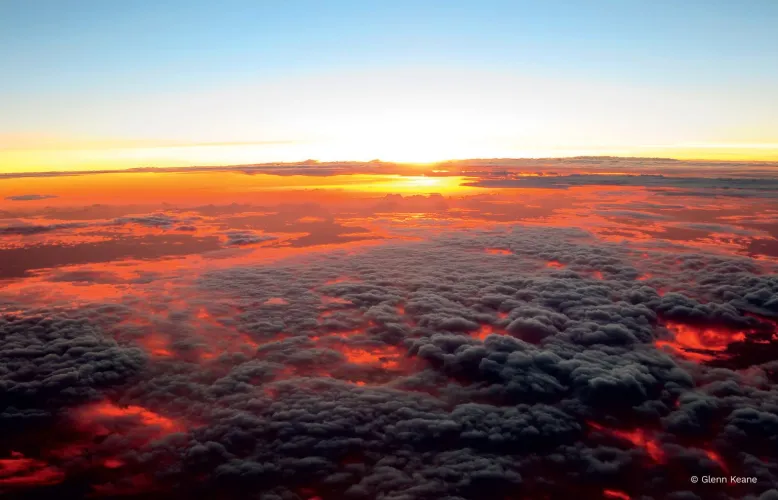
Sunset, east of Brisbane, Queensland. Credit: Glenn Keane.
At 41,000 feet, just before commencing descent at the tail end of a long-haul flight from Honolulu to Brisbane, commercial pilot Glenn Keane was amazed by the scene before him.
"This sunset from above appeared and I thought, wow, that's phenomenal," he said.
"I've seen some amazing sights flying, but certainly that was one of the picks."
Glenn's image, selected as the October image in the 2026 Australian Weather Calendar shows the contrast between the dark clouds and deep red glow of the sunset.
But what makes the colour so intense? It's all about which wavelengths of light reach your eye.
Sunlight is made up of the whole spectrum of visible colour, from red (longer wavelength) to violet (shorter wavelength).
When light travels through the sky, the wavelengths are scattered and bent as they interact with the molecules and particles in Earth's atmosphere.
Blue light has a relatively short wavelength and is scattered more strongly.
The longer wavelength of red light means it is more weakly scattered.
However, when the sun is low on the horizon at the end of the day, light must travel a long way to reach the viewer's line of sight.

Photographer Glenn Keane. Credit: Glenn Keane.
The blue light is scattered away over that distance, leaving redder colours more visible.
This magnificent sunset is one of the many fascinating weather phenomena Glenn witnessed from the flight deck during a more than 20 year flying career.
As a pilot for several international airlines across that time, Glenn saw a variety of weather in his work.
"In any one week, you could be flying in the tropics and then in the Arctic," he said.
"Any given day that you go to work, you're pouring over weather forecasts, en route and at your destination, and making your own assessments.
"It's very important to get really good, reliable weather information."
But it was back home in Australia that he remembers providing some of the most memorable weather.
"Some of the biggest storms I've ever seen have been on the north-west coast of Western Australia," Glenn said.
"They were huge storms that go up to 65,000 feet with the tops sometimes higher.
"I've actually seen lightning come out the top of some of those storms, and I've heard experts say it doesn't do that, but I've seen it happen."
Order your copy of the 2026 Australian Weather Calendar now at https://shop.bom.gov.au/


