No ears, no problem! The tobacco hornworm caterpillar, a common garden pest, can actually detect airborne sound via microscopic hairs on its body, according to a team of faculty and graduate students at Binghamton University. The research could have implications for improving microphone technology.
The very startled caterpillar
The genesis of this research goes back decades. Associate Professor of Biological Sciences Carol Miles realized that whenever she walked into a lab where her colleague was studying caterpillars, the caterpillars would jump when she talked. Her colleague said the caterpillars could hear her - and that they didn't like the sound of her voice.
"Every time I went 'boo' at them, they would jump," Carol Miles said. "And so I just sort of filed it away in the back of my head for many years. Finally, I said, 'Let's find out if they can hear and what they can hear and why.'"
Sound studies
Ronald Miles, a distinguished professor of mechanical engineering at Binghamton University's Thomas J. Watson College of Engineering and Applied Science, had previously researched how other animals respond to sound, including flies and spiders, which led to a new microphone patent.
"There's an enormous amount of effort and expense on technologies for detecting sound, and there are all kinds of microphones made in this world. We need to learn better ways to create them," Ronald Miles said. "And the way it's always been done is to look at what animals do and learn how animals detect sound."
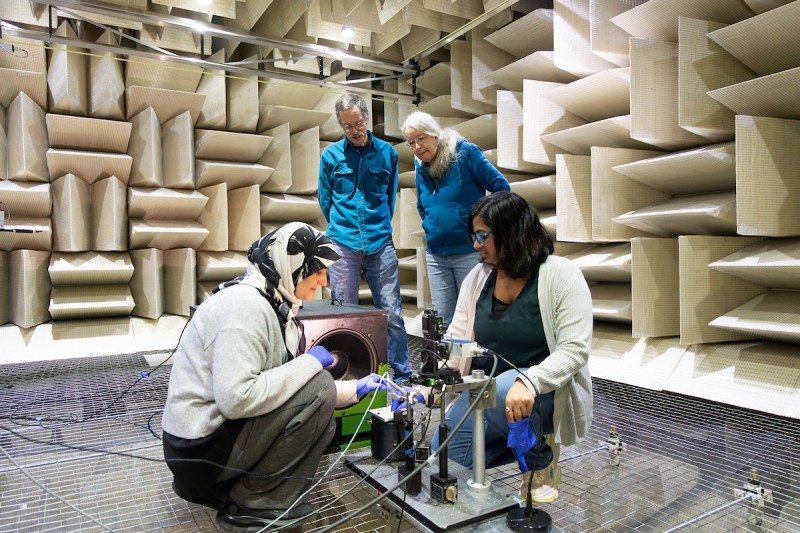
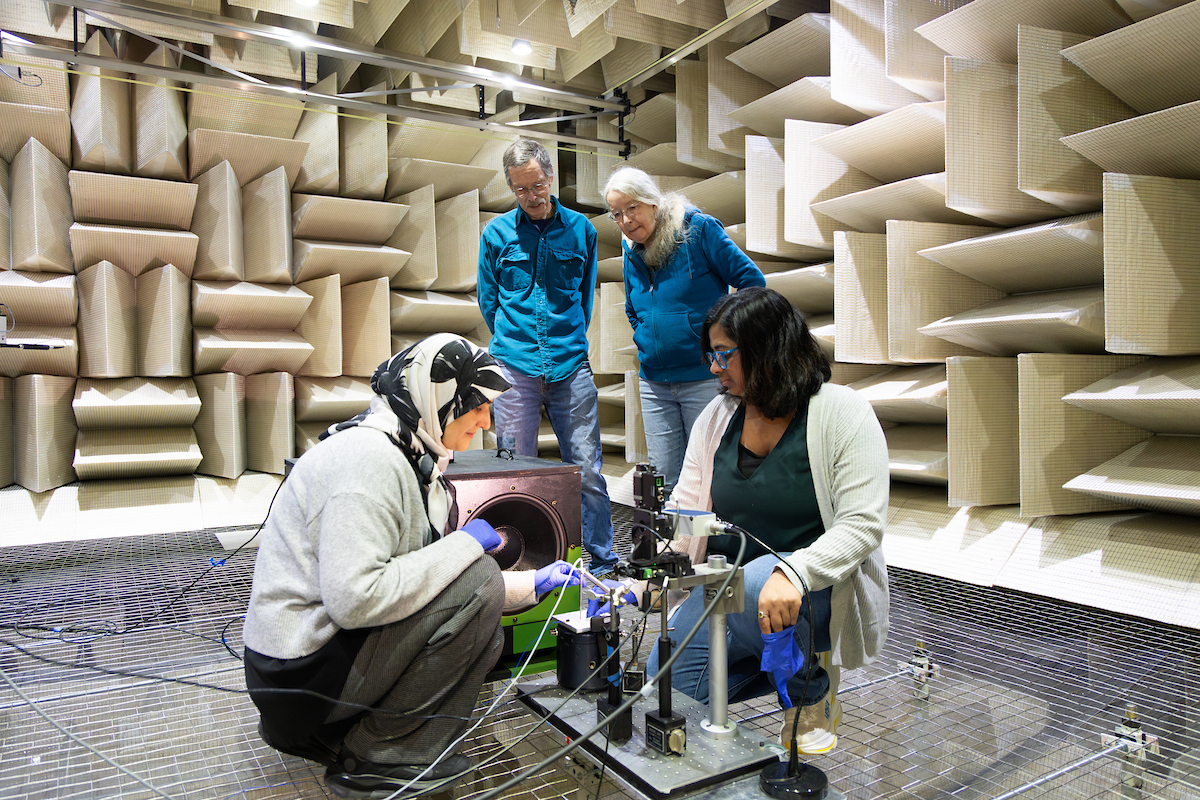
To learn whether and how the caterpillars could hear, the researchers conducted tests in Binghamton's anechoic chamber, one of the quietest rooms in the world, providing the team with an ideal environment for sound studies.
"It allows us really extremely accurate control over the sound field. And that's important if you're trying to figure out what it is that the animal is responding to - you need to be able to completely control all the inputs," Ronald Miles said. "So with this, we can give the animal just sound and no vibration, or just vibration and no sound, and we can accurately measure just how much of each the animal is responding to."
Testing … 1, 2, 3
The researchers played low-frequency (150 hertz) and high-frequency (2000 hertz) sounds, measuring how the caterpillars responded to surface vibrations and to the airborne sounds.
"We wanted to find out whether they are responding to this airborne sound or just the sound-induced vibration of the base, through their feet," said Sara Aghazadeh, a PhD candidate in the Department of Mechanical Engineering. "They are always on the stem of the plant, so we thought maybe the vibration of the plant is the reason for them to detect sound."
The researchers found that the caterpillars were 10 to 100 times more responsive to airborne sound than to surface vibrations felt on their feet.
"I know this sounds really silly, but there are videos of another species of caterpillar responding to sound on social media," said Aishwarya Sriram, a PhD candidate in biological sciences. "So we knew they responded, but we just didn't know if it was sound or vibration. We were extremely happy when we found out they detect airborne sound as well as base vibration."
Graduate students Aishwarya Sriram and Sara Aghazadeh test caterpillars for their ability to detect sound under the guidance of Distinguished Professor of Mechanical Engineering Ronald Miles and Associate Professor of Biological Sciences Carol Miles at the anechoic chamber in the Engineering and Science Building at the Innovative Technologies Complex. Image Credit: Greg Schuter..
Graduate students Aishwarya Sriram and Sara Aghazadeh test caterpillars for their ability to detect sound under the guidance of Distinguished Professor of Mechanical Engineering Ronald Miles and Associate Professor of Biological Sciences Carol Miles at the anechoic chamber in the Engineering and Science Building at the Innovative Technologies Complex. Image Credit: Greg Schuter..
×
Hearing through hair
Once the researchers confirmed that the caterpillars actually responded to airborne sound, they tested how they would react after removing tiny hairs from their bodies.
"We found that, yes, the caterpillar can detect sound rather than the sound-induced vibration of the substrate. So at that time, we wanted to figure out if they are hearing, where are the 'ears' of this caterpillar?" Aghazadeh said.
After removing hair from the caterpillars' abdomen and thorax via ablation, they were less capable of detecting sounds.
"A lot of other insects respond to sound, because sound causes motion of the air, and they have little hairs that can respond," Ronald Miles said.
A predatory frequency?
The researchers hypothesize that the caterpillars may have evolved to hear sounds at frequencies similar to those produced by predatory wasps as they beat their wings.
"The wing beat frequencies of these predatory wasps are around 150 or 100 to 200 Hz, so I think the caterpillars think that there is a predatory wasp hovering near or above the caterpillar, and that's why it primes itself when it hears the sound, and it reacts with a jump startle, or a freeze, or a twitch response," Sriram said.
/Public Release. This material from the originating organization/author(s) might be of the point-in-time nature, and edited for clarity, style and length. Mirage.News does not take institutional positions or sides, and all views, positions, and conclusions expressed herein are solely those of the author(s).View in full here.