Sea cucumbers may lack the charisma of other marine animals on the Great Barrier Reef yet it turns out the 'earthworm of the sea' holds the trump card on longevity, according to a first-of-its-kind genetic study with Southern Cross University.
The endangered black teatfish sea cucumber can live for decades, with a small portion of the animals estimated to live more than 100 years, in a new discovery that amazed a team of marine scientists, including Professor Steven Purcell from Southern Cross University's National Marine Science Centre.
The results of this pioneering genetic mark-recapture study , led by Dr Sven Uthicke from the Australian Institute of Marine Science (AIMS), are published in the journal, iScience.
MAIN IMAGE: Professor Steven Purcell holds a Thelenota ananas (pineapple sea cucumber) in waters off Lizard Island in the northern section of the Great Barrier Reef earlier this year (credit S Purcell).
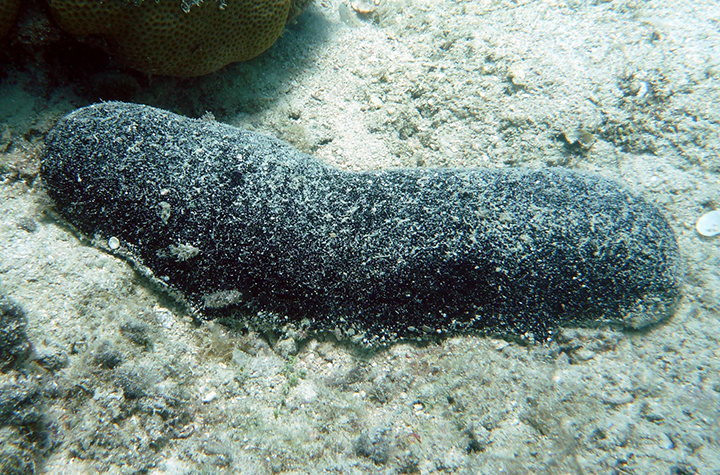
A Holothuria whitmaei (black teatfish sea cucumber) on the ocean floor off Lizard Island (credit S Purcell).
The researchers made the discovery by comparing DNA samples from a population collected in a no-take zone of the Great Barrier Reef Marine Park off Lizard Island in 2000 with samples collected from the same location 24 years later.
Not only do the findings suggest black teatfish sea cucumber populations will recover much slower than previously thought, says Professor Purcell, but there are implications for commercial fishery catch limits.
"This study is a gamechanger because it shows that some sea cucumber species might only sustain very low rates of harvesting," said Professor Purcell.
"This is a major breakthrough because conservation platforms and trade regulations for endangered wildlife are based upon estimates of an animal's lifespan. Scientific consensus is that longer lived species are at greater risk of population collapse."
Dr Uthicke of AIMS said: "We had a hunch that they could get older than the 10 years that was commonly thought.
"We collected 55 animals to sample and thought if we find three that were the same individuals as 24 years ago, that would be amazing. In fact, we found 60% (33) were the same as those sampled in 2000, and that really was a surprise.
"It shows adult black teatfish have extreme longevity and very low natural death rates. We found they live for at least 24 to 27 years on average, while some live for more than 100 years.
"Most of the recaptured animals had grown very little over the 24-year period, and many had become smaller."
Clocking up a century
The mark-recapture study involved taking a small biopsy from each animal, before they were returned to where they were taken around Lizard Island. Modelling was used to estimate their lifespan.
Professor Purcell was gobsmacked that some of the black teatfish studied were 100 years old.
"Using established equations of mark-recapture theory from other animals, we can calculate how old some must be to live for us to have found so many of the same animals 24 years later.
"In our study species, that turns out to be more than 100 years old."
Several published studies, on different species, now point to sea cucumbers as being long-lived animals. Most recently, Professor Purcell led a genetic mark-recapture study on the leopard sea cucumber that confirmed a lifespan of at least 33 years.
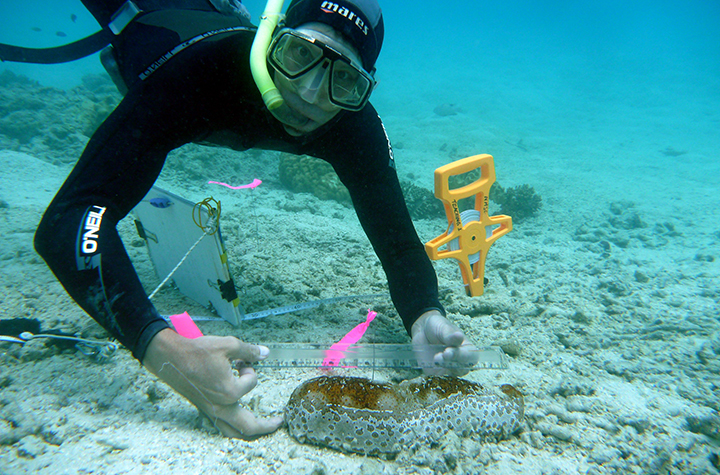
Professor Steven Purcell measuring a Bohadschia argus (leopardfish sea cucumber) (credit S Purcell).
Slow-moving, ocean floor-bound and worth a lot of money
Much like earthworms that break down leaf litter and return nutrients to the soil, sea cucumbers play an important role in tropical marine ecosystems , recycling nutrients on the ocean floor and mixing the sand on which they feed. Recent studies also show healthy sea cucumber populations can enhance coral health.
As with abalone and shark fin, sea cucumbers are a highly valued delicacy in some cultures and is fished in Australia, the Pacific Islands and Southeast Asia.
The black teatfish studied in this research is one of the most sought-after sea cucumbers in Australia, the Pacific Islands and Southeast Asia.
Sold for more than AU$400 per kg in Hong Kong, the black teatfish are now seldom seen in Asian markets as wild stocks have been overfished in most other countries. They can be found throughout the Great Barrier Reer, and their distribution extends across to Western Australia.
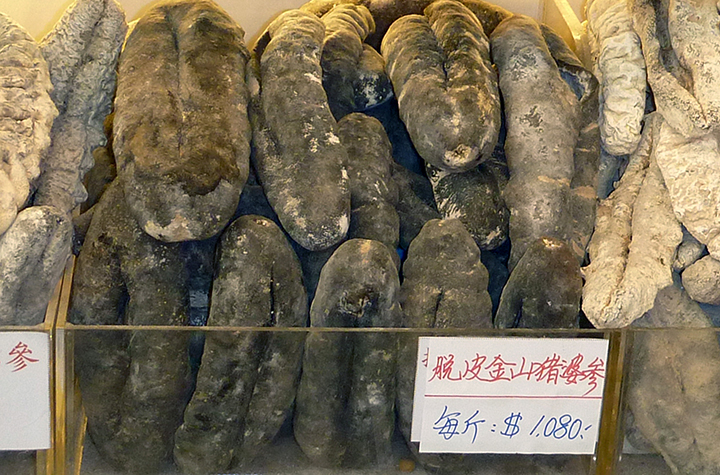
Black teatfish sea cucumbers on sale in a dried seafood store in Hong Kong in 2011. Price shown is in Hong Kong Dollars per catty*. These products were rare to find in the same stores in 2022 (credit S Purcell).
* In Hong Kong, one traditional catty (jin or gan) is defined as approx 604.8 grams.
The species is on Appendix 2 of the Convention on International Trade in Endangered Species (CITES) and presently classified as Endangered by the International Union for Conservation of Nature (IUCN) Red List of Threatened Species . CITES Appendix II compels countries to undertake a sustainability assessment of wild stocks and fishing impacts before they can export the species.
"These new research findings should have major implications to how fisheries for these sea cucumbers are managed in the broader Indo-Pacific region," said Professor Purcell who has specialised in sea cucumber research for 25 years.
In particular, Professor Purcell says, the black teatfish is targeted by foreign poachers on offshore Australian reefs, such in marine parks at Rowley Shoals (WA) and the Coral Sea (off northern QLD).
"We are most concerned about the black teatfish species because it has been decimated throughout most of its range in the Pacific Islands and Southeast Asia," he said.
"While the wild stocks are in better shape in Australia, the fishery management models for our stocks have not been conservative enough. Our research puts into question the long-term sustainability of the current harvest rates."
Co-author Dr Maria Byrne of the University of Sydney Professor of Marine Biology agreed, saying black teatfish were in a perilous state of conservation globally.
"The results of this study are a wake-up call to urgently increase their protection," Dr Byrne said.
Study details
Extreme longevity revealed by 24-year genetic mark-recapture challenges conservation of endangered sea cucumbers
Journal: iScience