Vulnerable communities in Chad are now benefiting from better climate, meteorological, hydrological services and life-saving early warnings thanks to a six-year project funded by the Climate Risk and Early Warning Systems Initiative (CREWS) By strengthening institutions, expanding observation networks, improving forecasting capacity, and enhancing last-mile service delivery, the project demonstrated how targeted investments can translate science and data into life-saving actions.
It is one of a whole series of CREWS-funded projects implemented by WMO to build resilience in countries which are severely exposed to extreme weather, water and climate impacts.
In recent years, Chad has experienced an increase in hydro-meteorological disasters such as floods and droughts, affecting the livelihoods of up to 2.4 million people. Recurrent droughts have significantly impacted Chad's agricultural production, a key sector that employs more than 80% of the workforce and accounts for 21% of the GDP.
The US$ 3.15 million project (2019-2025) aimed to strengthen the national capacity to deliver climate, hydrometeorological, and early warning services in selected sectors and communities (CREWS Chad).
It was led by the World Bank Global Facility for Disaster Reduction and Recovery (GFDRR), with US$1.5 million implemented by WMO and laid strong foundations for a more integrated, modern, and people-centred early warning system in Chad.
The project will now be scaled up with funding from the Green Climate Fund (GCF).
The country's capacity for early warning systems was previously limited to tracking drought and food insecurity, with flood forecasting at a pilot stage and no official mechanisms for severe weather warnings.
CREWS Chad sought to change that by supporting the country's national services for meteorology and climate, hydrology, civil protection, and food security across several key areas.
This was in recognition of the need for targeted support for translate advances in science and technology into tangible benefits for communities across Chad.
Institutional strengthening
The CREWS Chad project strengthened the technical and operational capacity of Chad's early warning services - led by Agence Nationale de la Météorologie ( ANAM ), Directorate for Water Resources (DRE), and Agence Nationale de la Protection Civile (DGPC). It developed strategic plans and the Early Warnings for All (EW4All) roadmap.
The agency's strengthened operational capacity was underlined by the remarkable coordination of a dozen different projects, operating in parallel by a wide range of partners including international organizations and development banks.
Observation
Significant progress has been made in Chad's observation network. Under the UNDP National Adaptation Plan ( NAP ) project between 2019 and 2023, a total of 70 meteorological stations, 15 hydrological stations and 215 rain gauges were procured, starkly improving the country's observational coverage. However, the project closed without connecting the stations to the WMO Information System (WIS).
With support from CREWS, NORCAP and the WMO regional office for Africa, in the context of the Digital Transformation of national meteorological and hydrological services, ANAM has installed in Oct 2024 its own WIS2Box node with an automatic data loader (ADL). This allowed the agency to share data from 24 stations internationally every hour, in line with the requirements of the Global Basic Observing Network (GBON) for surface observation.
Hydrological stations have also been connected to AGRHYMET to improve the performance of hydrological models, and virtual hydrological stations were established, significantly strengthening hydrological monitoring capacity.
Data Management
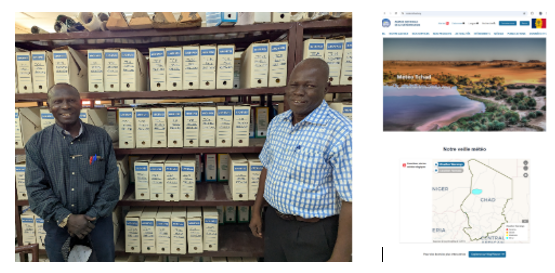
Recognizing the importance of analysing historical data for understanding contemporary climate events, the project has renovated a data archive room and digitalized 80% of Chad's historical climatological records, which will be integrated into a climate data management system in 2026, in line with WMO Open CDMS Strategy . This initiative will allow forecasts to be systematically compared to historical events and their associated impacts, enhancing the ability to analyse forecast impacts and inform decision-making.
Forecasting
To strengthen national forecasting capacity and expand early warning services, the project supported the design studies for a national forecasting centre, to be funded under an ongoing World Bank project, and jointly operated by ANAM and DRE in the near future.
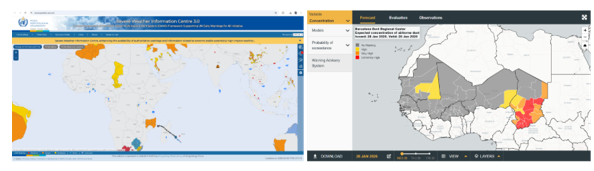
Improved sand and dust storm forecasts were provided by the Barcelona Dust Regional Specialized Centre (see SDS-WAS ), while partnerships with Météo-France and the European Centre for Medium-Range Weather Forecasts led to the development of a new sub-seasonal forecasting tool ( MISVA ), enabling the anticipation of intra-seasonal variability up to six weeks in advance.
Another collaboration with the European Organisation for the Exploitation of Meteorological Satellites (EUMETSAT) and the Spanish meteorological service (AEMET) has enabled the deployment of nowcasting to track convective events, a few hours before they hit (see NWCSAF & RDT ).
Flood forecasts, produced by AGRHYMET and the Swedish Meteorological and Hydrological Institute (SMHI), are contributing to stronger national systems for flood monitoring and early warnings ( FANFAR ). Together, these measures have expanded the range, quality, and usability of the forecasts in Chad.
Service Delivery
Substantial progress has been made in Chad's early warning and service delivery. With the installation of its open source Website ( ClimWeb ) equipped with the Common Alerting Protocol (CAP) composer , the agency published 248 alert bulletins in 2025 (visible on WMO Severe Weather Information System ) and continues to expand, as the system is currently under evaluation by Google Public Alert.
Local dissemination mechanisms were already successfully put in place in three pilot sites, namely Linia, Maïlaou-Tchendjou and Bongor, where nearly 600 people received training on contributing, disseminating and using weather and climate information to optimize agricultural production and prevent weather and climate-induced losses. Feedback from participants helped refine bulletins and services to better meet the needs of the local population. In the pilot sites, agreements were established with three community radio stations to broadcast location-specific bulletins and specific recommendations.