
Professor Jim Smith in the Chernobyl control room of Reactor 3. Credit: Jemma Cox.
Professor Jim Smith was a Green Party member at university, broadly anti-nuclear, when a reactor exploded in Soviet Ukraine in April 1986. He was studying astrophysics. He had no idea the accident would play such a significant role in the next four decades of his life.
"I remember it as being the biggest story worldwide," he recalls. "There were lots of rumours about thousands of deaths. We didn't know what was going on, because it was a closed system in the Soviet Union at that time."
Four years later, Jim found himself doing a PhD in Applied Maths at Liverpool University, modelling how radioactivity from the Chernobyl fallout had moved through the lakes and soils of the English Lake District - hundreds of miles from Ukraine, yet measurably affected.
It was the start of a journey that would take him deep into the Exclusion Zone itself and make him one of the world's foremost authorities on its long-term environmental consequences.
Lunch in the Exclusion Zone
Jim's first visits to the former Soviet Union, to the Belarusian part of the Exclusion Zone, were in the early 1990s. The safety protocols were, by today's standards, haphazard.
"We would wash our hands before we had lunch," he says, "but we would have lunch in the zone." He carried a dosimeter badge - a device measuring radiation exposure - but didn't always know quite what to make of the readings. "I remember going to some of the more contaminated areas and thinking, is this OK? Now that I know what the doses are, I know it was absolutely fine where we were. I've even swum in the cooling pond at Chernobyl."
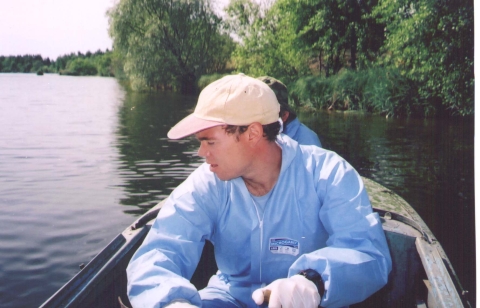
Jim in the Chernobyl cooling pond, a massive artificial reservoir, created by damning a section of the Pripyat River to provide cooling water for the power plant's four reactor units. Credit: Professor Jim Smith.
But the uncertainty he felt then shaped his career. It drove him to understand the actual science of radiation risk - the difference between fear and evidence.
The landscape he encountered was unlike anything he had imagined. Visiting Pripyat - the city built for workers at the Chernobyl plant, abandoned overnight in 1986 - in the late 1990s, he found vegetation beginning to reclaim the streets and sports grounds. By 2015, it had gone much further. "You can barely see the giant buildings for the trees. It really is that nature has taken over."
The eureka moment
It was what was living in that reclaimed landscape that produced the most striking result of Smith's career. Working with Belarusian colleagues who had spent years counting animal tracks in fresh snow across the Exclusion Zone - 35 walking routes of 10 kilometres each, spanning the full extent of the Belarusian sector. The international team mapped each route against the radiation levels that animals in that area were exposed to and compared the wildlife abundance in more contaminated areas against less contaminated ones.
Jim explains: "We wanted to know if there was a difference in the abundance and diversity of mammals in the more contaminated areas compared to the less contaminated areas, and we couldn't find a difference."
They then compared the mammal density in the Chernobyl Exclusion Zone against four other nature reserves in Belarus - including a UNESCO World Heritage Site. For non-predatory mammals such as wild boar, roe deer, elk, there was no statistical difference in population numbers. And the wolf population? Seven times higher at Chernobyl than anywhere else.
The conclusion, published in the journal Current Biology in 2015 , was quietly extraordinary.
"The ecosystem in Chernobyl is abundant. It's similar to other nature reserves in the region," Jim says. "And it's better than it was before the accident. Not because the radiation is good for the animals, but because of human habitation - the things we do by occupying an ecosystem, so hunting, fishing, forestry, agriculture - just being in an ecosystem is far worse than the world's worst nuclear accident."
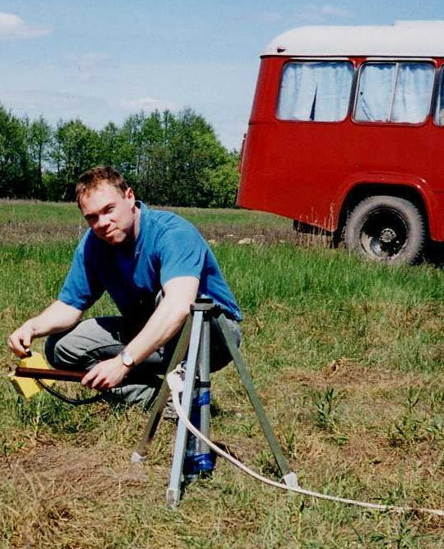
Professor Jim Smith in the Chernobyl zone in Belarus in 1994 holding a Dosimeter to check radiation levels. Credit: Professor Jim Smith.
Risk vs reward
The threshold on which the Exclusion Zone remains evacuated is roughly a one-in-ten-thousand annual risk of developing cancer in later life - a level deemed unacceptable for human habitation.
But put alongside everyday risks, that figure looks rather different. In the UK, around half of all people will develop cancer at some point in their lives, and 25-30 per cent will die from it - a reflection, Jim notes, of our longer lifespans as cancer incidence tends to rise with age.
Liquidators - the hundreds of thousands of soldiers and scientists sent in to clean up Chernobyl in the immediate aftermath - on average lost around two to three months of life expectancy because of their exposure. A smoker, by comparison, loses around ten years.
"We tend to focus on things like radiation as being big risks," Jim explains. "But the things that we do in our everyday life are the big risks - how we look after ourselves, whether we've got a job or not. All these things are more important."
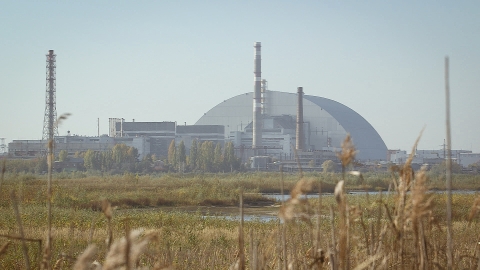
Chernobyl Nuclear Power Plant sarcophagus in 2018. Credit: Jemma Cox.
Vodka from the Fallout Zone
That insight led somewhere unexpected: a bottle of spirits. Jim and his Ukrainian colleagues had been working for years on whether the land surrounding the Exclusion Zone - where tens of thousands of people still live under restrictions on agriculture and investment - could safely produce crops again. They grew rye and measured it. It was slightly above the cautious Ukrainian limit for consumption. Then they distilled it.
"None of the radioactivity made it into the final product," he explains. "The distillation process leaves the radioactivity in the waste product." Their tests, conducted by two world-leading laboratories, could find only natural carbon-14 - the same trace radioactivity found in all foods and spirit drinks.
ATOMIK was born: the first consumer product to come out of the Chernobyl region since 1986. The Chernobyl Spirit Company now sells around 1,500 bottles a year, with at least 75 per cent of profits going back to communities affected first by the accident and now by Russia's invasion. To date, they have donated £50,000 - including contributing to the repair of a school whose windows were destroyed by a Russian missile.
"We started selling it in the UK and some countries in Europe, to help the communities in Ukraine" Jim says. "The economic development of these regions has been affected, not by the radioactivity, but by the perception of it."
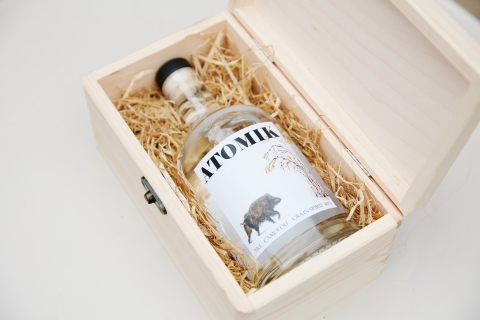
Atomik Vodka, credit: University of Portsmouth
Itching to go back
The war has made things complicated in ways that go beyond politics. Jim hasn't been back to Ukraine since before the Covid-19 pandemic. Field sites he had worked at for years are now mined by the military. When Russia first invaded via Belarus, troops drove the direct road from the border through Chernobyl towards Kyiv, but Ukrainians stopped them on that road.
"Chernobyl is back in Ukrainian hands," explains Jim. "But it makes it a complicated zone to work in."
A Russian drone struck the New Safe Confinement - the vast steel arch installed over the reactor in 2016 - in February 2025. The strike damaged the structure and started a small fire but crucially didn't penetrate the original Soviet sarcophagus beneath it.
"I don't see it's possible that it was an accident," says Jim. "It's a very difficult thing to miss. If Putin wanted to blow up Chernobyl, he could. I think it was part of the ongoing Russian nuclear threat - reminding us of what they can do if they want to."
What has not shifted is his conviction that the real story of Chernobyl is not one of permanent catastrophe, but of recovery and of how we misread risk.
"We tend to focus on things like radiation as being big risks. But the things that we do in our everyday life are the big risks."


