A cat named Ambition went missing again at COP31 on Thursday. While activists delivered the message with humour, it reflected a serious concern: explicit references to moving away from fossil fuels had disappeared from the latest draft climate agreement. On the eve of the summit's scheduled close, ministers and the Presidency were still trying to bridge sharp differences as civil society groups pressed for stronger action.
Today at COP31
- A new draft agreement drops: The text removes explicit references to transitioning away from coal, oil and gas, but acknowledges the 1.5°C goal overshoot.
- Key negotiation tracks still stalled: Finance, adaptation and just transition negotiation tracks remain unresolved as Friday's deadline approaches.
- Climate action advances: New electrification package highlights clean energy investments and progress across more than 150 countries plus the EU.
- Progress remains uneven: UN Climate Change Yearbook finds improvement in just 44 of 96 global climate indicators.
- El Niño in Africa: Ugandan activists demand better disaster preparedness as El Niño threatens their communities.
Have you seen Ambition?
Under a grey Antalya sky on Thursday morning, climate activists held up crumpled missing-cat posters outside the COP31 venue. One featured a green-eyed cat in a pink collar; another, a ginger tabby.
Both were called Ambition. And apparently, both had gone missing. Again.
The posters came with helpful clues.
"Ambition" hates overshooting the 1.5°C temperature limit, loves a transition away from fossil fuels (now known as TAFF) and responds to climate justice.
Philippine Menager of the Ecología y Desarrollo Foundation explained the campaign.
"Right now, in this COP we are missing ambition," she told UN News, adding that the cats would only come home with a meaningful roadmap for moving away from fossil fuels.
The campaign began at COP29 , she said, and Ambition has apparently been disappearing ever since.
But behind the cat humour is a serious demand that has resonated across the venue for the past 10 days: governments must agree on how to move away from coal, oil and gas while protecting workers and communities.
A new draft text
The cats were not the only ones struggling to find what they wanted.
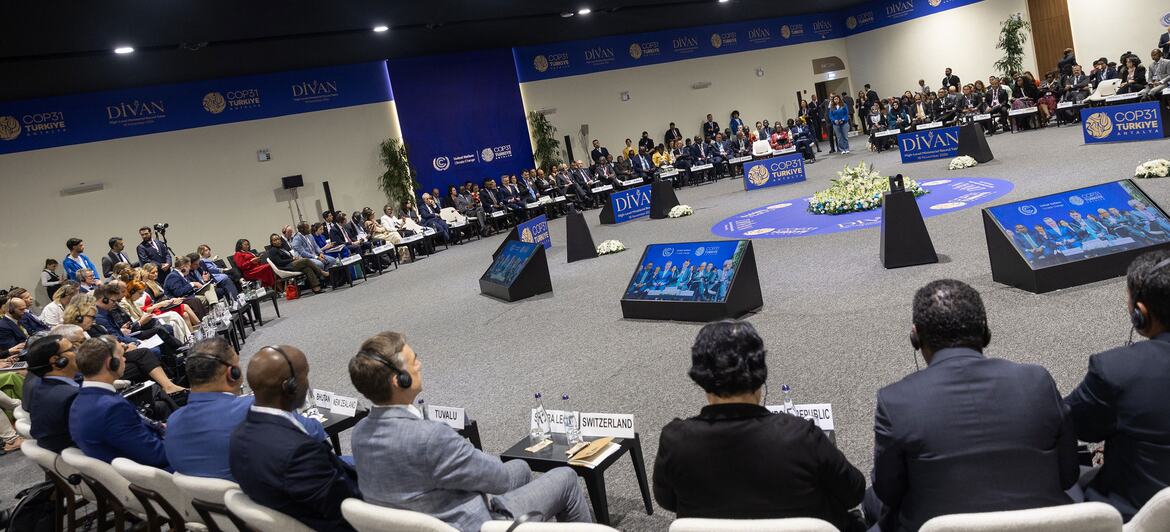
On Wednesday evening, COP31 President Murat Kurum gathered ministers for a Divan, a Turkish-style political exchange inspired by Ottoman tradition, in an effort to break the deadlock. Some described it as constructive; ministers from vulnerable countries said little progress had been made.
On Thursday afternoon, the latest draft of the summit's political agreement - known as the cover decision - had dropped explicit references to moving away from fossil fuels.
Instead, the text emphasizes clean energy and electrification, including Türkiye's proposed 35 by 35 target.
On adaptation finance, it reaffirmed the goal of tripling funding by 2035 but left crucial details, including how to calculate that increase, for further discussion.
At a press conference presenting the text, Australia's Chris Bowen, who is leading the negotiations, said COP31 would be the first climate summit to acknowledge that the world would fail to hold warming to the 1.5°C limit set out in the Paris Agreement .
"But we are determined that COP31 is not remembered for that, but is remembered as a COP which decides clearly and strongly that that is not acceptable," he said, referring to the language in the cover text calling for any 1.5°C overshoot to be kept as small and short as possible.
Mr. Bowen pledged to continue consultations through the night, adding: 'We won't be leaving the rooms of Antalya until we have that consensus."
But with Friday's deadline approaching, civil society groups are losing patience.
"Announcements in the cover decision won't cover up the fact that negotiations are struggling," Teresa Anderson of ActionAid International told journalists at a press conference.
She argued that developing countries were still being asked to do more without adequate financial support.
"Adaptation finance is not nice to have. Adaptation is how we all survive this climate crisis together".
A mixed picture on climate action
Meanwhile, a new UN Climate Change report offered a more encouraging, if incomplete, picture of global climate action.
The Global Climate Action Agenda brings together governments, businesses, cities and civil society to advance voluntary climate solutions. Its annual Yearbook tracks global progress and identifies where efforts are falling short.
The 2026 edition found that 44 of 96 indicators were moving in the right direction, while 19 showed no progress and 33 lacked sufficient data. Renewable energy capacity grew by 17 per cent between 2024 and 2025, but energy efficiency gains remained well below what is needed, while adaptation finance fell from $81.5 billion in 2022 to $64.1 billion in 2024.
At a high-level event on Thursday, the COP31 Presidency presented an electrification package supporting Türkiye's goal of increasing electricity's share of global final energy consumption to 35 per cent by 2035.
The package brings together activities involving more than 150 countries plus the European Union, 37 cities and over 260 businesses, from expanding electricity grids to electrifying transport and industry.
Among the results highlighted were more than 21,000 kilometres of electricity grids built in 2025 and annual investment plans of at least $156 billion for grids, renewable energy and storage.
But UN climate chief Simon Stiell acknowledged that the benefits must reach further.
"Vulnerable developing countries need affordable finance and technology. Workers and communities must help to shape and be supported through major change. Across the board, we need to move far faster to meet the demands of the science," he said.
The human cost of delayed action
Across the venue, participants made sure to show delegates the human consequences of their political decisions.
Kneeling before a crowd, a doctor told the story of Carter, a Canadian boy with asthma who went to the park, played in the water and attended a birthday party, unaware that nearby wildfires were thickening the air around him.
Carter struggled to breathe, and his parents rushed him to the emergency room, but he did not survive.
"Sometimes emergency doctors can't fix everything," the doctor said, adding that Carter's parents wanted his story to be told at COP31.
Young Ugandans brought another warning: the growing threat of El Niño.
Alison Nisima, from the village of Kakonkoma in southwestern Uganda, described children struggling along flooded paths to school, women walking long distances in search of safe water and families whose livelihoods depend on the rain, even when it becomes dangerous.
"For some, heavy rainfall may mean carrying an umbrella or changing travel plans. For a child whose route to school is flooded, it may mean missing class," she told a press conference.
With El Niño raising fears of further flooding in parts of East Africa, Ms. Nisima questioned whether communities would be able to act on warnings before disaster struck.
"A family may know flooding is coming, but where can they go?" she asked.
She urged leaders to invest in safe water, roads and local preparedness, and to involve young people who know firsthand which areas are most vulnerable.
"The purpose of an early warning should never be simply to tell people that danger is approaching. It should give them a fair chance to face it," she urged.