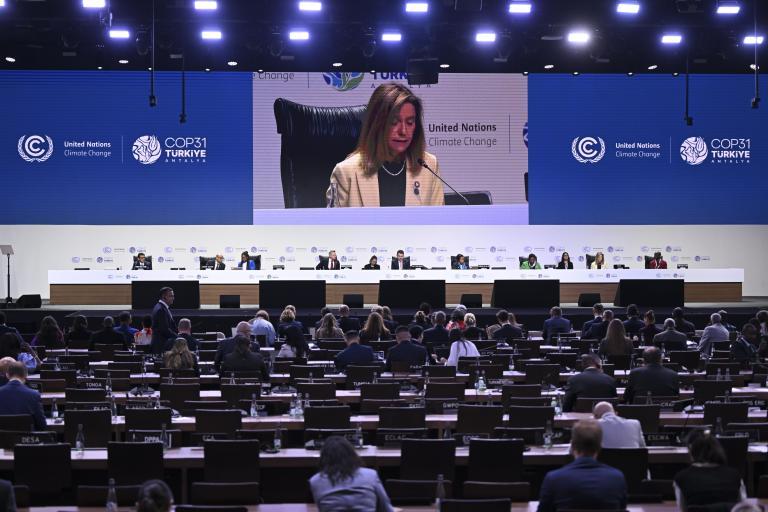
Science, action, investment and resilience were buzz words at the high-level session of the Leaders Summit at the UN Climate Change conference, COP31, as heads of state and government called for more greater global mobilization. The precarious state of the global climate and need for observations and early warnings was presented by WMO Secretary-General Celeste Saulo
"We have no other sky, no other Earth. Our shared home calls for shared responsibility and decisive action," said Recep Tayyip Erdoğan, President of the Republic of Türkiye, who convened the summit in Antalya under the theme "Towards a Sustainable, Resilient and Equitable Future." He reaffirmed Türkiye's ambition to make COP31 an Implementation COP, turning commitments into action.
Prime Minister Anthony Albanese of Australia - which shares the COP31 presidency with Türkiye - called for greater solidarity with Pacific small island states, which are on the frontline of sea level rise.
Brazilian President Luiz Inacio Lula da Silva - host of COP30 in 2025, bemoaned that climate action has slid down the list of priorities on the international agenda.
First climate duty is to tell the truth
"Our planet is heating up. The clock is winding down. It's make or bake time," said UN Secretary-General António Guterres .
As temperatures rise, adaptation is a matter of survival and climate finance must be adequate and accessible. Every person on Earth must be covered by an early warning system - and every community protected from floods, droughts and rising seas, said the UN Secretary-General in reference to the Early Warnings for All initiative he champions and which is co-led by WMO and the UN Office for Disaster Risk Reduction.
"Our first climate duty is to tell the truth. "Science is not telling us to surrender. It's telling us to fight harder;" said Mr. Guterres, who paid tribute to scientists - as well as young people, civil society, indigenous peoples and small islands.
State of Climate Update
WMO Secretary-General Celeste Saulo took the floor in the high-level segment to present the State of the Climate Update .
The Earth's energy imbalance is at its highest value since monitoring began in 1960 and this is supercharging extreme weather. The planet is taking in far more energy than it gives back, and it is accumulating heat at an increasing rate. As a result, the past 12 years have been the hottest on record, ocean heat and sea level is the highest on record, and extreme weather events are taking an increasing toll on society, she said.
Carbon dioxide in the air is now more than 50 per cent higher than before the industrial age. Methane has nearly tripled. Nitrous oxide is up by more than a quarter. All three are at new highs and measurements indicate a continuous increase in 2026, said Celeste Saulo.
"That is why the past 12 years are the 12 warmest on record. From January to September 2026, the global average temperature was about 1.47°C above pre-industrial levels. It will be even higher because El Niño is turning up the heat," she told the Leaders' Summit.
Early warnings save lives
But WMO's State of the Climate Update 2026 provides some hope, she said.
"The WMO community watches the skies, the oceans and the ice, and shares what it sees. That is how we predicted El Niño months ahead, giving countries time to prepare and protect. In the last 10 years, the number of countries with early warning systems has more than doubled . Where these systems are strong, deaths from disasters are six times lower," said Celeste Saulo.
WMO is making the case at COP31 for sustained investment in the observing, forecasting and early warning systems that protect us all.
"At WMO we know that what we measure helps us understand, anticipate, and plan. Every number I have shared today is possible because National Meteorological and Hydrological Services work together through a global observing system. Yet the places with the greatest gaps in observations are often the places hit hardest," said Celeste Saulo.
"So let us invest in the people and instruments that observe our planet and warn its people. That is how we build a sustainable, resilient and equitable future," she said.
Simon Stiell, Executive-Secretary of UN Climate Change said COP31 is working on two tracks: the negotiations, and the Global Climate Action Agenda - which brings the real economy closer to this process. It will focus on converting targets and plans into practical solutions; tripling finance for climate adaptions and improving access to finance.
"This is a chance to bank the benefits of climate action," he said.