
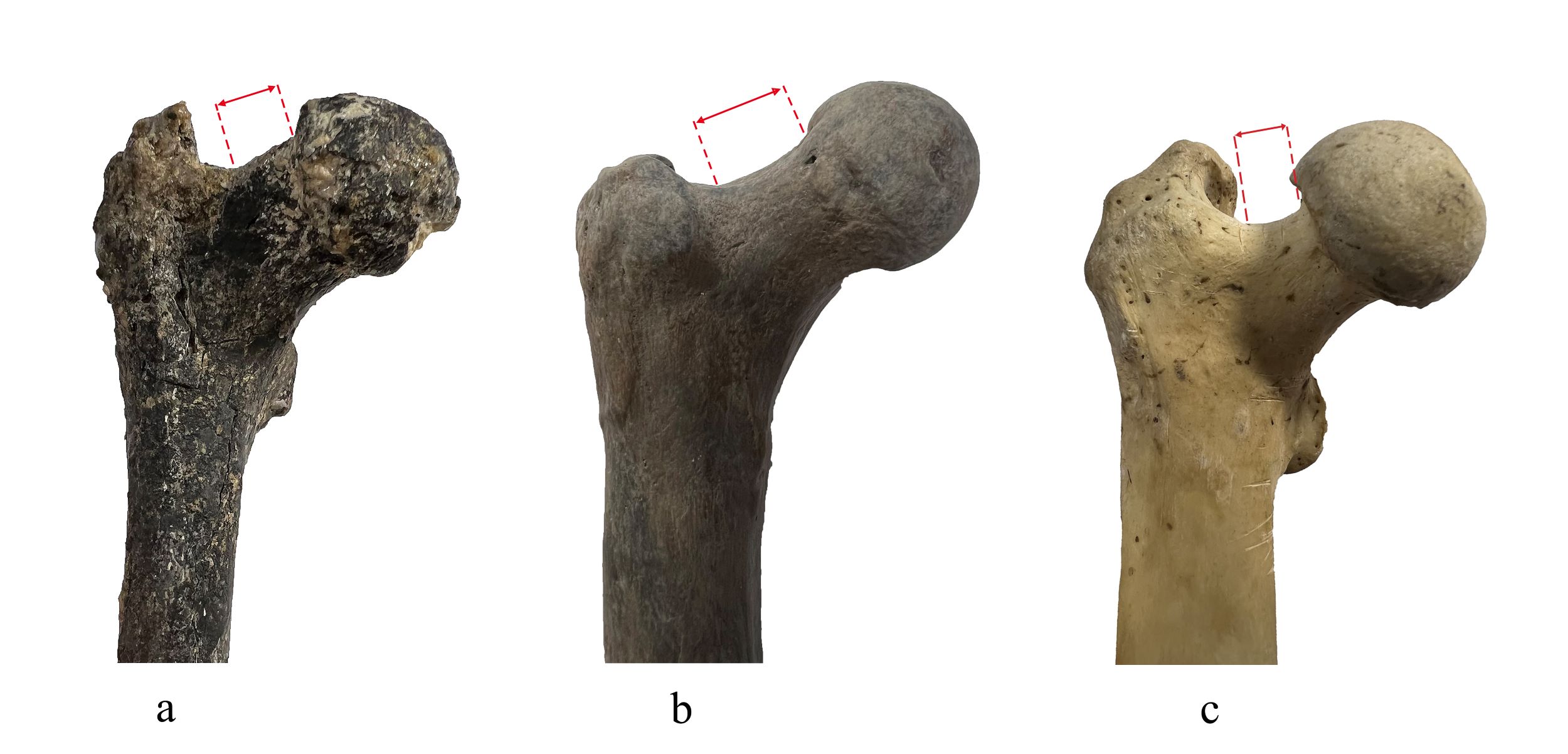
An international team of researchers say a newly discovered fossil thighbone from Bulgaria could rewrite the history of human origins. Walking on two legs has long been considered a milestone in human evolution and one of our most defining characteristics. Until now, researchers assumed that the first humans originated in Africa and that bipedalism developed there around six million years ago. However, experts from Bulgaria's National Museum of Natural History, Aristotle University of Thessaloniki in Greece, the Senckenberg Centre for Human Evolution and Palaeoenvironment at the University of Tübingen in Germany, and the University of Toronto in Canada say the femur shows unmistakable features of a biped, a human ancestor which was walking upright earlier than previously known - more than seven million years ago. The fossil - from the Azmaka excavation site, near the town of Chirpan in the Upper Thracian Plain - has been described this week in an article in the journal Palaeodiversity and Palaeoenvironments.
Graecopithecus - earliest human ancestor?
"At 7.2 million years old, this ancestor, which we classify as belonging to the genus Graecopithecus, could be the oldest known human," says Professor David Begun of the University of Toronto. The first Graecopithecus specimen, a fragment of lower jaw, was discovered at a site near Athens. The research team examined this find in 2017 and concluded that the shape of the tooth roots suggested Graecopithecus was an early human ancestor. The lower jaw could not provide evidence on how the creature moved, but here the newly-discovered femur from the Bulgarian site of Azmaka provides valuable new information.
The owner of the thighbone was likely a female weighing about 24 kilograms. She lived beside a river in what was then a savanna landscape similar to that of present-day East Africa. "A number of external and internal morphological features, such as the elongated, upward-pointing neck between the femur shaft and head, special attachment points for the gluteal muscles, and the thickness of the outer bone layer, have similarities with bipedal fossil human ancestors and humans," says Professor Nikolai Spassov of the Bulgarian National Museum of Natural History. This is where they differed from the thighs of tree-dwelling apes. "However, Graecopithecus did not quite move the way modern humans do," Spassov adds. The Azmaka thigh combines features of African apes with those of more recent bipeds.
"Graecopithecus represents a stage in human evolution between our arboreal and ground-dwelling ancestors, such as the almost twelve-million-year-old Danuvius guggenmosi from the Hammerschmiede site in southern Germany, and more recent finds from East Africa," says Begun. "One could certainly describe it as a missing link." Graecopithecus most likely descended from the eight- to nine-million-year-old Balkan-Anatolian apes like Ouranopithecus and Anadoluvius, which in turn evolved from ancestors in western and central Europe.
Climate change drove dispersal
"We know that large-scale climate changes in the eastern Mediterranean and western Asia led to the periodic emergence of extensive semi-deserts and deserts eight to six million years ago. This set off several waves of dispersal of Eurasian mammals to Africa and laid the foundation for today's mammal fauna of African savannas," says Professor Madelaine Böhme from the Senckenberg Centre for Human Evolution and Palaeoenvironment at the University of Tübingen. The authors of the study therefore suspect that great apes, too, spread southward. As yet it is unclear whether the ancestors of chimpanzees, gorillas, and humans had already diverged in Europe, and whether these waves of dispersal were a reason for the genetic isolation of their lineages. It is possible that Graecopithecus also spread from the Balkans to Africa, where, from six million years ago onward, early human ancestors such as the genus Orrorin emerged, followed later by Australopithecus afarensis, whose most famous representative is the fossil known as Lucy.
Work continues in Azmaka and at other sites in the Balkans to find more specimens of Graecopithecus and to learn more about the ecology and evolution of this surprisingly early biped and possible human ancestor.
Publication:
Nikolai Spassov, Dionisios Youlatos, Madelaine Böhme, Ralitsa Bogdanova, Latinka Hristova, David R. Begun: An early form of terrestrial hominine bipedalism in the Late Miocene of Bulgaria. Palaeobiodiversity and Palaeoenvironments, https://doi.org/10.1007/s12549-025-00691-0


