
Asmita Aasaavari immersed herself in ethnographic research and slowly built relationships for her dissertation, which this year received support from a fellowship through the UConn Humanities Institute
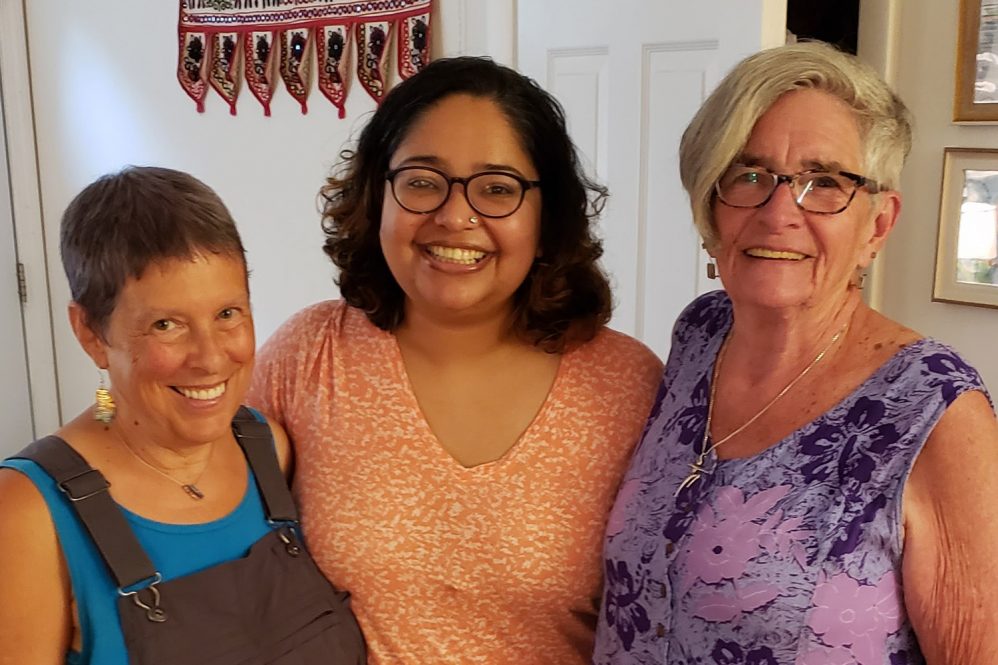
Aasaavari, center, meets with research participants in September 2024. (Contributed photo)
If only getting the names of those who Asmita Aasaavari needed to talk to were as easy as ordering a No. 5 off the drive-thru menu.
For three years, the Ph.D. candidate met with area senior center directors, social-service agency leaders, and boots-on-the-ground workers to try to make progress compiling a list of older adults in Tolland and Windham counties who'd be willing to talk to her.
Many extolled the virtues of her project to document what aging is like in northeastern Connecticut, but each time cited privacy restrictions that kept them from sharing contact information for their clients. Could they instead give people her flyer, they'd ask. If they were interested, they'd contact her.
Of course. But three years of experience hardened her to what would happen.
"These are people facing twin challenges of mental health and homelessness," Aasaavari says. "For them, it's difficult to keep track of important things in life such as following up with people, so even if they want to talk to me, they can't get themselves to coordinate and pick up the phone to call. Finding people was very difficult. It was a sheer test of tenacity."

The sociologist took to the streets to solve the problem, spending weeks and months visiting homeless shelters and soup kitchens to catch someone's eye, hanging out at bus stops during busy times of the day, showing up at food pantries to help carry bags of groceries.
Aasaavari immersed herself in her ethnographic research and slowly built relationships with those who agreed to be part of her research, which this year received support from a fellowship through the UConn Humanities Institute. She'd bring along a banana, maybe some peanuts, or a No. 5 off the drive-thru menu to gain their trust.
"Out of the 60 people I interviewed, I had to follow about 15 of them for a good six months to build that relationship," she says. "They have a distrust of authorities, of educated people like me, because we live in a deeply unequal society where poor people are held responsible for systemic failures and are judged for what they are going through.
"They thought I would be just like anyone else, and they had all the reasons to not want to trust me, so it was important that I consistently demonstrated that I wanted to talk to them not with the intent of hearing, but with the intent of listening," she adds. "And to do that, I would hang out with people in places, times, and moments when they least expected me to do so."
Working to Gain Trust
Aasaavari says she conceived the idea for her project, "Who Will Take Care of Me? Aging and Care in Northeast Connecticut," in 2021 when, as a UConn student in a course on feminist perspectives in caregiving, she started to think about how her mother at home in India left a flourishing career - and forewent pension benefits – to take care of her husband, Aasaavari's father, who has advanced vascular dementia.
She took note that in the U.S., much like in India, women most often are de facto caregivers in the absence of other social safety nets, which then raised the question of what people do if they can't afford to stop working to give or receive care. What if a person logged 50-hour work weeks their whole life and suddenly had to stop? How would they afford their bills? What would happen?
"People have a lot to say about this because once older adults stop working, they become invisible," Aasaavari says. "We live in a youth-privileging society. We don't live in a society in which older adults are valued just on account of being human. Their worth is measured in terms of productivity, health, and social status, and there's a decrease in social status once they get older, so a lot of people feel very invisible – if you're poor then all the more invisible, and if you're a person of color or have a disability, then all the more."
In setting parameters for her research, Aasaavari says she looked at Tolland and Windham counties not just because of proximity to UConn, but because New England has among the highest concentration of older adults in the nation, according to the U.S. Census Bureau.
Plus, having lived in the area since 2018, she noticed from the communities around her that there are "islands of prosperity" alongside "islands of deprivation" – that is, wealthy municipalities alongside poor municipalities, affluent neighborhoods alongside struggling ones.
In those islands, she sought to talk to people older than 62, she says, "but as I started talking to people, I realized that because of the impact of poverty, poor people die a decade earlier than those who are well off. I also met a lot of people who are in their 50s, but their bodies are that of a 70-year-old because of the structural violence of poverty."
What They Said Was Hard to Hear
Consider some of the stories she heard during interviews that spanned 90 minutes to a couple of hours – stories about child sexual abuse, marital rape, homelessness, death of adult children and spouses at the hand of substance abuse, physical assault by adult children, ICE, kidnapping, Department of Children and Families involvement, grandparents raising grandchildren.
As almost anyone would, she started feeling vicarious trauma, lying awake at night with the guilt of being able to afford not just rent but heat. Even as she fought insomnia, those oral histories she'd recorded painted the picture she was looking for.
"I situate myself to be a feminist gerontologist who looks at things from a political economy perspective, which is to say that people's experiences of old age are shaped by social, economic, and political forces rather than just the biological process," Aasaavari says. "The kind of neighborhood, class, gender, and race people are born into and things they experience throughout their lives, such as marital status, employment trajectory, health conditions, and disability, shape how people experience later years of their lives.
"A political economy and feminist perspective challenges the individualistic, 'anti-aging' view, by focusing instead on how society produces old age and determines the quality of life for people," Aasaavari continues.
She asked people about their job history and how they landed each position - that offered a look at the person's connections. White people, she says she found, even if they're poor, have increased opportunities because more people are willing to take a chance on them regardless of factors like lack of education.
She asked about relationships with doctors and how long the person has been with their primary care physician, which offered a look at the availability of health insurance throughout the lifespan. Has it been robust enough for a continuity of care?
She asked about the moment the person first realized they were getting older – What things are more difficult to do now compared to their 30s? Who can they turn to for help? Do they know about the support groups in the community? - which offered a look at what care networks are like.
One very interesting thing that I found is that people are hesitant to ask for help because American society encourages people to be fiercely independent, autonomous, and self-sufficient, a pick-yourself-up-by-your-bootstraps kind of mentality. — Asmita Aasaavari, a Ph.D. candidate in sociology
"One very interesting thing that I found is that people are hesitant to ask for help because American society encourages people to be fiercely independent, autonomous, and self-sufficient, a pick-yourself-up-by-your-bootstraps kind of mentality," she says. "Talking to people got me thinking of what we can do as a society to cultivate values that normalize interdependence."
She continues, "I would ask older adults I was interviewing, 'If you were feeling lonely, who would you reach out to?' Some said they wouldn't, because they didn't want anyone to know they were lonely. Others would say they wished they had someone, but they don't. There was even one person who said they would go to the gas station, buy ice cream, and eat it there."
She heard from a woman in a wealthy suburb who owns her home and said she lived a comfortable life until her husband died. Now she goes to the local food pantry, something she never imagined doing.
Another person said they sleep in their car parked on a back road in a rural town at night and move to a rest stop during the day. The police don't bother them there.
Still another talked about what it's like falling in love in their golden years with someone who also seeks a nightly roof at the homeless shelter.
Moved to Tears and to Change
"There were times I was embarrassed to cry," Aasaavari says of listening to people's stories. "I was so moved, and the person sitting in front of me had a straight face even though they've gone through so much. How can I be the one to cry? One time, they held my hand and said, 'Sweetheart, you can cry. I've gotten so tired of crying, my tears have dried up. But you can cry.'"
All told, she captured hundreds of hours of stories from area older adults who she's categorized into two groups for the purpose of her analysis: economically distressed and "forgotten," or those who might not be disadvantaged, but who are still at the level of just existing.
Now removed from the daily visits to bus stops, pantries, and shelters, Aasaavari says she nonetheless keeps in touch with some participants – one even officiated her wedding last year, and another she periodically calls at 8 p.m. to keep them from an after-dark junk food binge.
"People are not just struggling with homelessness. They're struggling with basic things," she says of the older adult population in Connecticut. "Can someone remove the snow? Can someone help with yard work? Can someone talk to me on the phone? Can someone take me to the grocery store?
"I want something much more meaningful to come out of this work," she continues. "I don't just want it to be published in journals, that doesn't really change people's lives. We have a duty to create a better world because the truth of all this is we will all get older. None of us can escape aging, and the fear of getting older that we see in Connecticut is not unique to just our state. It is an inherently American cultural phenomena in which aging is equated with decline, loss of independence, and decreased social value."
She adds, "Older people who are struggling are all around us, but at times our class, age, and racial privileges prevent us from wanting to see them."


